




Gold has held its place in financial history longer than almost any other asset. It survived currency changes, market crashes, political shifts, and major economic cycles. People trust it because it holds value when other assets struggle.
Today the same question still comes up: Does gold always rise, and why does it behave the way it does?
In this article, you will explore:
Let’s look at gold’s history, its dynamics, and understand where it might go next.
Many people believe gold always goes up, but its history shows a different story. Gold has long cycles. Some periods move fast and break records, but other times it can stay slow for years.
To predict where the prices might go next, it helps to look at why people expect it to rise and what holds it back at times.
Gold is one of the first assets people think of when inflation rises. It keeps its value when money loses purchasing power, which creates the belief that its price must climb over time.
Gold is a scarce metal. Mines cannot suddenly increase production. This limited supply supports the idea of long-term price strength.
If you check gold’s price over decades, it mostly goes up. This long view makes people think gold increases forever. But in fact, there are also long periods of without an uptrend.
Gold has been trusted for generations. Countries, banks, and individuals hold it as protection during financial uncertainty. This trust keeps long-term demand stable.
Gold can stay in a range for many years. These quiet periods test investors’ patience and remind us that it doesn’t move in a straight line. When stock markets are booming, investors often shift money there. Gold becomes less attractive, which slows its momentum.
Interest rate changes affect gold prices too. Higher real interest rates usually reduce gold demand because other assets start to look more rewarding.
Gold is priced in USD. When the dollar gains strength, precious metals lose momentum, even if global demand stays healthy.
Gold’s role in the global economy didn’t appear suddenly. It evolved through different financial systems and political periods. Each stage shaped how we see gold today and why it still matters in the current system.
For many years, money was backed by physical gold. Countries agreed that their currencies could be exchanged for a fixed amount of gold. This system created stability because governments couldn’t print money freely.
However, it also limited economic growth. When countries needed more flexibility during wars or recessions, the gold standard became too strict for modern economies.
After World War II, global leaders created a new system. The US dollar became the central currency, and it was tied to gold at a fixed price of $35 per ounce. Other countries then fixed their currencies to the dollar.
This system worked for a while, but it had limits. As global trade expanded, the United States had trouble maintaining the gold backing. In 1971, the US ended dollar convertibility into gold. This decision collapsed the Bretton Woods system and opened the door to floating exchange rates.
Once gold was no longer tied to the dollar, its price moved freely. This period created several major cycles:
These cycles show that gold indeed reacts to the economy, politics, and how investors feel. It doesn’t move in a straight line.
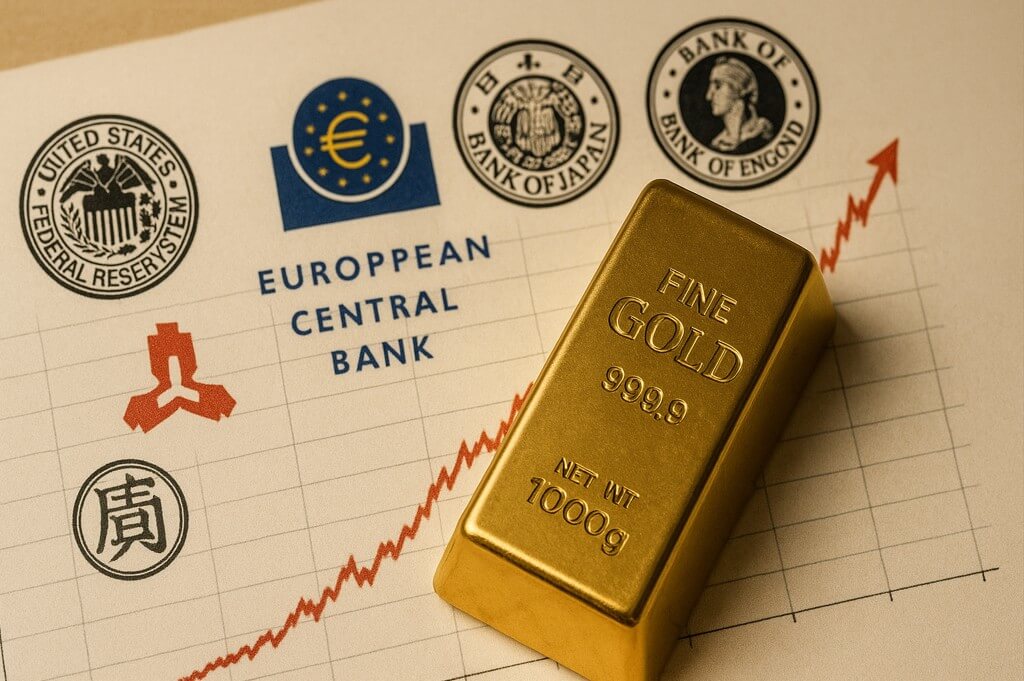
Central banks made noticeable moves in recent years. Many of them increased their gold holdings, and 2025 became one of the most active periods in modern history. These decisions were not random. They were shaped by global risks, economic pressure, and the need for long-term safety.
Gold gives the power of stability to central banks. When countries face inflation, sanctions, trade restrictions, or political pressure, gold becomes a form of protection. It is difficult to freeze, block, or control.
This made gold more attractive than ever for countries seeking security.
Several nations added significant amounts of gold to their reserves:
On the other hand, the United States also holds the largest gold reserve in the world, at 8,133.46 tons.
The global environment changed quickly. Several factors pushed central banks toward more gold:
These conditions made gold one of the safest tools for reserve management. Central banks reacted early, and their buying pressure became a key driver of the 2024–2025 gold rally.
People look at gold differently depending on their goals. Some see it as a long-term investment. Others view it as protection during uncertain times. Institutions also use it for stability and risk management. So, the answer is not one-sided. It depends on what you expect from your money.
Gold has a strong reputation, but it hasn’t always made investors happy. There were long periods when the price stayed flat or even declined.
These cycles often test patience and remind us that gold doesn’t move like technology stocks or fast-growing assets. It has slow phases, and they can last for years.
Gold’s biggest example of stagnation happened after its first major peak in 1980. The price reached around $850 per ounce but then spent nearly two decades moving sideways.
From the mid-1980s to the late 1990s, gold stayed within a wide range and struggled to gain momentum. Many investors who bought at the top waited a very long time to break even.
A similar slow period happened between 2012 and 2018. Gold hit a record high in 2011, then corrected and stayed calm for several years. It only started to recover again when global uncertainty increased in 2019 and 2020.
Gold often spends months in quiet consolidation, then surges in sudden, forceful moves. Economic trends, supply pressures, and shifts in global mood all play a part. Seeing how these elements interact brings more clarity to gold’s overall rhythm.
Commodities often behave quietly for long stretches. Prices move sideways, volume stays low, and interest fades. This can last for months or even years.
But these calm periods usually mean one thing: the market is gathering energy. Once conditions shift, the breakout can be fast and aggressive.
Gold followed this pattern many times.
Gold surprised many investors in 2024 and 2025. It broke records, stayed strong during global uncertainty, and kept rising even when other markets slowed.
After this kind of performance, traders naturally ask what comes next. Will gold keep climbing in 2026, or is the market getting ready for a pause?
The metal entered a strong uptrend during these two years.
Several things fueled this move:
These conditions supported the rally and helped gold set new all-time highs.
Statistically, big rallies often cool down before starting another strong wave. Gold just delivered two powerful years, so some natural consolidation would not be surprising.
A few factors could slow the pace:
These elements can create calmer price action for a while.
Despite the possibility of slower momentum, gold still has strong support from global events.
Donald Trump’s leadership style and policy changes could create unpredictable market reactions. Trade tensions are still active. Several regions are affected by ongoing conflicts.
Any new shock can quickly increase demand for safe assets again.
Central bank demand is another key factor. Continued buying from large institutions would help maintain support for gold into 2026.
So even if the year starts slowly, a new wave of demand can appear at any moment.
Let’s look at what analysts are saying and think about possible price targets for gold in 2026.
If the rally cools a bit, but gold remains strong, we could see prices settle around the $4,000-$4,400 per ounce range.
For example, Morgan Stanley estimates a 2026 price of about $4,400/oz.
If geopolitical risks increase, inflation stays elevated, and central banks remain active buyers, gold may push toward $5,000 per ounce by the end of 2026.
Major institutions such as Bank of America and HSBC have raised their forecasts to this level.
In a more aggressive scenario, gold could move far above normal expectations. If global stress increases, if central banks continue buying heavily, or if new conflicts disrupt markets, the rally can gain another strong wave of momentum.
The first major level to watch is $6,000 per ounce. If the market breaks that level with strong demand, a move toward $8,000 is also possible.
These targets may sound high today, but gold has shown many times that it can move faster than expected when the world becomes uncertain.
Gold has been through every major event in modern history and still manages to surprise traders.
As we look toward 2026, gold carries both potential and uncertainty. Some scenarios point to a pause. Others point to another burst of energy.
Either way, gold will remain one of the most watched assets, and it will keep rewarding those who study its rhythm and stay patient.
And who knows… maybe 2026 will be another golden year.
May the gold be with you. 🪙✨
Sign up in seconds for free, access your platform, and start trading with ease.

 Follow the Gold, Understand the Money
If you want to understand money, start with gold. History shows how gold tracks real value while currencies change.
Detail China’s Growing Interest in Gold
China’s gold reserves keep rising. So, how should we read this? Is this part of a deeper move away from the U.S. dollar system?
Detail Gold’s Crash Was Not the Full Story: What Comes Next?
Gold dropped sharply, but does that tell the whole story? What really happened, and what could come next?
DetailThen Join Our Telegram Channel and Subscribe Our Trading Signals Newsletter for Free!
Join Us On Telegram!


