




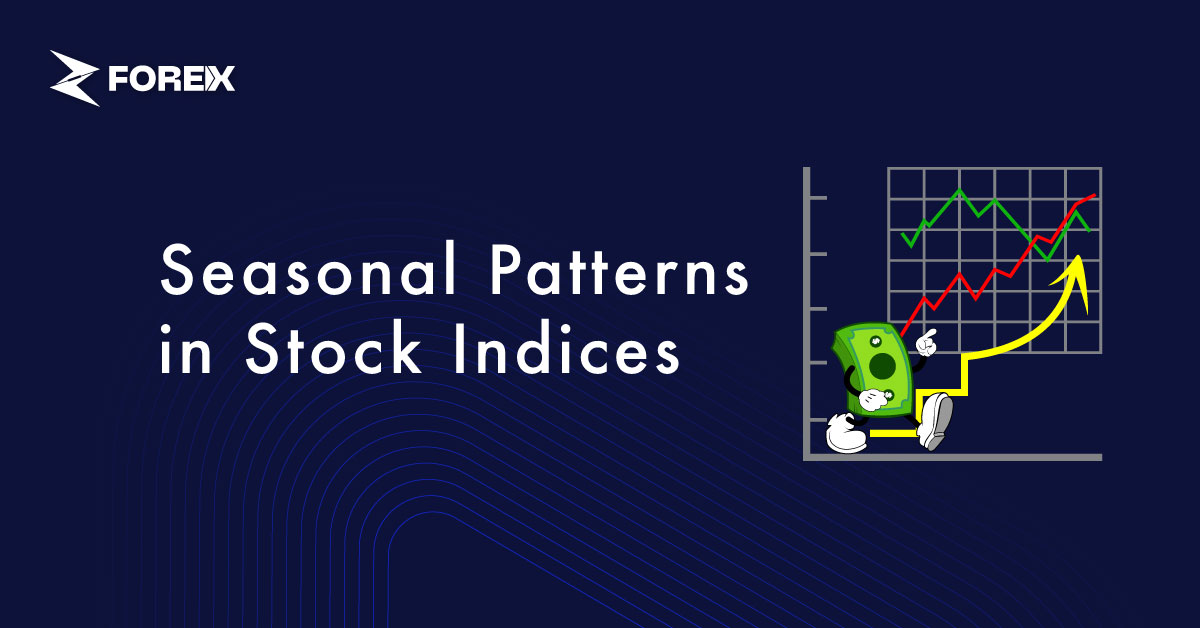
Stock markets are often seen as unpredictable, but history shows that certain patterns tend to repeat at specific times of the year. Seasonality refers to recurring trends in markets that appear at specific times of the year. It shows up in many equity indices and can be quite useful when you know where to look.
While not a guarantee of future returns, understanding seasonal tendencies in equity indices can provide valuable context to frame market behavior within a broader cycle.
Seasonality describes how market behavior can repeat during certain periods of the year. In equity indices, this can mean stronger average returns in some months, softer performance in others, or short bursts around events like year-end or month-end.
These patterns are direct or indirect results of how money moves through the system. Investor psychology, tax planning, fund rebalancing, and corporate reporting cycles all have their own effect on index behavior.
Markets don’t move the same way every year, so it’s important to treat seasonality as a tool rather than a rule.
Seasonality shows up around the calendar. Certain months, quarters, or holiday periods have well-known tendencies. Some are backed by long-term data, while others are more like old market habits. Either way, they influence how traders think about timing and sentiment.
The last quarter of the year has historically been one of the strongest for equity indices. For the S&P 500, average returns in Q4 are higher than in any other quarter. Many studies point to the same pattern in Europe and Asia as well.
Why does this happen? Several drivers repeat year after year:
The effect is not guaranteed every year, but history shows Q4 has carried a bullish tilt in many cases.
The “Santa Claus Rally” refers to a short, specific window: the last five trading days of December plus the first two days of January. Over decades of data, this period has often shown a positive bias.
It’s important to note that this is not a sure thing. Some years show no rally, and in rare cases the market falls.
This effect is one of the most famous seasonal patterns. It’s based on the idea that equity markets tend to perform better from November through April than from May through October.
The pattern is real in many historical studies, but it is not as reliable as it once was. Globalization, electronic trading, and policy changes have made the edge less consistent.
The January Effect describes a tendency for stocks, especially smaller companies, to perform better in January than in other months.
At the end of the year, investors often sell losing positions for tax reasons. In January, some of that money returns to the market, lifting beaten-down names.
Historically more visible in small-cap indices than in large-cap benchmarks. The effect has weakened over the past two decades as markets have become more efficient.
Today, traders view the January Effect less as a guaranteed setup and more as a reminder to watch for shifts in market tone at the start of the year.
The turn-of-the-month effect is the tendency for equity indices to show stronger returns in the few days around the change of a calendar month. Most studies focus on the last trading day of the month through the first three trading days of the next.
Cash inflows from salaries, pensions, and systematic investments often hit at month-end. Funds then deploy that cash into markets.
Traders sometimes use this window to time entries, especially if other signals also lean bullish. The effect is small. Transaction costs can eat most of it if traded mechanically.
Options expiration happens every month, and quad-witching (four contracts expiring together: stock options, index options, stock futures, and index futures) happens four times a year. These events can bring spikes in trading volume.
As contracts expire, traders roll or close positions, which can create short bursts of volatility. Price action can be choppy on expiration days, and spreads can widen.
Some indices may also show temporary distortions in volume and intraday moves. The effect is not always large or predictable. It’s more about short-term market noise than a clear directional bias.
Implementing seasonal patterns into your trades comes down to three important rules.
|
Setup |
Window |
How It Works |
Entry Idea |
Risk/Exit Notes |
Example |
|---|---|---|---|---|---|
| Q4 Bias + Breadth Confirmation | Mid-Oct → Dec | Year-end flows + broad participation | Buy dips or breakouts if breadth strong & VIX easing | Stop under swing low, scale out by late Dec | Long S&P CFD, stop −0.8%, TP +1.6% |
| Santa Window | Last 5 days of Dec + first 2 of Jan | Short holiday rally tendency | Intraday pullbacks, small size | Close after 7 days or +1R | Buy SPY day 2, exit by early Jan |
| Turn-of-Month Timing Aid | Last day of month → first 3 of next | Cash flows and rebalancing | Add to existing longs | Tight stops, fade strength by day 3–4 | Add 25% to Nasdaq long, trim day +2 |
| “Sell in May” Risk Dial | May → Oct | Summer often weaker | Reduce exposure or hedge if momentum weak | Cut gross 20–40%, rotate to low-vol | Shift from IWM to SPY, add small hedge |
| Options Expiry / Quad-Witching | Monthly, 4× major per year | Contract rollovers cause noise | Use limit orders, smaller size | Avoid chasing breakouts late Friday | Skip OPEX Friday, re-enter Monday |
| January Turnaround | Late Dec → mid-Jan | Small caps rebound after tax-loss selling | IWM/SPY ratio turning up | Tight stops, exit on +5–8% move | Long IWM vs SPY, close on +2–3% ratio |
Seasonal edges only matter if they can be tested and repeated. Traders don’t need complex code to do this. Even a simple spreadsheet or charting platform works.
Q4 has a long history of being strong for U.S. equities, and 2023 followed that script.
Lesson: The seasonal window lined up with real flows and improving sentiment, giving the bias more weight.
Seasonality can be useful, but it is far from reliable on its own. A pattern that worked for decades may fade once it becomes too widely known, as seen with the January Effect.
Seasonal patterns are fragile. Unexpected events and or external shocks can change everything. Central bank moves, wars, or crises may easily wipe out a seasonal bias and send markets the other way.
Note: Even when the pattern holds, small gains can disappear once you include spreads, commissions, and slippage.
Each market has its own seasonal character, so patterns aren’t always universal. A tendency in the S&P 500 might not exist in the DAX, FTSE, or Nikkei. That’s why traders need to check local data instead of assuming the same playbook works everywhere.
The best use of seasonality is as a context layer. When it lines up with trend, breadth, and macro signals, the odds improve. When it doesn’t, it’s best ignored.
What is seasonality in indices?
It’s the idea that certain times of year show repeatable patterns in returns, volatility, or flows.
Is seasonality the same as a trading signal?
No. It’s context. Traders combine it with trend and risk signals before acting.
Does seasonality work in every index?
Not always. Some effects show up clearly in the S&P 500 but are weaker or absent in others.
How do I check if a seasonal edge is real?
Run a simple test of past monthly/quarterly returns on your index. Look at win rates and average gains.
Can I trade only based on the Santa Claus Rally?
It’s risky. Treat it as a tilt, not a system. Use small size and watch for volatility spikes.
How do traders use “Sell in May”?
They often cut exposure or rotate to low-vol sectors, but only if other signals also look weak.
How can I blend seasonality with factor signals?
Use ratios like RSP/SPY or XLY/XLP. If they confirm the seasonal bias, conviction is higher.
What about cross-asset seasonality?
Check copper/gold or HYG/IEF ratios. They often confirm whether equities’ seasonal tone is valid.
Does options expiry affect seasonal edges?
Yes. OPEX and quad-witching can add noise. Many pros reduce size or avoid fresh entries those days.
How do funds exploit seasonality?
Institutions often align rebalancing, hedges, or tax trades with seasonal flows. Retail traders can track these patterns but should size smaller.
Sign up in seconds for free, access your platform, and start trading with ease.

 $200 Oil Scenario: The Chain Reaction Across Markets
What happens if oil hits $200? See the impact on global markets, sectors, inflation, and which industries could win or lose.
Detail Biggest Manipulations in Financial Market History
Financial markets have seen their share of manipulation over the years. Here are seven of the biggest cases in modern history.
Detail Petrodollar System: Why It Still Matters
Energy markets depend on supply routes, currency systems, and trade infrastructure determine prices, inflation, and financial stability across the global economy.
DetailThen Join Our Telegram Channel and Subscribe Our Trading Signals Newsletter for Free!
Join Us On Telegram!


