




People invest for two simple reasons: Grow their money and avoid losing it.
Some prefer to play defense, while others are willing to take on more risk for the chance of higher returns. No matter the style, one factor always sits in the background: interest rates.
Rates set the price of money. They change loan costs for households, funding costs for companies, the value investors place on future profits, and how cash flows between stocks and bonds.
When rates rise, borrowing becomes more expensive and stock valuations can come under pressure. When rates fall, credit loosen, and risk assets often get a lift.
Quick Take:
In daily life, interest rates usually mean the level set by the Federal Reserve or the European Central Bank. Though, there are several different rates that influence stocks
These rates flow into equity markets through a few simple but powerful channels. First, they affect how much it costs companies to borrow. Second, they change the return investors expect from “safe” assets like government bonds.
If treasuries suddenly offer 5%, the stock market needs to deliver more than that to remain attractive. Finally, rates influence the valuation math: The higher the rate, the less future earnings are worth in today’s terms.
Simply, interest rates directly shape how investors price stocks and how attractive equities look compared to other assets.
For investors, it helps to think of four main channels that connect changes in rates with changes in equity values.
When rates rise, borrowing costs go up. Companies with high debt suddenly face larger interest expenses, which cuts into their earnings. They may delay expansion plans, reduce share buybacks, or scale back dividends.
On the other hand, lower rates ease these pressures, leaving more cash available for investment and payouts. This is why highly leveraged companies and cyclical sectors often feel rate changes first.
Stock valuations are built on expected future profits. To compare tomorrow’s earnings with today’s money, analysts use a “discount rate,” and interest rates are a big part of that. Higher rates mean a higher discount rate, which reduces the present value of future cash flows.
Growth stocks (especially in technology) are most sensitive because much of their value comes from profits far in the future. Lower rates work the opposite way, often boosting appetite for growth companies.
Households are affected just as much as businesses. Rising rates make mortgages, car loans, and credit cards more expensive. As a result, consumer spending may slow down. That directly affects sectors like retail, housing, and autos.
Falling rates lower monthly payments, leaving consumers with more money to spend. This often lifts revenues of the companies whose shares are traded on the stock market.
Rate differences between countries move currencies. When US rates climb relative to Europe, the dollar tends to strengthen, making American exports less competitive and weighing on multinational earnings.
At the same time, stronger currencies usually push down commodity prices, which influences energy and materials stocks. Rate shifts also change the relative appeal of bonds and equities, nudging big investors to rebalance across asset classes.
Interest rate changes don’t hit all sectors equally. Some stand to gain when borrowing costs rise, while others perform best when policy is loose. Here’s how the major sectors tend to react:
Financials
Banks and insurers can benefit from higher rates, as lending margins widen. However, if short-term rates climb faster than long-term ones, a flat or inverted yield curve may limit those gains.
Technology
Tech and other growth-driven sectors are highly sensitive to discount rates. Rising rates often pressure valuations, while falling rates usually drive strong rallies as investors look for long-duration growth stories.
Utilities
Seen as bond-like for their steady dividends, utilities lose appeal when bond yields climb. In a lower-rate environment, they regain their defensive status and attract income-focused investors.
Real Estate (REITs)
Real estate companies rely on borrowing and are hurt by higher financing costs. Their dividends also look less attractive when safer bond yields rise. Rate cuts typically lift the sector.
Consumer Staples
These companies offer stability and reliable cash flows, but like utilities, they become less appealing when investors can get better yields from fixed income.
Consumer Discretionary
Car makers, retailers, and leisure companies are closely tied to consumer credit. Higher borrowing costs can slow sales, while lower rates usually unlock more household spending power.
Industrials
This sector thrives when credit is cheap and investment picks up. Rising rates can slow infrastructure and capital projects, weighing on earnings.
Energy
Oil and gas companies are influenced less by rates directly and more by global demand and commodity prices. Still, higher rates that strengthen the dollar can push energy prices lower, indirectly hurting revenues.
Materials
Like energy, materials depend on global demand. Higher rates and a stronger currency often weigh on commodity prices, but in expansionary phases with lower rates, demand for metals and chemicals usually rises.
Healthcare
Traditionally considered defensive, healthcare holds up better during periods of rising rates because demand for services is less cyclical. However, investor preference can shift toward higher-growth names when rates fall.
Interest rates are only one part of the story. The other is liquidity, which shows how much money is circulating in the system. Central banks control this through Quantitative Easing and Quantitative Tightening.
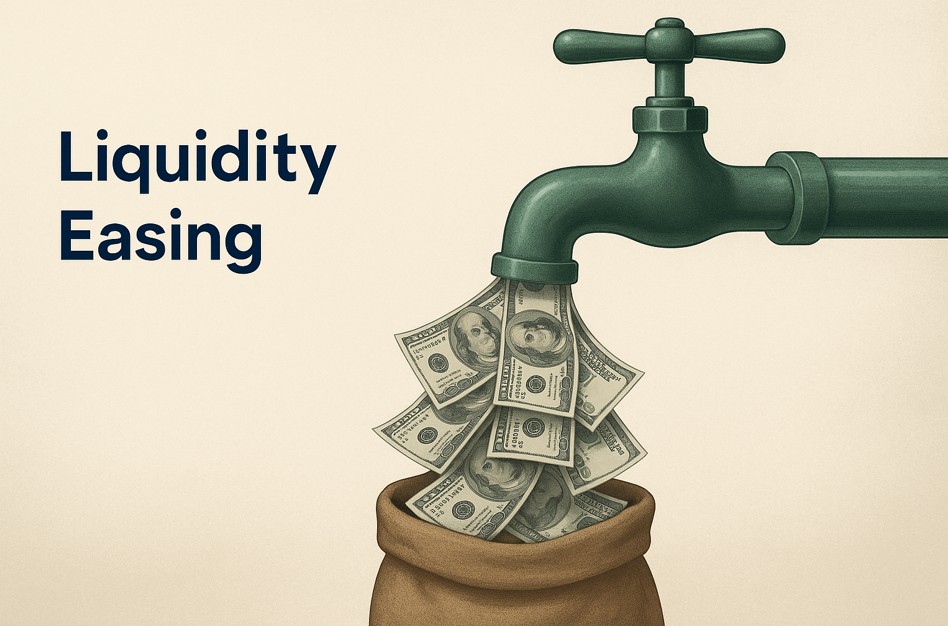
QE is when a central bank buys government bonds or other securities to inject money into the economy. This pushes bond prices higher, yields lower, and encourages investors to move into riskier assets like stocks.
We’ve seen QE play out several times in modern history:

QT is the reverse. Instead of buying bonds, the central bank allows them to mature or actively sells them back into the market. This reduces liquidity, nudges yields higher, and can pressure stocks.
Examples include:
As you can see, QE periods have generally supported equity rallies by lowering yields and fueling risk appetite. QT periods, on the other hand, often slow momentum, widen credit spreads, and increase volatility.
For traders, this means monitoring not just interest rate changes but also the size and direction of central bank balance sheets. A rate cut during QT might not have the same bullish effect as one during QE.
The Fed spent much of 2025 balancing two opposing forces:
Chair Jerome Powell faced political heat as President Trump repeatedly called for sharper rate cuts to boost markets and growth ahead of the election. The Fed resisted this pressure, keeping the policy rate around 4.25%–4.50% through mid-year, while signaling a cautious approach.
Markets, however, were far more aggressive. Futures priced multiple cuts by year-end, betting the Fed would ease quickly. This gap between Fed guidance and market pricing fueled sharp rallies in stocks during the summer, especially in the tech sector. At the same time, tight high-yield spreads suggested investors were underestimating credit risk.
The ECB held its deposit rate at 2.0% while warning about inflation staying above target. President Christine Lagarde stressed central bank independence, indirectly responding to the US debate.
Equity markets in Europe reacted positively to hints of a gradual easing path, though weak growth in Germany and Southern Europe kept investor sentiment cautious.
US: Treasury yields dropped from their 2024 highs. They stayed volatile. Each new jobs or inflation report shifted market expectations.
Eurozone: Bond yields eased slightly. The gap between Germany and Southern Europe widened. This showed the recovery was uneven.
Emerging markets: A strong US dollar added pressure. Money flows swung sharply on speculation about Fed cuts.
Looking ahead, the key question is whether inflation will slow enough for central banks to cut rates without sparking new price pressures.
In the United States, growth may cool further. If inflation drifts closer to 2 percent, the Fed could begin a series of cuts in early 2026. That would likely support equities. It could also risk creating new bubbles in credit and housing.
In the Eurozone, rate cuts will probably be slower. Structural inflation pressures, such as energy costs and wage growth, may hold the ECB back.
For global markets, 2026 may bring divergence. US stocks could benefit from easier policy, while European equities may continue to lag.
When people talk about high-yield (HY) spreads, they’re looking at the difference between the yield on risky corporate bonds and safer government bonds like US Treasuries. Think of it as the extra premium investors demand to lend money to weaker companies.
Note: If the US 10-year Treasury yields 4% and HY bonds yield 7%, the spread is 3%. If that spread suddenly jumps to 5% or more, it usually signals stress.
In the summer of 2025, HY spreads narrowed back to levels not seen since before the Fed’s 2022 hiking cycle. Investors were accepting less than 3 percentage points over Treasuries to hold junk debt. That sounds optimistic, but it can also be a warning. Stocks and bonds are both priced for good news, leaving little margin of safety if growth slows or defaults rise.
Equity and credit markets move together. When credit investors feel safe, stocks often rally as well. When credit markets show stress, spreads widen, and junk yields climb. In those moments, stocks usually follow lower.
Many past downturns were signaled first by credit spreads widening before equities sold off.
Interest rates affect markets through many channels, but you don’t need to drown in data. A simple tracking template helps traders stay focused on what really matters. Here’s a structured approach you can use week by week:
Policy decisions from the Fed, ECB, BoE, and BoJ, along with bond yields like the US 2-year and 10-year Treasury, should be tracked closely.
The 2-year reflects short-term expectations, while the 10-year reflects growth and inflation. The gap between them (the yield curve) is one of the clearest signals investors use.
Practical takeaway: If the 2-year yield is above the 10-year, it often hints at slower growth ahead. Stocks, especially financials, usually feel it first.
CPI, PCE, Eurozone HICP, GDP updates, ISM/PMI surveys, and labor market reports are the drivers of rate expectations. Stronger-than-expected inflation pushes yields higher and pressures valuations. Weak growth or soft jobs data usually drags yields lower.
Practical takeaway: Always compare results with forecasts. A hot CPI print tends to lift yields and the dollar, which often hits tech stocks hardest.
High-yield spreads, investment-grade spreads, and bond issuance levels reveal how much risk investors are willing to take. Tight spreads mean confidence, while widening spreads show fear creeping in. Credit markets often send warnings before equities do.
Practical takeaway: If high-yield spreads widen sharply while stocks remain calm, treat it as an early red flag. Equities often follow credit stress with a lag.
Fed minutes, ECB press conferences, and policy speeches often move markets more than the actual rate decision. Subtle changes in wording, like shifting from “higher for longer” to “data dependent,” can signal a change in stance.
Practical takeaway: Don’t just track the rate — listen for the tone. A small tweak in language can spark big moves across equities and currencies.
The VIX index, US Dollar Index (DXY), and commodities such as oil and gold all reflect the mood of the market. A falling VIX with tight credit spreads signals calm, while a stronger dollar usually pressures emerging markets and commodity stocks.
Practical takeaway: If commodities and currencies start to move opposite to equities, it may signal a shift in risk appetite before stocks adjust.
|
Category |
What to Check |
Why It Matters for Stocks |
Frequency |
|---|---|---|---|
| Rates & Yields | Fed Funds Futures, 2y & 10y yields | Shows expectations, affects valuations | Daily |
| Yield Curve | 2y/10y spread | Recession signal, bank profitability | Weekly |
| Inflation Data | CPI, PCE, Euro HICP | Key driver of central bank policy | Monthly |
| Growth & Jobs | GDP, ISM/PMI, NFP | Reveals demand strength, earnings outlook | Monthly |
| Credit Markets | HY spreads, IG spreads | Early stress indicator before equities | Weekly |
| Central Banks | Fed, ECB statements | Shape market expectations | Weekly |
| Sentiment | VIX, DXY, oil, gold | Measures risk appetite and hedging flows | Daily/Weekly |
Interest rates and liquidity regimes create different market environments. Traders cannot predict the future, but knowing which sectors and strategies tend to work in each scenario will support your profitability.
Borrowing costs rise, valuations compress, and central banks stay cautious. Pressure on growth stocks and debt-heavy companies. Financials may benefit if the yield curve stays positively sloped.
Trade Ideas
Central banks cut to offset slowing demand. Yields fall, but earnings outlook weakens. Defensive sectors outperform, cyclicals lag. Credit spreads may widen.
Trade Ideas
Central banks flood markets with liquidity, bond yields sink. Strong rallies in growth and risk assets. Credit spreads tighten.
Trade Ideas
This situation refers to long-term yields rising faster than short-term yields. The growth outlook improves, demand for long-term capital increases, and cyclicals, small caps, and financials often benefit
Trade Ideas
This refers to short-term yields moving above long-term yields. Markets expect a recession and eventual rate cuts, while bank profits compress, growth prospects weaken, and volatility increases
Trade Ideas
Interest rates may seem like a technical topic, but they shape nearly every move in the stock market. From company borrowing costs to investor sentiment, from bond yields to credit spreads, rates set the background rhythm that equities dance to.
History shows that easing cycles can fuel powerful rallies, while tightening phases often test valuations and reveal weak spots.
At the end you can be more profitable with a strong understanding of these concepts, especially trading in the stock market.
Trade a top selection of US and European stocks with zForex! Enjoy tight spreads, high leverage, and fast execution backed by reliable support.
Sign up in seconds for free, access your platform, and start trading with ease.

 $200 Oil Scenario: The Chain Reaction Across Markets
What happens if oil hits $200? See the impact on global markets, sectors, inflation, and which industries could win or lose.
Detail Biggest Manipulations in Financial Market History
Financial markets have seen their share of manipulation over the years. Here are seven of the biggest cases in modern history.
Detail Petrodollar System: Why It Still Matters
Energy markets depend on supply routes, currency systems, and trade infrastructure determine prices, inflation, and financial stability across the global economy.
DetailThen Join Our Telegram Channel and Subscribe Our Trading Signals Newsletter for Free!
Join Us On Telegram!


