




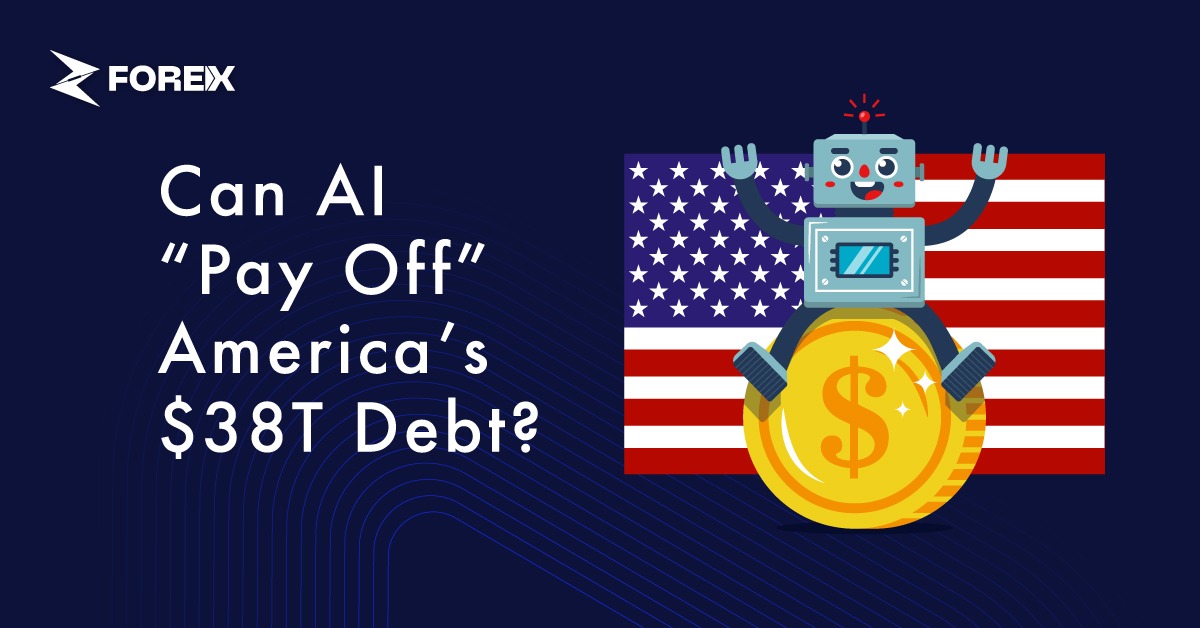
Today, total U.S. debt has passed $38 trillion and continues to rise. Interest costs are no longer a distant concern. They are now a visible and growing part of the federal budget. This has pushed a new question to the front. Can economic growth alone solve the problem?
The debate intensified after comments from Elon Musk. He said, “We are 1,000% going to go bankrupt as a country, and fail as a country, without AI and robots.” In his view, productivity growth driven by automation is not optional. It is the only way to buy time before fiscal pressure becomes unmanageable.
Here is the logic behind this: AI could raise productivity, expand output, and lift long-term growth without inflation. If the economy grows faster, the debt burden becomes easier to carry.
But is this sustainable? Or is it just an optimistic story built on future promises?
There is no single public calendar that lists every U.S. debt payment in one place. That’s because U.S. debt is spread across thousands of Treasury securities, each with its own maturity date and interest schedule.
What is public is the structure. Treasury notes and bonds pay interest twice a year. Principal is repaid at maturity. Short-term bills roll over frequently, while longer-term bonds extend payments far into the future. This means the U.S. is constantly refinancing old debt while issuing new debt to cover deficits.
Based on this structure and current interest costs, upcoming payment periods tend to cluster around standard coupon dates. The table below shows a simplified view of how these obligations typically appear.
|
Date |
Type of payment |
Estimated size |
What it represents |
|---|---|---|---|
| March 15 | Semiannual interest | ~$500–600B | Interest paid on a large share of outstanding Treasury notes and bonds |
| April 15 | Principal + interest | Varies | Maturing medium-term notes and short-term bills |
| May 15 | Semiannual interest | ~$500–600B | Second major coupon cycle for notes and bonds |
| June 15 | Principal + interest | Varies | Maturities of notes and inflation-linked securities |
| September 15 | Semiannual interest | ~$500–600B | One of the largest recurring interest payment dates |
These figures are approximate and meant to show scale, not precision. What matters is the pattern. Interest payments are large, recurring, and growing.
The United States cannot go bankrupt in the legal sense, the way a company can. The real risk is a fiscal breakdown, when debt expands faster than the economy and lenders begin to demand higher returns to keep financing it.
This is where the AI argument enters. The claim is not that AI erases debt. It is that faster productivity growth could lift GDP enough to stabilize the debt-to-GDP ratio. In simple terms, the economy grows faster than the debt pile.
Research does not fully support extreme optimism. Studies from the Dallas Fed show very wide outcome ranges. In some scenarios, AI adds only a small boost to annual productivity. In more optimistic cases, gains are larger, but they depend on fast adoption, workforce adjustment, and heavy investment.
The Penn Wharton Budget Model offers a more cautious view. Their estimates suggest AI could lift GDP over the long run, but the effect builds slowly. The impact on federal deficits in the early years is limited. Debt dynamics improve only if productivity gains persist for many years.
This highlights the core issue. AI may help the trajectory, but it does not solve the problem on its own. Growth takes time. Debt and interest costs are already compounding. The gap between promise and timing is where the risk lies.
Looking beyond the headline numbers, the real issue is sustainability. The question is not how large the debt is today, but whether the economy can grow fast enough to carry it over time. This is why debt-to-GDP is the key metric.
It comes down to a basic balance. If the economy expands faster than borrowing costs and fresh debt, the strain on public finances eases. If interest bills and deficits grow more quickly than overall output, the weight of debt increases. Recently, that balance has been clearly under pressure.
Projections from the Congressional Budget Office highlight the risk. Even without a major shock, debt is expected to rise relative to GDP in the coming decades. Growth alone helps, but only if it is strong, consistent, and sustained.
This is the point where AI matters. To change the trajectory, productivity gains must be large enough to lift long-term growth above debt and interest dynamics. Small or delayed gains do not move the needle.

The strongest version of the AI story is about broad productivity. It assumes AI becomes a general-purpose technology that spreads across most industries. That means it changes how work is done, how decisions are made, and how output is produced. The payoff only becomes meaningful if adoption moves beyond tech firms and reaches the “boring” parts of the economy too.
There is evidence that AI can raise productivity in specific jobs. A large field study in customer support found AI assistance lifted output meaningfully, with the biggest gains among less experienced workers. That supports the idea that AI can speed up learning curves and standardize best practices. Still, that is one sector and one workflow. Scaling this across the whole economy is a different challenge.
The biggest constraint is diffusion and friction. Many firms do not have clean data, good processes, or people trained to use AI well. Some recent corporate research also points to “rework” costs, where time saved by AI is partly lost correcting mistakes. This is why the boom case depends on execution, not just capability.
So yes, it is possible. But not on its own. The boom case requires heavy investment, process redesign, and fast adoption across a wide range of industries. Without that, AI remains a productivity upgrade in pockets, not the economy-wide engine needed to change debt dynamics.
AI may lift productivity over time, but several barriers limit how fast and how far those gains can translate into fiscal relief. These obstacles are structural. They are already visible today.
AI adoption is uneven and slow outside a few sectors. Large productivity gains usually come after processes are redesigned, not when tools are first introduced. That transition often takes years.
Debt servicing costs are rising immediately. Net interest expense is already one of the fastest-growing items in the federal budget. Even optimistic AI scenarios do little in the early years because productivity gains compound slowly. Debt pressure, by contrast, compounds right away.
There is also a physical constraint. AI growth depends on data centers, power generation, and grid capacity. According to the International Energy Agency, data centers are among the fastest-growing sources of electricity demand globally. In the U.S., power availability has already become a bottleneck in some regions. Productivity cannot scale without infrastructure, and infrastructure does not scale overnight.
AI can improve how governments operate, but it cannot set fiscal priorities. It may help detect tax fraud, automate audits, or improve procurement efficiency. These gains matter, but they are incremental.
The main forces behind rising debt are policy decisions. Long-term projections are shaped largely by entitlement programs, defense spending, and mounting interest costs. Without adjustments in these areas, any gains from higher productivity risk being absorbed by increased spending in other parts of the budget.
History offers a lesson. Past productivity booms did not automatically reduce debt. In many cases, faster growth encouraged more spending rather than restraint. Technology can support better policy execution, but it cannot enforce fiscal discipline.
Some expect AI to push prices lower by reducing costs and improving efficiency. In theory, cheaper goods and services support consumers and growth. But debt dynamics work differently.
When prices fall, the real value of debt rises. This increases the burden on borrowers, including governments. Central banks are aware of this risk, which is why they actively try to avoid sustained deflation.
If AI-driven productivity leads to downward pressure on prices without matching income growth, debt ratios can worsen instead of improve. This is why growth must be nominal as well as real. Efficiency alone does not solve a debt problem if it compresses prices too much.
AI is not a magic solution to America’s debt problem. It cannot erase existing obligations or replace hard fiscal choices. What it can do is improve the path, if productivity gains are broad, sustained, and arrive in time.
The most realistic outcome is not debt elimination, but stabilization. If AI raises productivity across many sectors, nominal growth can improve. That makes the debt burden easier to manage, even if the total number keeps rising. Small or delayed gains, however, change very little.
In the end, AI buys opportunity, not certainty. It can support growth, efficiency, and better policy execution. The impact on debt pressure depends on how governments act. Technology can open the door, but policy still decides what happens next.
Sign up in seconds for free, access your platform, and start trading with ease.

 Silver Rally Ahead? Supply Deficit Meets Rising Demand
A new silver rally may be forming as supply deficits deepen and China’s demand grows. Here’s what is driving the momentum.
Detail Fed Rate Cuts 2026: How to Position Now
Fed rate cuts in 2026 could reshape markets. See expectations, asset impact, and positioning strategies for bonds, gold, stocks, and USD.
Detail Analyzing the U.S. Labor Market Outlook for 2026
Year’s first jobs report looked reassuring. A closer breakdown, however, tells a more layered story about the direction of the labor market.
DetailThen Join Our Telegram Channel and Subscribe Our Trading Signals Newsletter for Free!
Join Us On Telegram!


