


The euro surged past $1.09, driven by deficit spending plans and ECB signals of a less restrictive policy.
The yen strengthened to 147 per dollar as US recession fears increased safe-haven demand, while Japan’s GDP growth slowed. Gold held above $2,910, supported by trade tensions and Fed rate expectations. GBP remained near $1.29, benefiting from dollar weakness and expectations of slower BoE rate cuts. Silver surged to nearly $33 as investors expected a Fed rate cut following weak US economic data.
| Time | Cur. | Event | Forecast | Previous |
| 12:30 | USD | Core CPI(MoM)(Feb) | 0.3% | 0.4% |
| 12:30 | USD | CPI(MoM)(Feb) | 0.3% | 0.5% |
| 13:45 | CAD | BoC Interest Rate Decision | - | 4.632% |
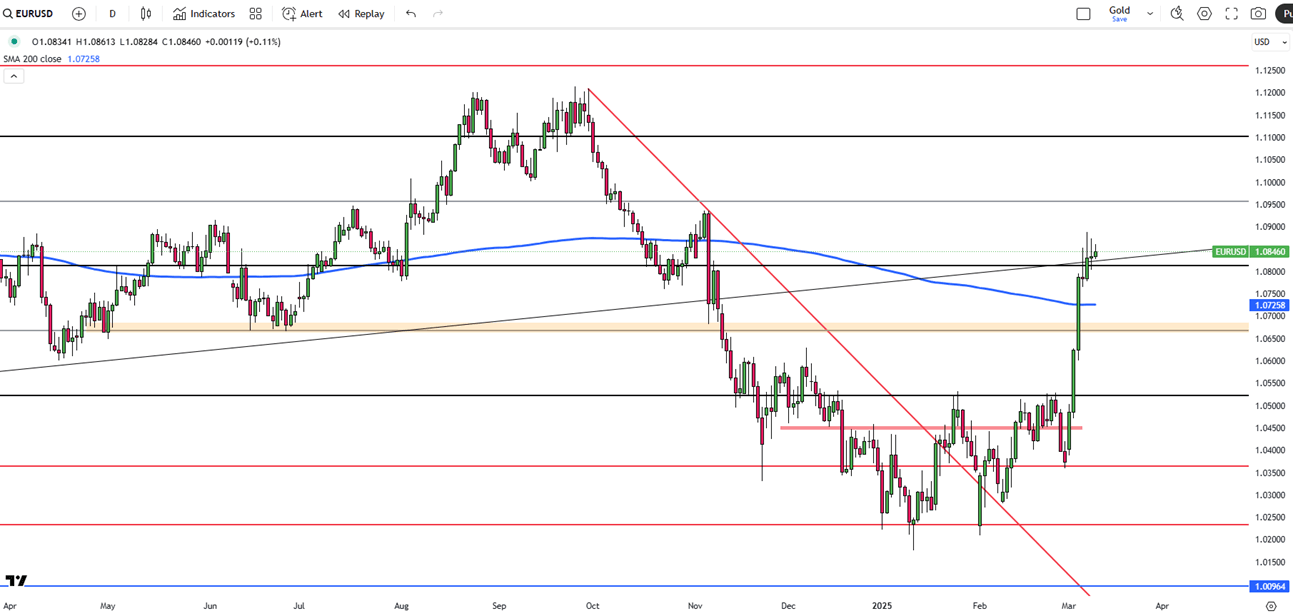
The euro surged past $1.09, its highest in four months, gaining 5% since early March. This rally was driven by Eurozone plans to expand deficit spending, stimulating growth prospects. Germany pushed for a €500 billion infrastructure fund, while France and Italy supported joint EU funding for economic and military initiatives.
The ECB signaled a shift toward a less restrictive policy after last week’s rate cut, suggesting the easing cycle may be nearing its end. Meanwhile, US economic concerns pressured the dollar, further lifting the euro.
Key resistance is at 1.0950, followed by 1.1000 and 1.1050. Support stands at 1.0800, with further levels at 1.0730 and 1.0650.
| R1: 1.0950 | S1: 1.0730 |
| R2: 1.1000 | S2: 1.0700 |
| R3: 1.1050 | S3: 1.0650 |
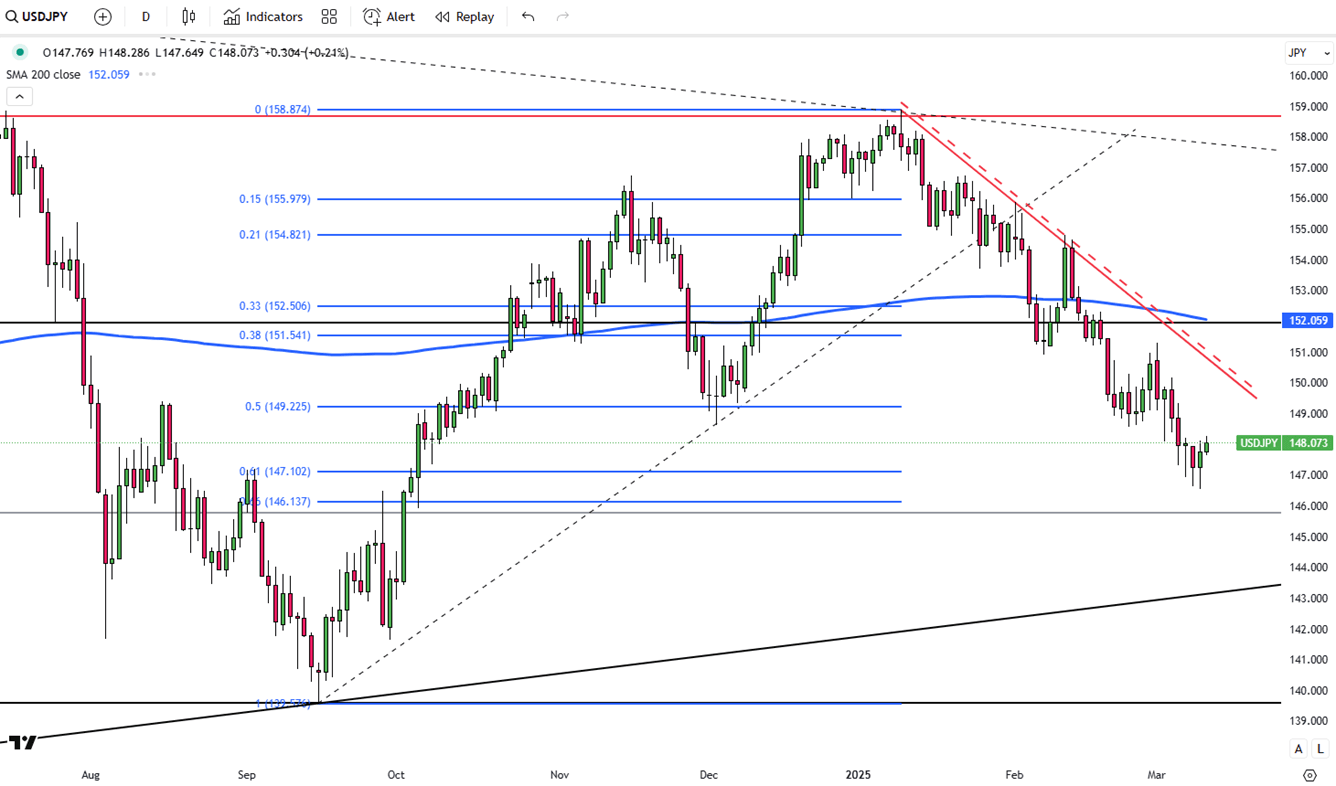
The Japanese yen strengthened to 147 per dollar on Tuesday, its highest in five months, as US recession fears drove investors to long-term trusted assets. Trump's reluctance to dismiss recession risks, along with trade policy uncertainty, added to yen demand.
Japan's economic outlook weakened as Q4 GDP growth was revised down to 2.2% from 2.8%, reflecting weak private consumption. Despite this, the BOJ is expected to keep rates steady in March, with potential hikes later. Finance Minister Shunichi Kato cautioned against excessive currency volatility amid the yen’s rapid gains.
Key resistance is at 149.20, with further levels at 152.00 and 154.90. Support stands at 147.00, followed by 145.80 and 143.00.
| R1: 149.20 | S1: 147.00 |
| R2: 152.00 | S2: 145.80 |
| R3: 154.90 | S3: 143.00 |
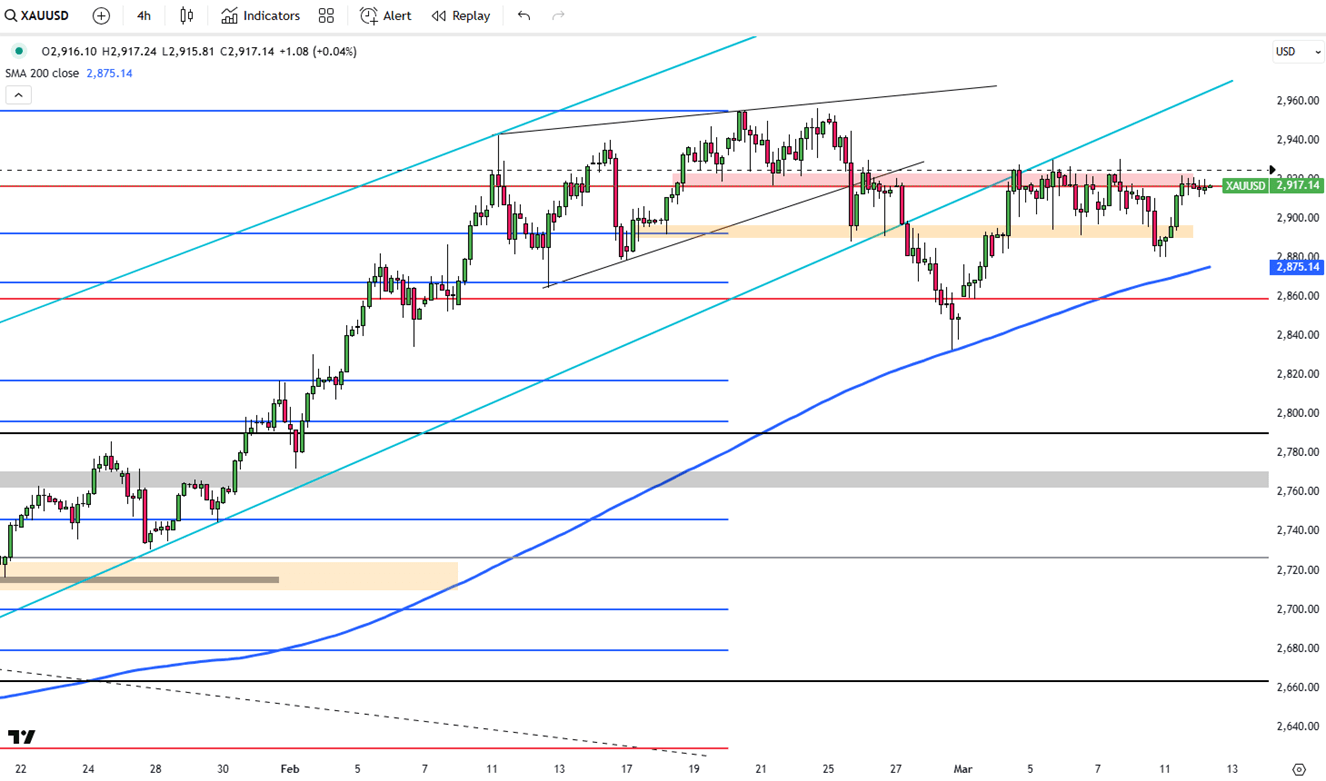
Gold held steady above $2,910 per ounce, maintaining a 1% gain. Investor sentiment shifted after Trump reversed his plan to double tariffs on Canadian steel and aluminum, just hours after the announcement. Ontario Premier Doug Ford also paused a 25% surcharge on US electricity exports.
Trade uncertainties and US recession fears continued to support gold, though geopolitical tensions eased as the US restored military aid to Ukraine following a 30-day ceasefire agreement with Russia. Markets now focus on upcoming US CPI data for clues on the Fed’s rate outlook.
Key resistance stands at $2,923, with further levels at $2,955 and $3,000. Support is at $2,860, followed by $2,830 and $2,790.
| R1: 2923 | S1: 2860 |
| R2: 2955 | S2: 2830 |
| R3: 3000 | S3: 2790 |
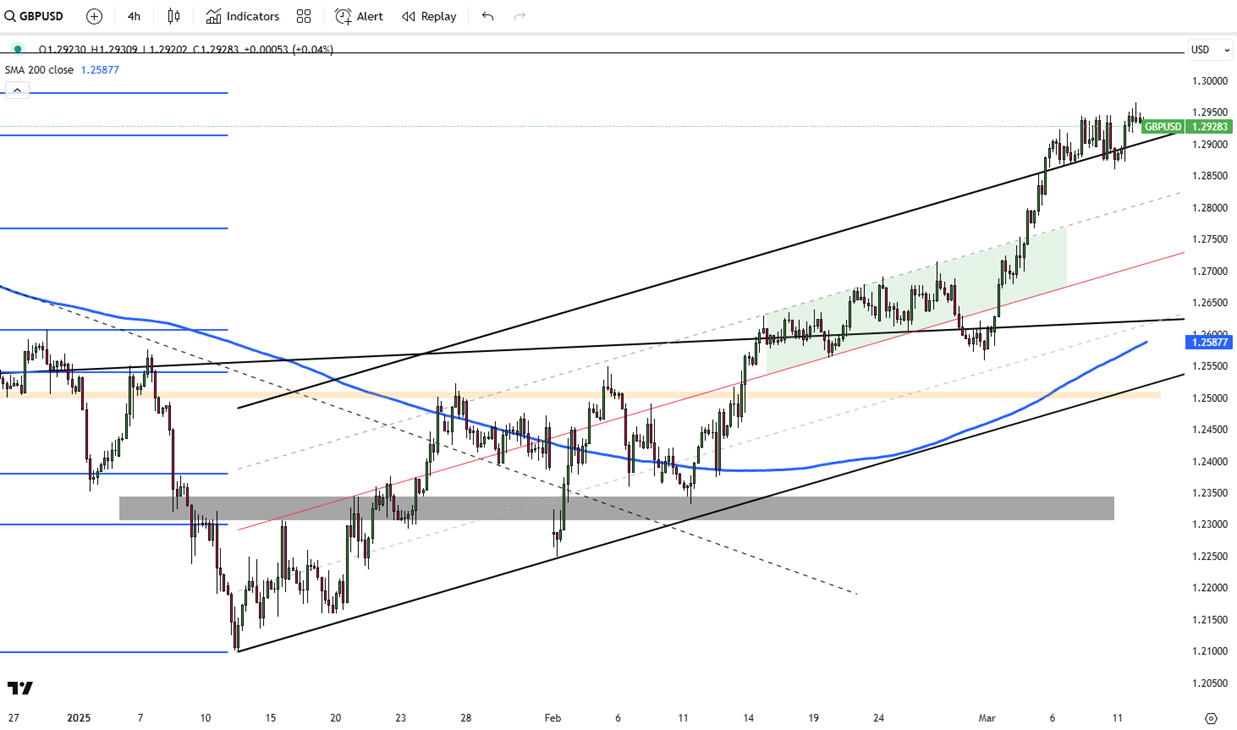
The British pound held around $1.29, near a four-month high, as dollar weakness persisted on US economic concerns and tariff risks. Sterling was supported by expectations that UK rates will stay higher for longer, with traders pricing in only 52bps of BoE cuts in 2025.
UK’s monthly GDP data for January and the Office for Budget Responsibility’s economic and borrowing forecasts on March 26 are now awaited, which could impact market sentiment.
If GBP/USD breaks above 1.2950, the next resistance levels are 1.2980 and 1.3050. On the downside, support stands at 1.2860, with further levels at 1.2760 and 1.2660 if selling pressure increases.
| R1: 1.2950 | S1: 1.2860 |
| R2: 1.2980 | S2: 1.2760 |
| R3: 1.3050 | S3: 1.2660 |
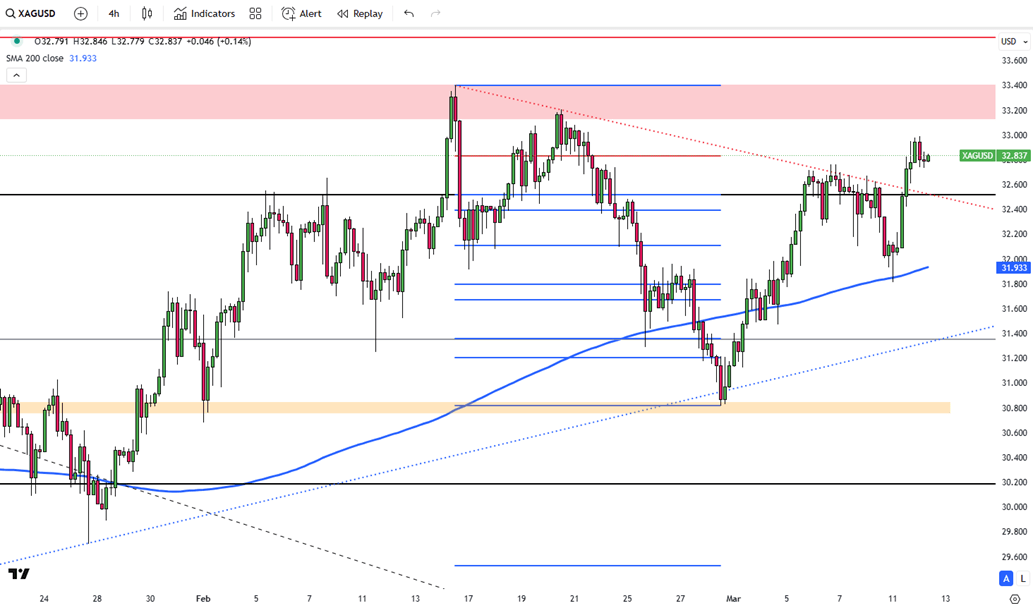
Silver surged to nearly $33 as the US Dollar fell sharply, with the DXY dropping to 103.35, its lowest in four months. Concerns over Trump’s tariff policies and their impact on the US economy fueled the dollar’s decline, supporting demand for silver.
Investors now await US CPI data for February, which could influence Fed rate expectations. A slower inflation rate may increase the likelihood of a May rate cut, with odds rising to 51% from 37% in a day, further supporting Silver’s appeal as a non-yielding asset.
If silver breaks above $32.75, the next resistance levels are $33.15 and $33.80. On the downside, support is at $31.00, with further levels at $30.20 and $29.75 if selling pressure increases.
| R1: 32.75 | S1: 31.00 |
| R2: 33.15 | S2: 30.20 |
| R3: 33.80 | S3: 29.75 |
Escalating Middle East tensions pushed oil prices higher following a deadly drone strike on Saudi Aramco's Shaybah facility, renewing inflation concerns and expectations for further Federal Reserve tightening.
Rising oil prices renewed inflation concerns as uncertainty surrounding the US-Iran conflict and continued disruptions in the Strait of Hormuz reinforced expectations for further monetary tightening.
Elevated oil prices and rising Treasury yields weighed on precious metals as persistent geopolitical tensions reinforced inflation concerns and expectations for further Federal Reserve tightening.
Then Join Our Telegram Channel and Subscribe Our Trading Signals Newsletter for Free!
Join Us On Telegram!


