


PAMM stands for Percentage Allocation Management Module. It allows investors to allocate funds to a money manager’s trading strategy, with profits and losses distributed according to each investor’s share.
One trader handles the market decisions, while several investors participate with different amounts of capital. The PAMM system keeps track of those allocations and calculates the trading results and applicable fees for each participant.
For the investor, the main decision is which manager to follow and how much to allocate. Understanding what happens to that money, including how losses and fees are handled, is just as important as choosing the strategy.
A PAMM account is a managed trading arrangement built around proportional participation. Investors allocate capital to a strategy, and the manager decides which trades to open, adjust and close.
PAMM is often described as a shared trading pool because investors participate in the same managed strategy. The exact account and accounting structure varies between providers, however. Some use a pooled trading account; others track participation through separate investor records or accounts. The common feature is percentage-based allocation of results.
The basic setup involves three sides:
The manager may invest personal capital alongside clients, although this is not a universal requirement.
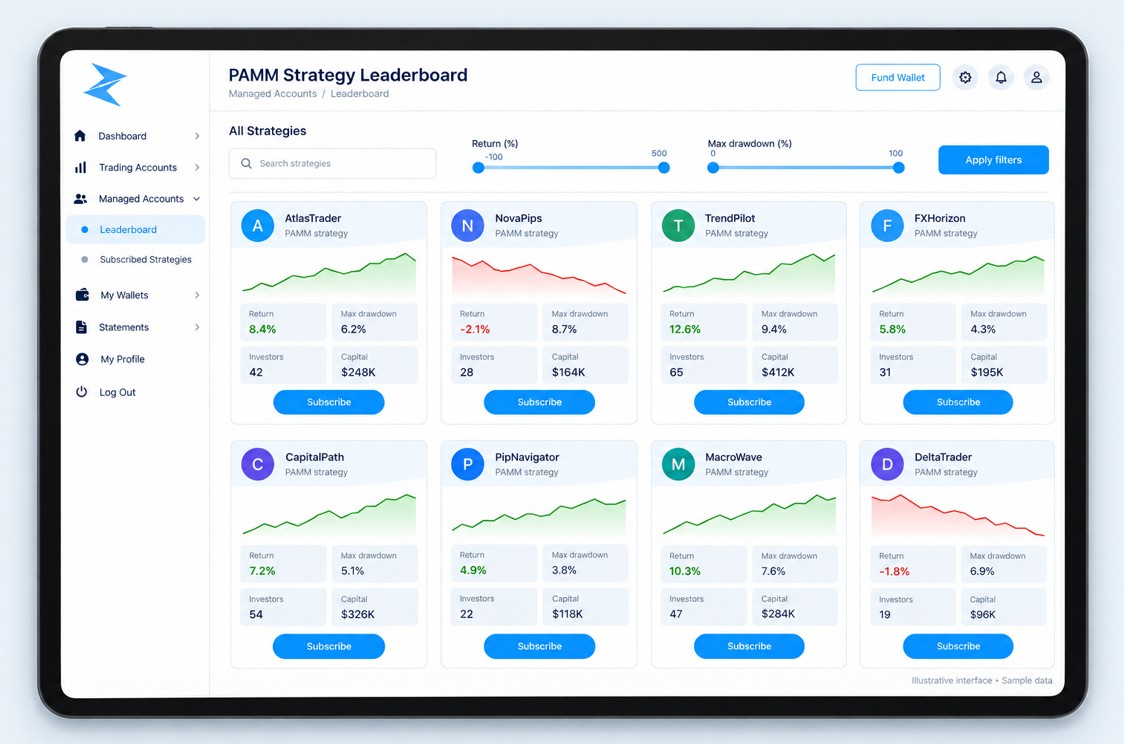
1. Open and fund an account
The investor opens an eligible account with the broker, completes verification and deposits funds through the broker’s funding process. Allocating money to a PAMM strategy normally takes place within that service, rather than by sending trading capital to a manager’s personal bank account.
2. Review the manager and accept the terms
Before joining, the investor checks the strategy, trading history, drawdowns, fees and withdrawal rules. The manager may also be called a master trader. Their offer should explain the conditions for participation, including any minimum allocation and when an investment becomes active.
3. Allocate capital to the strategy
Once the allocation is accepted and activated, the platform records the investor’s participation. The relevant start time matters: depositing into a client wallet and having funds actively participating in a PAMM strategy are not necessarily the same event.
4. The manager trades and the platform tracks results
The manager chooses the markets, position sizes, entry and exit points, and use of leverage. The PAMM system tracks the resulting gains and losses against each investor’s share. The strategy may be manual, automated or a combination of both.
5. Results and fees are settled under the agreed rules
At the relevant accounting or settlement point, the platform records each investor’s result and any fees due. Some services call this process a rollover. It should not be confused with an overnight financing charge on a trading position.
Investors can then continue participating or request a withdrawal under the service’s terms. Allocated profits do not necessarily arrive in a bank account: they may remain in the investment until withdrawn.
A simple example makes the percentage mechanism easier to understand. Suppose a strategy begins with $60,000, including some of the manager’s own capital.
|
Participant |
Starting allocation |
Share |
Gain if the strategy rises 8% |
Loss if the strategy falls 8% |
|---|---|---|---|---|
| Manager | $6,000 | 10% | $480 | $480 |
| Investor A | $12,000 | 20% | $960 | $960 |
| Investor B | $18,000 | 30% | $1,440 | $1,440 |
| Investor C | $24,000 | 40% | $1,920 | $1,920 |
| Total | $60,000 | 100% | $4,800 | $4,800 |
These are two separate hypothetical outcomes. Assume everyone participates for the full period, there are no deposits or withdrawals, and the 8% result is after normal trading costs but before manager fees.
Investor A’s starting share is $12,000 divided by $60,000, or 20%. A $4,800 strategy profit therefore gives Investor A $960 before manager fees. If the strategy instead loses $4,800, the investor bears a $960 loss.
The dollar amounts differ, but every participant has the same 8% result before manager fees in this simplified proportional setup. A smaller allocation reduces the dollars exposed, not the percentage loss from the same strategy.
A PAMM manager can earn a return on any personal capital invested in the strategy and receive fees from participating investors. These are separate sources of earnings. A return on the manager’s own funds is not a fee charged to clients.
A performance fee is an agreed percentage of eligible profit. There is no universal PAMM fee rate, and different managers can offer different terms.
Continue the example above and assume the manager charges each investor a 15% performance fee. All positions are closed, the full profit is eligible for charging, there are no earlier losses to recover, and no other manager fees apply.
|
Investor |
Profit before manager fee |
Performance fee at 15% |
Profit retained |
|---|---|---|---|
| A | $960 | $144 | $816 |
| B | $1,440 | $216 | $1,224 |
| C | $1,920 | $288 | $1,632 |
| Total | $4,320 | $648 | $3,672 |
Investor A finishes with $12,816: the original $12,000 plus $816 after the performance fee. The 15% is charged on eligible profit, not on the original deposit.
The manager receives $648 in investor performance fees, plus the $480 trading gain on their own allocation. Their combined earnings in this example are $1,128.
In systems with automated fee processing, the applicable amount is deducted from the investor’s investment or account and credited to the manager’s designated account. The investor does not normally need to make a separate payment after every profitable trade.
Fees may become payable on a scheduled date or when an investment ends, depending on the agreement. Leaving profits invested does not necessarily postpone the fee.
Check what counts as profit. A calculation based only on closed positions can differ from one that also considers floating gains or losses. A fee on individual winning trades is also different from a fee on the investment’s overall net profit.
Some managers charge a management fee based on the value of the investment and the time under management. Other arrangements may include a fixed subscription or an entry or exit charge, where supported. Not every PAMM offer uses these fees.
Management or fixed fees can still apply during a losing period. A performance-fee arrangement with no newly chargeable profit does not necessarily mean the investor has no costs at all.
zForex does not add a separate fee for copying through its PAMM and MAM services. The master trader sets the applicable service fees, and participating investors pay them under the agreed terms.
Those fees are separate from normal trading costs, such as spreads, trading commissions and applicable overnight charges. Review the manager’s offer and the underlying trading account conditions together to understand the total cost.
A high-water mark helps prevent performance fees from being charged again when an investment is simply recovering an earlier loss. It is not automatically part of every PAMM offer, so check the agreement.
Using Investor A’s example, assume the agreement sets the reference at the investment value after the performance fee. The first fee leaves the investor with $12,816, which becomes the reference for future charges.
This example assumes no deposits, withdrawals, other manager fees or changes to the calculation rules. Other services may define the reference using cumulative profit or a different accounting convention. Ask how cash movements and any reset provisions affect it.
A high-water mark governs performance-fee calculations. It does not prevent trading losses.
Percentage shares change as capital enters or leaves the strategy. That does not mean an existing investor automatically loses money when someone else joins.
For example, suppose your allocation is worth $12,000 within a strategy valued at $60,000. Your share is 20%. If new investors add $40,000, the total becomes $100,000 and your share falls to 12%, assuming no trading movement or charges during the update.
Your investment is still worth $12,000. If the larger strategy subsequently gains 10%, your 12% share of its $10,000 profit is $1,200 before manager fees. That is still a 10% return on your own capital.
New investors do not receive gains earned before their participation begins. Likewise, an existing investor’s additional deposit is capital, not a trading profit.
The platform uses its accounting rules to determine when allocations change and how open positions are treated. Withdrawing capital while trades remain open may require an exposure adjustment. It should not be assumed that every deposit or withdrawal simply resizes every position immediately.
The manager makes the strategy’s trading decisions, including which markets to trade, when to enter or exit, how much exposure to take and how to handle losing positions.
Investors generally do not select individual trades within that allocation. Their choices concern the manager, the amount committed and whether to continue participating under the agreed terms.
The manager’s trading authority should also be distinguished from control over withdrawals. In a typical broker-operated service, funding and withdrawal requests follow the broker’s client procedures. Read the agreement to understand the actual permissions.
One useful detail is how much personal capital the manager has in the strategy. A meaningful investment exposes the manager to trading losses alongside clients, but it does not prove that the approach is sound.
The manager’s capital is not normally a reserve that absorbs everyone else’s losses first. Under the proportional example above, the manager and investors each bear their own share of the loss.
Treat personal investment as one part of the evaluation. A trader can lose their own money through poor decisions just as easily as client money.
PAMM allows investors to delegate day-to-day trading rather than place every order themselves. It can appeal to people who lack time for active trading or want exposure to a strategy they do not trade independently.
The platform also reduces the manual work involved in recording participation and allocating results across investors with different amounts of capital.
Delegating execution still leaves work for the investor. Choosing a manager, understanding the costs and reviewing performance remain ongoing responsibilities.
The manager can lose money, and participating through PAMM does not protect the allocated capital from a poor strategy or adverse markets. Past returns do not guarantee future performance.
A manager’s return should be viewed alongside drawdown, which measures the decline from a previous peak. Two strategies can produce similar final returns while exposing investors to very different losses along the way.
Check how drawdown is measured. A figure based only on closed trades may miss substantial losses in positions that remain open.
Large positions can make ordinary market movements or a short losing streak damaging to the account. Several trades may also depend on the same market view, even when they involve different instruments.
Look at the overall exposure rather than judging each trade in isolation. Trading currencies, gold and indices does not automatically mean the strategy is diversified.
Some managers keep losing positions open and add more exposure while waiting for a reversal. The record of closed trades can look stable even as floating losses grow.
Compare balance with equity. Balance generally reflects booked transactions and realised results; equity also reflects open gains and losses. The way a manager handles losing trades often tells you more than a high win rate.
All three approaches let clients participate in another trader’s strategy, but they organise participation differently.
|
Feature |
PAMM |
MAM |
Classic copy trading |
|---|---|---|---|
| Core mechanism | Results allocated according to investors’ shares in a managed strategy | Trading activity allocated across linked client accounts | A provider’s trades replicated into follower accounts |
| Position sizing | Generally follows proportional participation | Uses the agreed account allocation settings | Uses the platform’s copy settings |
| Investor decisions | Manager selection, allocation and participation | Management terms and permitted account settings | Provider selection and available copying controls |
| Main practical focus | Sharing a strategy’s results by percentage | Managing trading across multiple client accounts | Following another trader’s activity |
PAMM generally suits participation in a shared strategy on a proportional basis. MAM can support different allocations across linked accounts, while copy-trading services often offer follower-controlled settings.
Features overlap, however. Not every MAM service offers the same customisation, and copy-trading platforms can also provide flexible sizing. The ability to stop participation, close positions or withdraw money depends on the particular service.
Investors can generally request withdrawals, but the timing and amount available depend on the terms. Some services process requests at specified settlement points or apply notice periods.
Open positions matter because their value is still changing. A withdrawal may require positions to be reduced, unrealised results to be accounted for, or outstanding fees to be settled. Your original deposit is not a guaranteed withdrawal amount.
Before joining, check:
PAMM settlement timing and the payment provider’s transfer time are separate stages. Approval within the platform does not necessarily mean the money has reached your bank account.
The easiest number to notice is usually the total return. It is also easy to misunderstand on its own. A strong result may reflect a repeatable approach, aggressive risk-taking or a favourable market period.
Useful points to check include:
A longer record gives you more periods to examine. Look at what the manager did when volatility rose and trades moved against them, rather than concentrating only on the best month.
Open a zForex account and log in to your client panel to find the PAMM section. Review the manager’s strategy, fees and participation terms before allocating funds. Traders interested in becoming money managers can contact the zForex team to discuss the setup requirements.
Can my return differ from the manager’s published return?
Yes. Your entry date, later deposits or withdrawals, and applicable fees can produce a different result. Compare figures for the same period and check whether the published return is before or after manager fees.
Does a PAMM rollover mean all trades are closed?
Not necessarily. A rollover can be an accounting process that updates allocations, results or fees while positions remain open. Its exact function depends on the platform and service settings.
Can I allocate funds to more than one PAMM manager?
Some services allow multiple allocations, subject to their rules and minimums. Several managers can still hold similar trades, so check whether the strategies create overlapping exposure.
What happens if a manager stops running the strategy?
The service’s closure process determines how open positions, final results and outstanding fees are settled. Check the notice arrangements and when the remaining funds become available for withdrawal or reallocation.
Are PAMM accounts limited to forex?
No. Depending on the broker and service configuration, managers may also trade metals, indices, energy products or stock CFDs. The available instruments come from the trading setup rather than the percentage-allocation model itself.
Sign up in seconds for free, access your platform, and start trading with ease.

 What Is MAM and How Does It Work?
Learn how MAM accounts work, how trades are allocated, how managers earn fees, and what investors should check before joining a managed trading service.
Detail How Index Futures Influence the Stock Market Open
How do index futures influence the stock market open? Learn what pre-market moves reveal about opening prices, market sentiment, and trader psychology.
DetailThen Join Our Telegram Channel and Subscribe Our Trading Signals Newsletter for Free!
Join Us On Telegram!


