


The euro rebounded to $1.04 as EU leaders prepared a Ukraine peace proposal for the U.S., supporting sentiment.
Meanwhile, the U.S. dollar eased as investors weighed tariff uncertainty, with Commerce Secretary Howard Lutnick suggesting possible revisions. The yen strengthened as the BOJ maintained its hawkish stance, while gold and silver saw gains amid trade and inflation concerns. Market focus now shifts to the ECB meeting, where another rate cut is expected.
| Time | Cur. | Event | Forecast | Previous |
| 13:00 | EUR | CPI(MoM) | 2.3 | 2.5 |
| 17:45 | USD | S&P Manufacturing PMI(MoM) | 51.6 | 51.2 |
| 18:00 | USD | S&P Global Manufacturing PMI(MoM) | 50.6 | 50.9 |
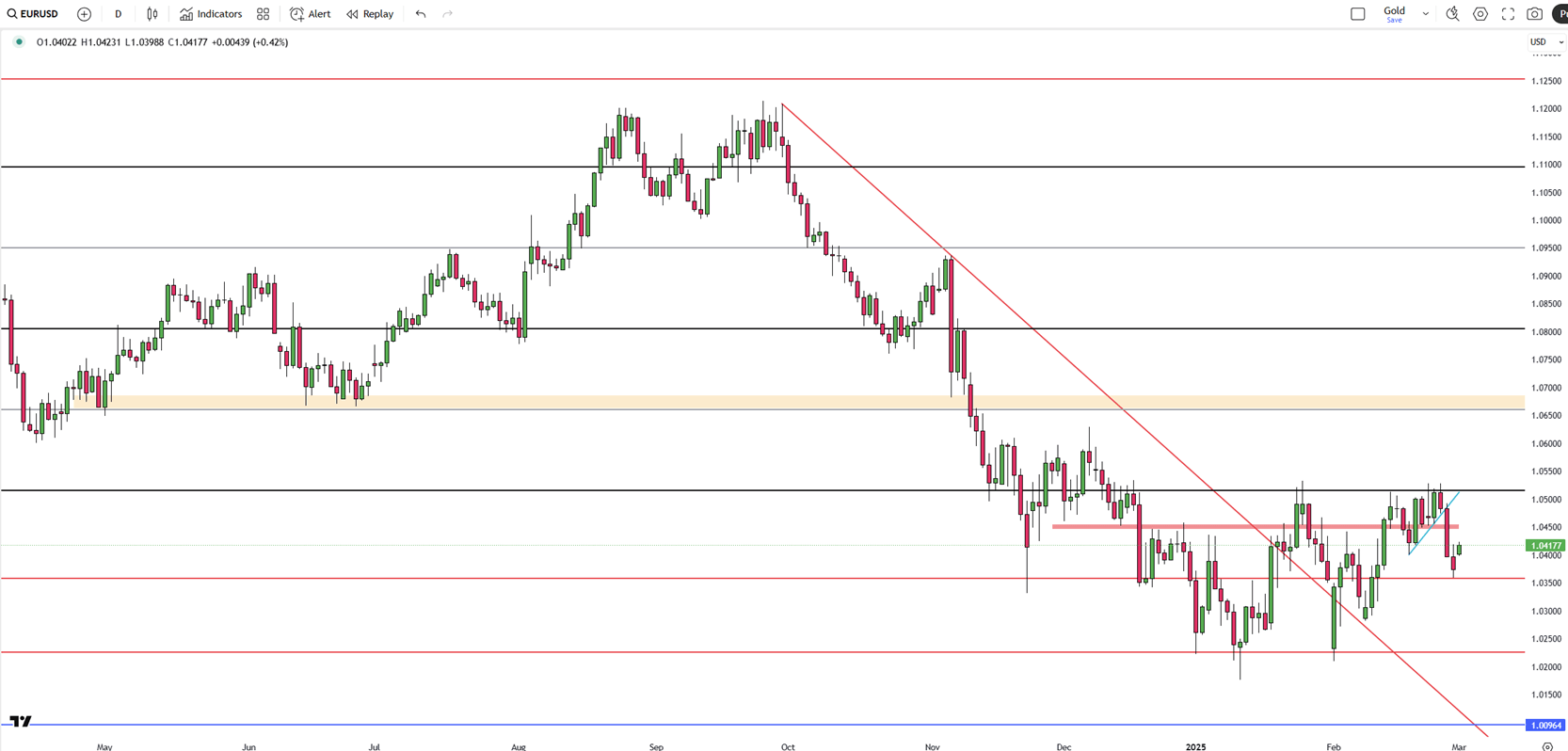
The euro rose to $1.04 after three losses, driven by optimism over Europe's new Ukraine peace initiative. PM Keir Starmer announced EU leaders would draft a proposal for the U.S., following Zelenskyy's failed deal with Trump but positive talks in Britain. Investors now focus on the ECB meeting, expecting a 25bps rate cut after January’s reduction.
Key resistance is at 1.0460, followed by 1.0530 and 1.0600 as rising US economic strength and escalating trade tensions keep EUR/USD under pressure. Support stands at 1.0350, with further levels at 1.0275 and 1.0220.
| R1: 1.0460 | S1: 1.0350 |
| R2: 1.0530 | S2: 1.0275 |
| R3: 1.0600 | S3: 1.0220 |
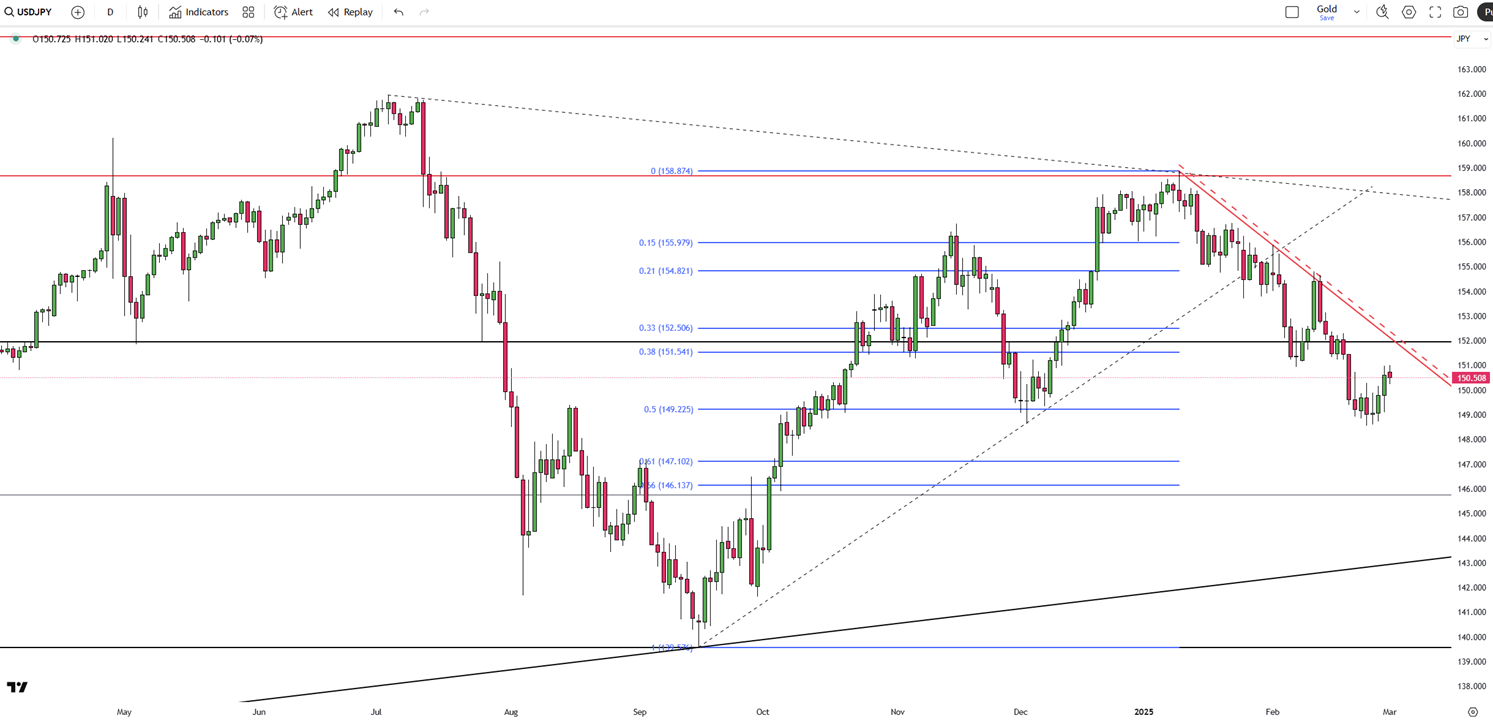
The Japanese yen climbed to 150.3 per dollar on Monday, reversing a two-day decline as the U.S. dollar weakened against major currencies. The shift was driven by the euro’s strength, fueled by optimism over Europe’s diplomatic efforts in Ukraine, and U.S. Commerce Secretary Howard Lutnick’s statement that tariffs on Mexico and Canada remain "fluid," suggesting they may be lower than the proposed 25% while confirming a 10% tariff on China. Domestically, Japan’s February manufacturing PMI was revised slightly higher but remained in contraction for the sixth straight month. The Bank of Japan is expected to continue raising interest rates this year, backed by strong economic conditions, inflation, and wage growth.
Key resistance is at 154.90, with further levels at 156.00 and 157.00. Support stands at 148.60, followed by 147.10 and 145.80.
| R1: 154.90 | S1: 148.60 |
| R2: 156.00 | S2: 147.10 |
| R3: 157.00 | S3: 145.80 |
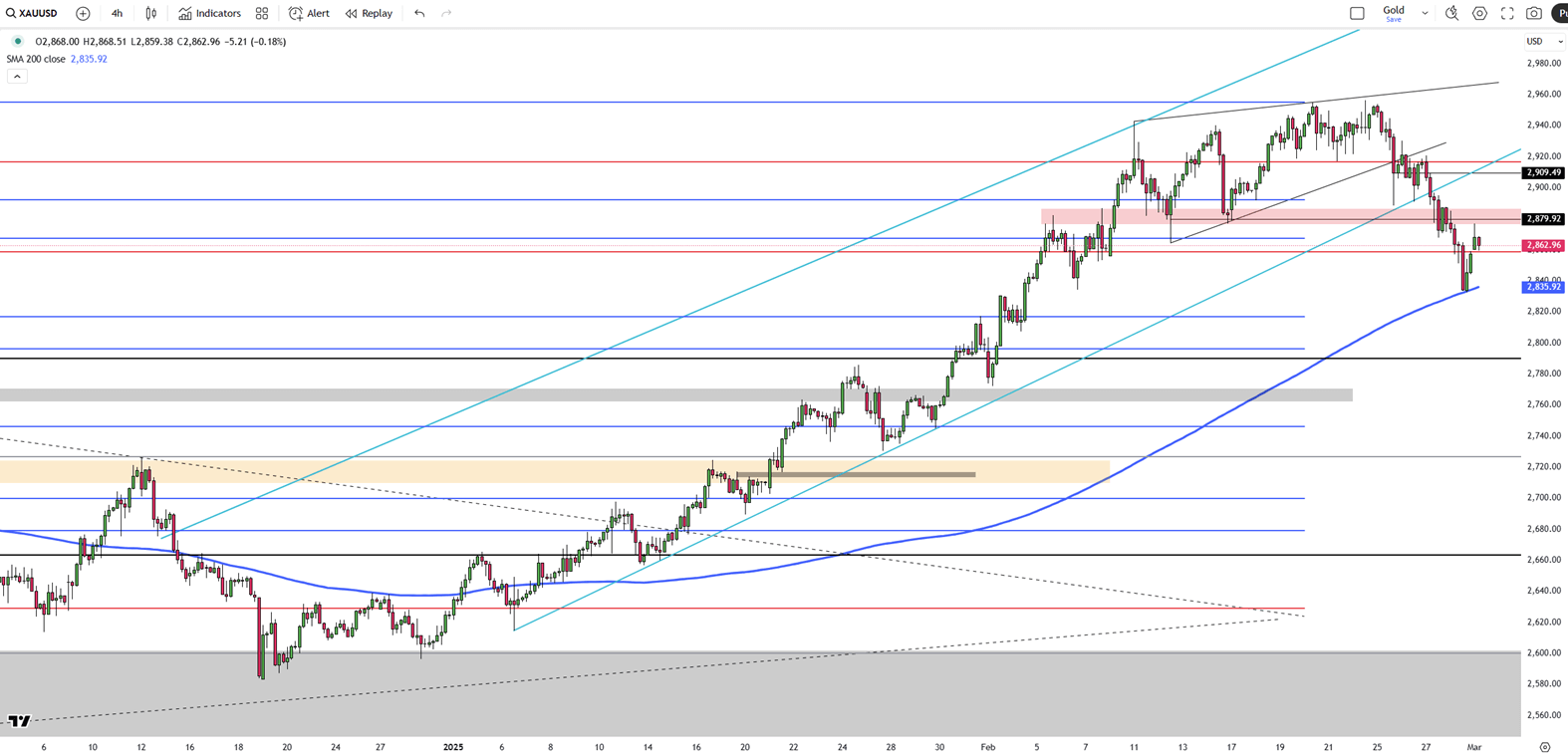
Gold rose above $2,860 per ounce on Monday. Trump’s planned tariffs on Mexico, Canada, and China fueled safe-haven demand. The planned tariffs on Mexican and Canadian goods, are set to take effect on March 4, along with an additional 10% duty on Chinese imports. Fears of retaliation and inflationary effects increased gold’s appeal, while a weaker U.S. dollar made it more attractive for foreign buyers. Growing concerns over the U.S. economy also reinforced expectations of Fed rate cuts, adding to gold’s strength as a non-yielding asset.
Key resistance stands at $2,880, with further levels at $2,917 and $2,949. Support is at $2,830, followed by $2,790 and $2,760.
| R1: 2880 | S1: 2830 |
| R2: 2917 | S2: 2790 |
| R3: 2949 | S3: 2760 |

The British pound fell to $1.265 as February PMI data showed business activity stalled for the fourth straight month, with rising job losses from weaker sales and higher costs. Concerns over stagflation complicate the BoE’s outlook, though sterling remains up 0.5% for the week after strong inflation data. UK retail sales beat expectations, and January's budget surplus reached £15.4 billion, below the £20.3 billion forecast. GfK’s consumer confidence index stayed negative but improved across key metrics.
The first resistance level for the pair will be 1.2680. In the event of this level's breach, the next levels to watch would be 1.2720 and 1.2770. On the downside 1.2500 will be the first support level. 1.2435 and 1.2350 are the next levels to monitor if the first support level is breached.
| R1: 1.2680 | S1: 1.2500 |
| R2: 1.2720 | S2: 1.2435 |
| R3: 1.2770 | S3: 1.2350 |
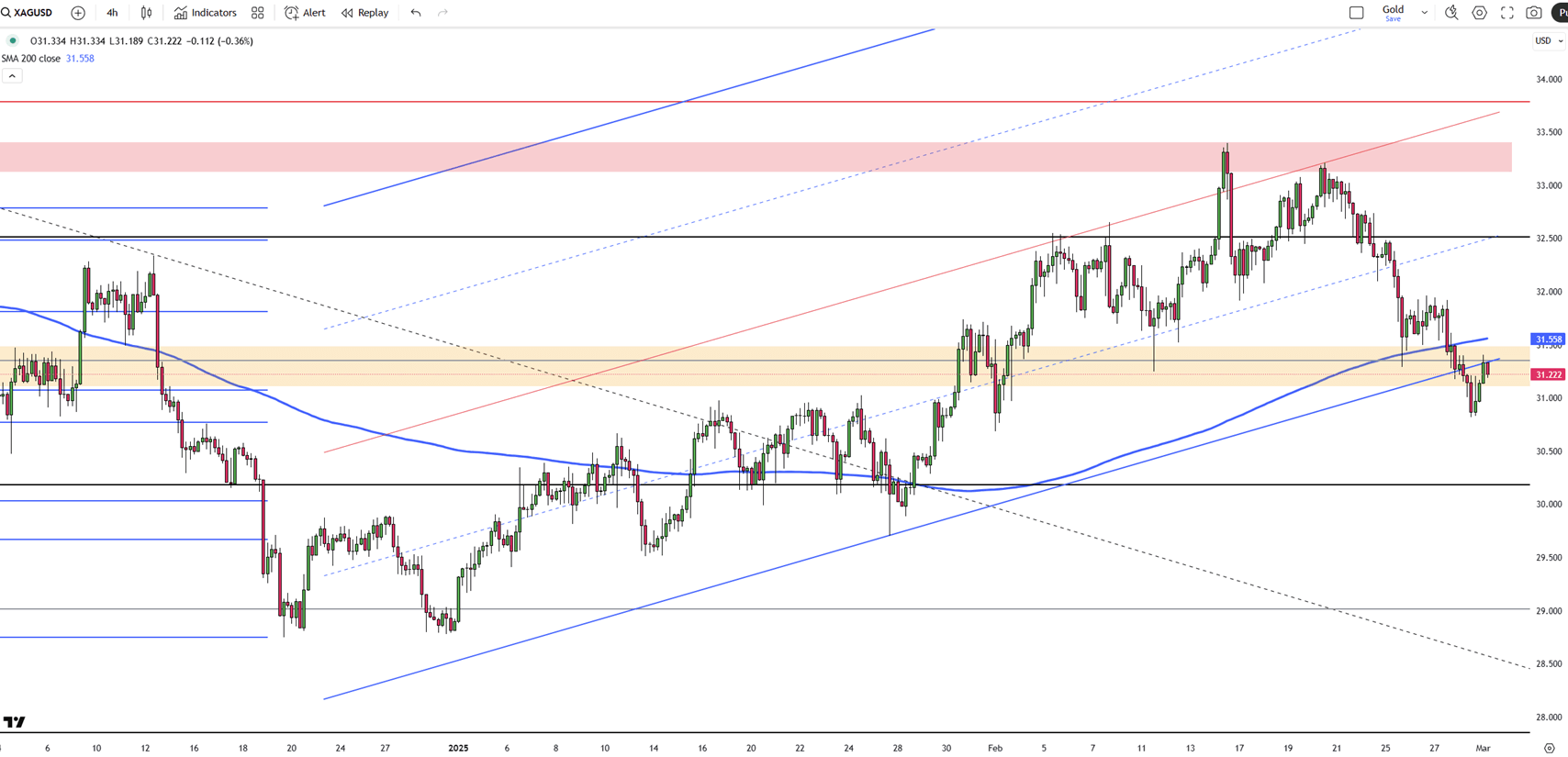
Silver (XAG/USD) rebounded on Monday, trading around $31.30 per troy ounce during Asian market hours after two days of losses. The metal benefited from increased safe-haven demand driven by concerns over US President Donald Trump’s trade policies. A weaker US Dollar is also supporting silver, making it more attractive to investors using other currencies. The US Dollar Index (DXY) hovers around 107.30.
Technically, the first resistance level is 33.15, with the next levels at 33.80 and 34.50 if breached. On the downside, support stands at 31.00, followed by 30.20 and 29.75 if further declines occur.
| R1: 33.15 | S1: 31.00 |
| R2: 33.80 | S2: 30.20 |
| R3: 34.50 | S3: 29.75 |
 BOJ Takes Rates to a 31-Year High
The Bank of Japan raised its key short-term interest rate by 25 basis points to 1.25% in September, pushing borrowing costs to their highest level since April 1995 and taking another step away from decades of ultra-loose monetary policy.
Detail Fed Hike Sets the Tone for Markets (09.18.2026)Monetary policy remained a key driver at the end of the week following the Federal Reserve’s first rate hike since July 2023.
 Fed Hikes to 4%, and It May Not Be Done
The Federal Reserve raised interest rates for the first time since 2023, delivering a unanimous 25 basis point increase to 3.75%–4.00% in September.
DetailThen Join Our Telegram Channel and Subscribe Our Trading Signals Newsletter for Free!
Join Us On Telegram!


