


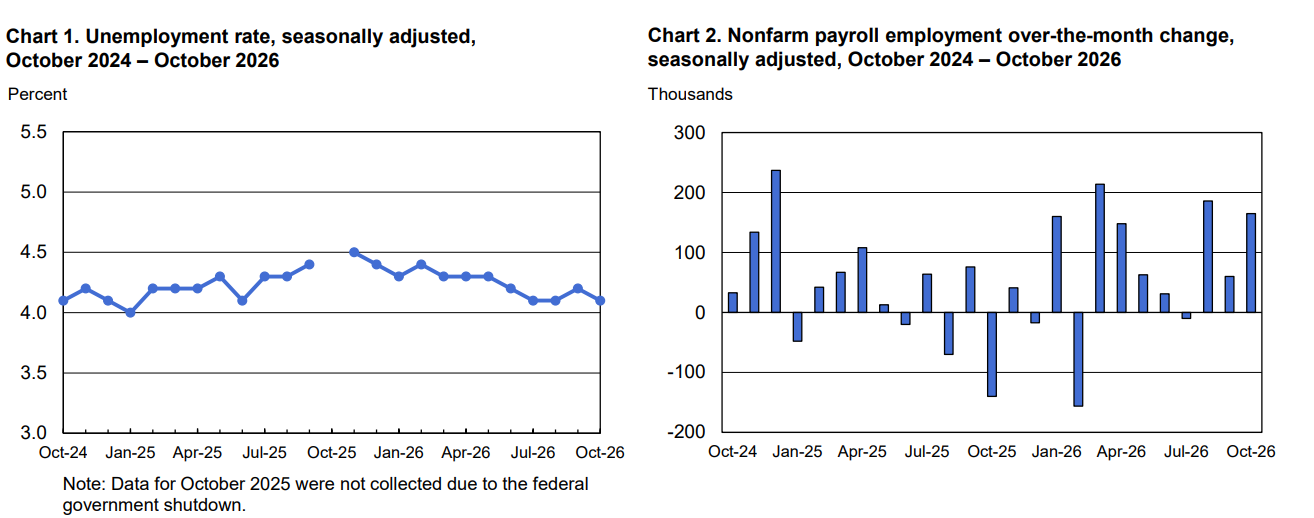
The US labor market showed renewed strength in October 2026, adding 165,000 jobs, the largest monthly increase in seven months. The figure comfortably exceeded economists’ expectations of 65,000 and followed an upwardly revised gain of 60,000 in September.
The latest employment report suggests that hiring remains resilient despite concerns about slowing economic growth and elevated borrowing costs.
October’s employment increase was considerably stronger than the 12-month average of 48,000 jobs per month.
Employment figures for August and September were also revised upward by a combined 84,000 positions, indicating that hiring had been stronger than initially estimated.
Together, these figures suggest that labor market conditions improved heading into the final quarter of 2026.
Professional and business services recorded the largest increase in employment, while healthcare and logistics also contributed significantly.
The main sectoral changes included:
Manufacturing continued its recovery, with employment increasing by 101,000 positions since December 2025, when the sector reached a recent low.
Meanwhile, hiring remained broadly unchanged in construction, retail trade, financial activities, leisure and hospitality, and government.
Stronger employment growth could influence the Federal Reserve’s interest rate outlook.
A resilient labor market may give policymakers more room to maintain restrictive monetary conditions, particularly if inflation continues to exceed the central bank’s target.
However, employment growth alone will not determine future policy decisions. The Fed will also assess wage increases, unemployment trends, and upcoming inflation figures before adjusting borrowing costs.
October’s report indicates that the US economy entered the final quarter of 2026 with stronger employment momentum than previously anticipated.
Hiring gains across professional services, healthcare, logistics, and manufacturing, alongside positive revisions to earlier data, point to improving labor market conditions.
Investors will now focus on whether this hiring momentum continues, as sustained employment strength could affect interest rate expectations, Treasury yields, and the US dollar.
Markets turned cautious ahead of the US employment report as a renewed technology stock selloff and post-midterm political uncertainty weighed on sentiment.
The US dollar weakened following the sweep of Democracts in the midterm elections, while renewed hopes for a resolution to the US-Iran conflict pushed oil prices lower and eased inflation concerns.
Then Join Our Telegram Channel and Subscribe Our Trading Signals Newsletter for Free!
Join Us On Telegram!


