


Personal income in the United States fell by 0.4% in May, equivalent to a $109.6 billion decrease, according to data from the US Bureau of Economic Analysis.
Disposable personal income, which reflects income after taxes, declined by 0.6% or $125.0 billion.
Personal consumption expenditures also edged lower, dropping by 0.1% or $29.3 billion for the month. Total personal outlays, including consumption, interest payments, and transfer payments, decreased by $27.6 billion.
Americans continued to set aside part of their income despite lower earnings. Personal savings reached $1.01 trillion in May, with the personal saving rate steady at 4.5%.
The decline in personal income was mainly driven by a reduction in government social benefits and a decrease in farm proprietors’ income. These declines were partially offset by an increase in employee compensation.
The $29.3 billion decline in personal consumption was led by a $49.2 billion fall in spending on goods. This was partly balanced by a $19.9 billion increase in services spending, reflecting continued resilience in the services sector.
Price pressures remained moderate in May. The PCE price index rose by 0.1% compared to the previous month and increased by 2.3% from a year earlier. Core PCE, which excludes food and energy prices and is closely monitored by the Federal Reserve, rose by 0.2% month over month and 2.7% year over year.
The latest data suggests that while consumer demand is cooling, inflation pressures remain within a manageable range. The Federal Reserve will closely watch these figures as it considers the future path of interest rates amid evolving economic conditions.
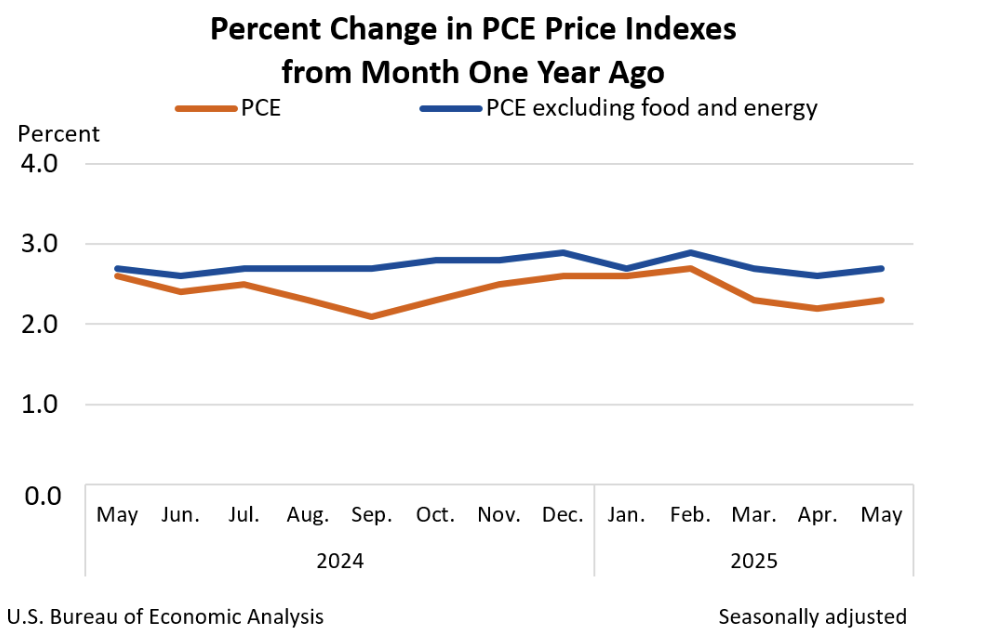
Source: Bureau of Economic Analysis
A deepening sell-off in technology and artificial intelligence stocks pressured financial markets, forcing investors to liquidate precious metals holdings to cover losses elsewhere.
Escalating Middle East tensions pushed oil prices higher following a deadly drone strike on Saudi Aramco's Shaybah facility, renewing inflation concerns and expectations for further Federal Reserve tightening.
Rising oil prices renewed inflation concerns as uncertainty surrounding the US-Iran conflict and continued disruptions in the Strait of Hormuz reinforced expectations for further monetary tightening.
Then Join Our Telegram Channel and Subscribe Our Trading Signals Newsletter for Free!
Join Us On Telegram!


