


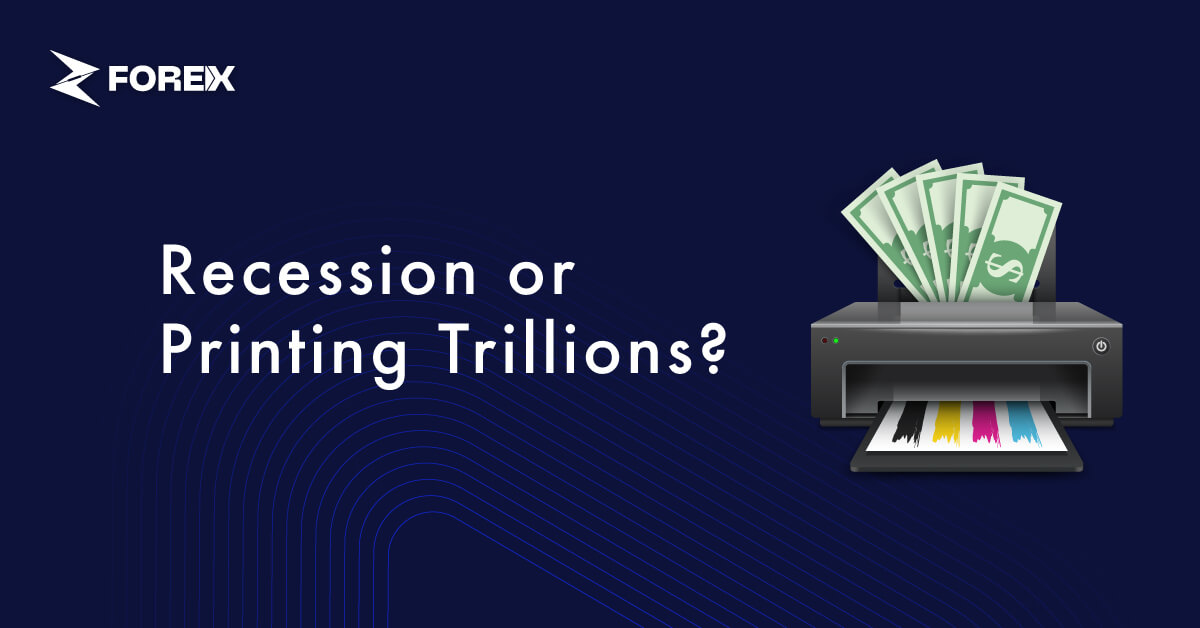
What Will the U.S. Choose: Recession or More Money Printing?
The United States may no longer have the freedom to go through a normal recession cycle. In the past, these downturns were painful but accepted as part of the system. Today, the situation is more complicated.
Recessions cannot be treated as a normal slowdown. They reduce tax revenue, widen the federal deficit, increase borrowing needs, and put more pressure on the bond market.
If growth turns negative, Washington and the Federal Reserve may feel forced to step in again, not because it is a perfect solution, but because the alternative may be harder to control.
In simple terms, the U.S. may face a difficult choice: allow a deep recession to expose the weakness of the system, or print more money and deal with the inflationary consequences later.
The U.S. government runs on tax collections. Income taxes, corporate taxes, payroll taxes, and capital gains taxes all depend on one thing: economic activity. When people are working, companies are profitable, and markets are rising, the government collects more money.
During a recession, this flow weakens. People lose jobs or earn less, businesses report lower profits, and stock market gains shrink or disappear. That means there is less income to tax, less profit to tax, and fewer capital gains to collect from investors.
At the exact moment when the government needs more money to support the economy, its tax revenue starts falling. So, the budget gets hit from both sides: less money coming in, more money going out.
This pattern has appeared several times in recent U.S. history. Let’s check it out.
|
Period |
Main Shock |
Tax Revenue Impact |
Budget Impact |
|---|---|---|---|
| Early 2000s | Dot-com crash and 9/11 | Tax collections fell from around $2.05 trillion in 2000 to $1.78 trillion in 2003 | A budget surplus turned into a deficit |
| 2008 Financial Crisis | Housing crash and banking stress | Tax revenue dropped from $2.57 trillion in 2007 to $2.11 trillion in 2009 | The deficit surged to around $1.41 trillion |
| 2020 Pandemic | Economic shutdowns | Tax revenue fell only slightly because stimulus arrived quickly | The deficit jumped sharply due to massive spending |
| 2022-2023 | Lower capital gains and post-pandemic tax effects | Tax collections fell from $4.9 trillion to $4.44 trillion | The deficit widened again |
The key point is simple: Less money comes in, more money goes out, and the gap must be filled with more borrowing.
In the past, the U.S. could absorb recessions more easily because the starting point was different. Debt levels were lower, interest payments were more manageable, and the government had more room to borrow during difficult periods. Today, that room looks much smaller.
The national debt has already climbed to extreme levels, and the government continues to spend far more than it collects. When annual spending is above revenue by trillions of dollars, even a normal year adds more debt to the system. A recession would make this worse because tax revenue would fall while emergency spending would likely increase.
That is why today’s debt level changes the meaning of a recession. Beyond a slowdown, it could become a fiscal stress test for the U.S. government, the bond market, and the broader financial system.
Debt is just one side of the story. What matters is debt compared to the size of the economy (debt-to-GDP ratio). If the economy grows faster than debt, the situation looks more manageable. If debt rises while growth slows, the pressure starts building quickly.
A recession makes this ratio worse on both sides. GDP can shrink, while the government borrows more to cover falling tax revenue and higher spending.
That is the “house of cards” risk. The higher the debt-to-GDP ratio climbs, the more sensitive the system becomes to any shock. A normal recession can then turn into something bigger.
The U.S. government does not fund its deficits alone. It needs investors to keep buying Treasury bills, notes, and bonds. In simple terms, the government borrows money from the market, and investors lend that money because they trust the U.S. system, the dollar, and the government’s ability to manage its debt.
Confidence also matters. If investors start to believe that debt is rising too fast, they may demand higher yields before lending more money. That means the government must pay more interest on new debt.
Higher Treasury yields also influence mortgage rates, business loans, credit cards, and many other parts of the economy. So, pressure in the bond market can quickly spread into everyday financial life.
When Treasury yields rise, the impact does not stay inside the bond market. U.S. government bonds act as a benchmark for many borrowing costs across the economy. So, when investors demand higher yields from the government, interest rates for households and businesses usually move higher too.
That can make mortgages, car loans, credit cards, and business financing more expensive. Consumers may spend less, companies may delay investment, and housing activity can slow down. In other words, higher yields can weaken the same economy the government is trying to protect.
This creates a difficult loop. A recession can push the government to borrow more, but more borrowing can lift yields, and higher yields can make the recession worse.
At first, deflation may sound like a relief. After years of rising prices, lower costs for goods, housing, or services can look positive for consumers. But in a debt-heavy economy, falling prices can create a different problem.
The issue is that debt does not fall just because prices or incomes fall. A household still owes the same mortgage. A company still has the same loans. The government still has the same debt to service. If income weakens while debt stays fixed, the real burden of that debt becomes heavier.
This is why deflation can be dangerous for the U.S. fiscal picture.
So, while lower prices may look attractive on the surface, deflation can make the debt problem worse. For a government already running large deficits, that is not an easy environment to accept.
When recession and deflation risks rise, policymakers face an uncomfortable choice. They can allow the downturn to deepen and risk a larger debt, banking, and market crisis, or they can inject liquidity into the system and try to stabilize the economy quickly.
This is why money printing becomes the easier political and financial choice. It does not solve the structural debt problem, but it can buy time. It supports markets, helps prevent a deeper collapse, and keeps the economy moving when private demand is weakening.
The cost comes later. More liquidity can protect the system in the short term, but it may also create inflation, weaken purchasing power, and push the debt problem further into the future.
For investors, the bigger question is not only whether the U.S. enters a recession. The more important question is what happens after the slowdown becomes too painful to ignore.
If tax revenue weakens, deficits expand, debt pressure rises, and markets start to shake, the likely response may be another wave of liquidity.
In simple terms, the system may move toward more stimulus, easier financial conditions, and eventually more money creation.
That creates a different roadmap for investors.
A recession scare can hurt markets at first, but if it leads to trillions in new liquidity, the next major move may not be a traditional recession trade.
Treasury yields, credit stress, Fed language, fiscal spending plans, the dollar, gold, and market expectations for rate cuts will be key drivers for sure.
If policymakers choose money printing again, investors may start looking less at short-term economic weakness and more at which assets can hold value in a world of weaker purchasing power.
This is also where politics enters the picture. Recessions are painful, visible, and unpopular. They bring job losses, weaker markets, falling confidence, and pressure on households.
Inflation is also damaging, but it can be delayed, explained through external factors, or pushed into the future more easily than a deep recession.
That gives policymakers a reason to avoid the pain today and deal with the bigger problem later. Stimulus, easier money, and money printing can calm the economy for a while. Over time, they can make debt bigger, inflation harder to control, and the final solution more difficult.
In the end, the U.S. may not be choosing between a perfect solution and a bad one. It may be choosing between two difficult outcomes: allow a deeper recession that exposes the weakness of the system or print more money and accept the inflationary consequences later.
Based on past reactions, policymakers may continue choosing the second path because it buys time.
Sign up in seconds for free, access your platform, and start trading with ease.

 PAMM vs MAM vs Copy Trading: Key Differences
With PAMM, money participates in a managed pool. MAM keeps client accounts separate but gives the manager a central way to trade them. Copy Trading leaves the follower with an independent account and reproduces another trader’s positions there.
Detail What Happens When a Company Joins or Leaves the S&P 500?
How companies join or leave the S&P 500, what happens before and after the change, and the key announcement and effective dates that matter.
Detail What Is PAMM and How Does It Work?
Learn how PAMM accounts work, how profits, losses and manager fees are calculated, and what to check before allocating funds to a trading strategy.
DetailThen Join Our Telegram Channel and Subscribe Our Trading Signals Newsletter for Free!
Join Us On Telegram!


