


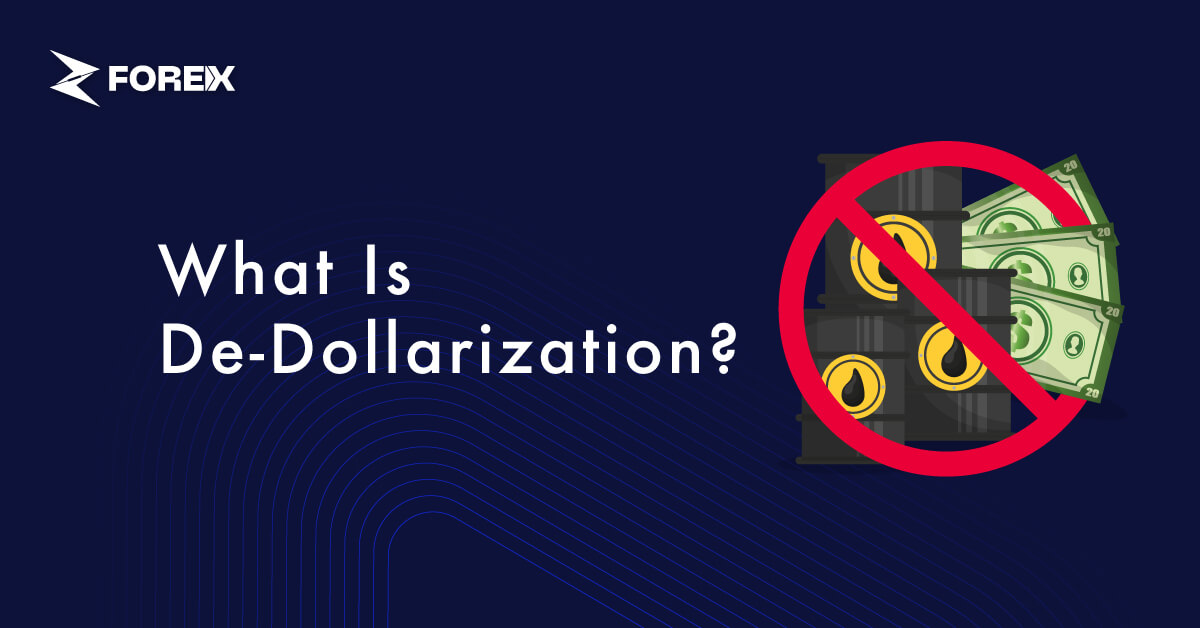
The US dollar has been at the center of global trade for a long time. Still is. Countries buy oil and gas in dollars, central banks hold it as reserves, and businesses rely on it for cross-border transactions.
This theme created a continuous demand for the U.S. dollar and kept it strong. Lately, that balance has started to crackle. More countries are settling trade in their own currencies, building alternative systems, and adjusting how they manage their reserves.
This trend, known as de-dollarization, is gradually reshaping how money moves across the global economy.
In simple terms, de-dollarization means using the US dollar less. Countries start trading with each other in their own currencies instead of dollars. Central banks reduce the number of dollars they hold in their reserves.
The global system has worked on dollars for years. A country sells goods or oil, gets paid in dollars, and then uses those dollars again. Often, they end up buying US assets like Treasury bonds.
That pattern is starting to change. More transactions are being done outside the dollar. Some countries are building their own payment systems to avoid relying on it.
It’s not a sudden switch, and the dollar is still used globally. The share, however, is slowly getting smaller, and that’s what people refer to as de-dollarization.
The dollar is strong because there is demand for it. Inside the US, that demand is built into the system. Taxes are paid in dollars. Loans are repaid in dollars. Daily transactions run on it. People and businesses need dollars to operate, so demand stays steady.
Globally, the same logic applies. Many key markets use the dollar by default. Oil is the best example. If a country wants to buy energy, it often needs dollars first. That alone creates ongoing demand.
Countries that earn dollars through trade do not just hold them idle. They usually invest those dollars back into US assets, especially Treasury bonds. This keeps money flowing back into the system and supports the currency.
As long as this cycle continues, the dollar stays strong. High demand keeps its value stable and allows the US to borrow at relatively low costs.
If demand for the dollar drops, its value starts to weaken. That is the starting point. A weaker dollar means imports become more expensive.
Since the US relies on global supply chains, higher import costs quickly feed into inflation. Everyday goods, energy, and raw materials all become more expensive.
Interest rates tend to move higher. When there is less demand for dollar-based assets like US Treasuries, investors expect better returns to hold them. That pushes borrowing costs up across the system, from mortgages to business loans.
The pressure builds from both sides; prices go up, while financing becomes more expensive. Wages usually adjust more slowly than both, which reduces purchasing power over time.
This is why demand for the dollar matters. It directly affects inflation, interest rates, and overall living standards.
One of the clearest signals comes from central banks. For years, they kept a large share of their reserves in US dollars and Treasury bonds. That was the standard approach. It offered liquidity and stability.
Now, that mix is changing. Central banks have been buying more gold and reducing their exposure to dollar assets. In early 2026, gold holdings even moved ahead of US Treasuries in total reserve value for the first time in decades.
This shift matters because central banks are not short-term traders. They move slowly and with purpose. When they change allocation, it usually reflects a longer-term view.
Part of the demand that used to go into dollars is now going somewhere else.
There is no single reason behind this shift. It comes from a mix of political, economic, and financial factors. Some of them have been building for years. Others became more visible after recent global events.
The dollar is a tool of power as much as a currency.
A key moment came in 2022, when the US and its allies froze a large part of Russia’s foreign reserves. These were assets held in dollars and within the Western financial system. Once frozen, Russia could not access them.
This sent a clear message to other countries. Holding assets in dollars comes with risk. If relations break down, access to those assets can be restricted.
Since then, many countries have started to think differently. Some are reducing exposure to the dollar to avoid similar situations.
Another concern is how the US manages its finances. The government spends more than it collects in taxes. The gap is covered by borrowing, mainly through issuing Treasury bonds. Over time, this has pushed total debt to very high levels.
For foreign investors and central banks, this raises a simple question. How sustainable is this path?
If debt keeps growing and deficits continue, confidence can weaken. Some countries prefer to reduce their exposure rather than rely too heavily on US debt.
The third factor is monetary policy. When there is not enough demand for government debt, the Federal Reserve steps in. It buys bonds and injects liquidity into the system. In simple terms, more money is created.
This supports the system in the short term, but it also reduces the value of the currency over time.
For countries holding large dollar reserves, this is not ideal. They may get paid back, but in weaker dollars.
That is why some central banks are shifting part of their reserves into assets that cannot be printed, such as gold.
The petrodollar system is simple. Oil is priced and traded in US dollars. Any country that wants to buy energy needs dollars first.
This created constant demand. Countries earn dollars through trade, then use those same dollars to pay for energy. A large part of that money later flowed back into US assets. That cycle helped keep the dollar strong for decades.
Now, parts of that system are starting to change. Some countries are trading oil in other currencies. China has been settling energy deals in yuan. Iran is selling oil outside the dollar system and using the proceeds to buy goods directly from its trade partners.
Energy is one of the largest markets in the world. When transactions begin to move away from the dollar, demand starts to shift with it.
The system is still in place. Most oil is still priced in dollars, but the share is no longer as stable as it once was.
As reliance on the dollar starts to ease, countries are building other ways to trade. One of the most visible changes is in bilateral agreements. Instead of using the dollar as a middle step, two countries trade directly in their own currencies. This reduces the need to hold large amounts of dollars just to complete transactions.
There is also progress in payment systems. Some countries are developing their own networks to handle cross-border transfers without going through traditional dollar-based infrastructure.
Trade flows are adjusting as well. In some cases, countries sell goods, get paid in a local currency, and use that same currency to buy imports. The dollar is no longer part of the cycle.
None of these replaces the dollar overnight. Each new agreement and system reduces its role a bit more.
If the dollar loses strength over time, the main risk is simple: purchasing power goes down. Prices rise faster than income, and savings lose value. That is what people try to protect themselves.
Here are some practical approaches:
In conclusion, you don’t need to move away from the dollar completely. Just avoid being all-in on it.
De-dollarization is not something you measure with a single number. You need to observe it in a few areas.
The first one is the US Treasury demand. This is one of the clearest signals. If demand for Treasuries starts to weaken, it means fewer dollars are being recycled into the system.
You can also see interest rates. Strong demand for Treasuries keeps yields low. When demand drops, yields move higher because investors want better returns.
Another area is central bank reserves. If central banks are reducing their dollar holdings and increasing exposure to gold or other assets, that shift is part of the bigger trend.
Finally, look at global trade patterns. More deals being settled in local currencies, especially in energy and large commodity trades, show that the dollar is being used less in real transactions.
Sign up in seconds for free, access your platform, and start trading with ease.

 How Index Futures Influence the Stock Market Open
How do index futures influence the stock market open? Learn what pre-market moves reveal about opening prices, market sentiment, and trader psychology.
Detail What Is the Nasdaq?
What is the Nasdaq? Learn how the Nasdaq Composite Index works, which stocks it includes, and what influences its performance.
Detail What Is the FTSE 100?
The FTSE 100 tracks the largest companies listed on the London Stock Exchange. Explore how it is calculated and what influences its performance.
DetailThen Join Our Telegram Channel and Subscribe Our Trading Signals Newsletter for Free!
Join Us On Telegram!


