


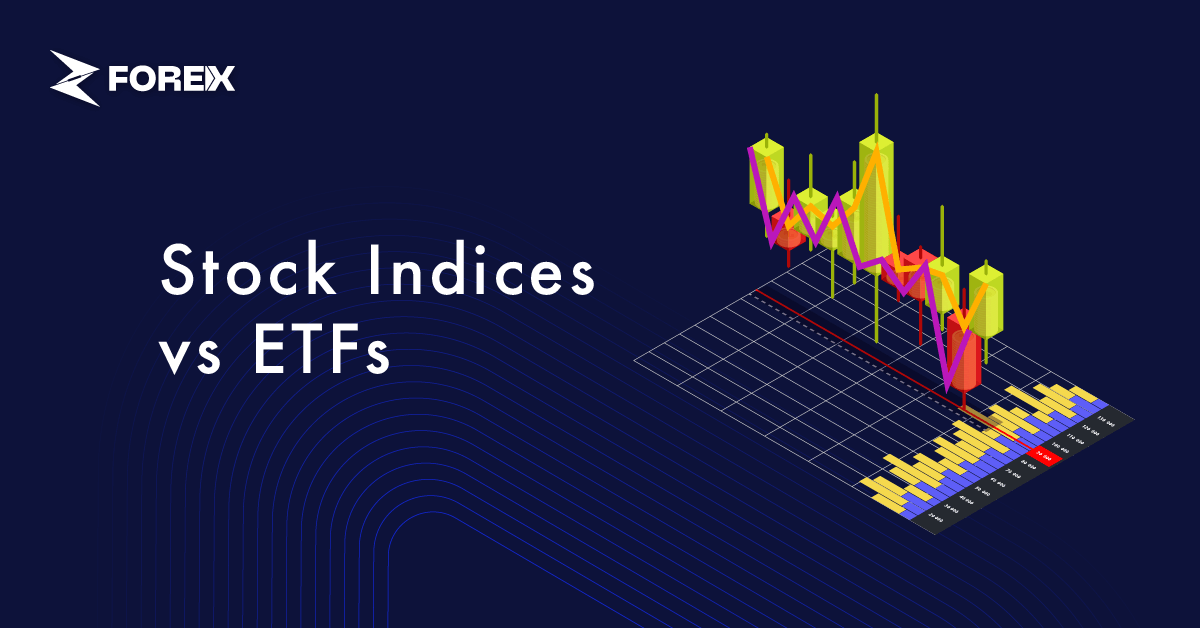
Most traders roam the financial markets without having enough comprehension of the differences between stock indices and ETFs. Let’s start with the basics and understand what they mean first.
Stock indices are benchmarks. ETFs are tradable funds that track those benchmarks. You can’t buy an index directly, but you can buy an ETF that follows it. The main differences show up in how you trade, what you pay, and how closely the ETF tracks its index.
Basically:
Index = measure, ETF = instrument.
A stock index tracks the performance of a group of companies that share certain traits, such as size, sector, or country. Examples include the S&P 500 in the United States, the FTSE 100 in the UK, or the Nikkei 225 in Japan.
An index is not something you can buy directly. It’s a measure, not an investment instrument. Investors use indices to see how a market is doing, compare portfolios, or create strategies around overall market trends.
On the other hand, you can trade indices in CFD form. An index CFD is a contract that lets you speculate on the price movements of an index without owning the real stocks. It gives traders the chance to go long or short, use leverage, and access global indices directly from a trading platform.
An ETF, or exchange-traded fund, is a tradable product that tracks an index or a basket of assets. It trades on an exchange just like a stock. That means you can buy and sell it throughout the trading day at market prices. Popular examples include the SPDR S&P 500 ETF (SPY), Invesco QQQ (tracking the Nasdaq-100), and iShares MSCI Emerging Markets ETF (EEM).
ETFs mirror the performance of their chosen index, minus costs. Some use full replication by holding every stock in the index. Others use sampling or derivatives to stay close to the benchmark.
Although they have similar functions, stock indexes and ETFs are not the same.
The table below highlights how they differ in practice.
|
Feature |
Stock Index |
ETF |
|---|---|---|
| What it is | A benchmark that measures the performance of a group of stocks. | A fund that tracks an index and trades like a stock. |
| Can you trade it? | Not directly. You can trade it through CFDs or other derivatives, but the index itself is mainly used as a benchmark to follow and compare. | Yes, intraday on exchanges through any broker. |
| Pricing | Not traded, only calculated values. | Market price during the day, NAV once per day. |
| Costs | Spreads, and / or commissions on CFD instruments. | Expense ratio, bid-ask spread, brokerage fees. |
| Use | Benchmarking, strategy design, market sentiment. | Gaining exposure, hedging, asset allocation. |
An ETF is built to follow an index as closely as possible. The fund manager holds the same stocks, or a sample of them, to match the benchmark. Market makers step in with a process called creation and redemption. They swap baskets of stocks for ETF shares and the other way around. This helps keep the ETF price close to its net asset value (NAV).
For traders, the main point is that ETFs work like regular stocks. You can buy and sell them during the day and even use order types like limit or stop. Some products can also be traded with a margin or options.
Trading an ETF is a simple process. The simplicity comes from the fact that it behaves like a normal stock on the exchange. You buy and sell it during the day, and you can choose different order types depending on how you want to enter or exit.
The ease of trading also comes from the size and activity. Larger, well-known products usually trade very smoothly with tight spreads. Smaller or less active ones may cost a bit more to trade, especially when markets are busy or right around the open and close.
Both indices and ETFs are useful, but in different ways. The matrix below shows when each is the better tool.
If you want a benchmark, use a stock index.
If you want exposure, use ETFs.
Example: When you buy an S&P 500 ETF, you participate in the performance of the same companies the index follows.
ETFs and index funds both aim to track an index, but they work in different ways. Think of them as two paths to the same goal.
When deciding, consider your trading style. If you want flexibility and execution control, ETFs win. If your goal is “set it and forget it,” an index fund might feel cleaner.
There can be discrepancies between an ETF and the index it follows. This gap is called tracking error. Several factors can cause it:
Structure matters too. Some ETFs use physical replication (buying the real stocks), while others use synthetic replication with swaps or derivatives. Dividends are another point: distributing ETFs pay them out, while accumulating ETFs reinvest automatically.
Liquidity is also a hidden risk. A fund with high daily volume looks liquid, but real liquidity depends on the stocks inside the ETF. If liquidity is low in those stocks, spreads get wider.
ETFs look advantageous to trade, but there are a few layers of cost that matter beyond the headline expense ratio.
ETFs are easy to use, but index futures can be a better fit in some trading situations. They tend to work well when:
That said, futures are not for everyone. Contracts expire and need to be rolled over, and leverage can increase losses as much as gains. For long-term investing or a simple way to track the market, ETFs usually make more sense.
Can I invest in a stock index directly?
No. An index is just a benchmark. To get exposure, you need an ETF, index fund, futures contract, or CFD.
Are ETFs and index funds the same thing?
Both track indices, but ETFs trade intraday on exchanges, while index funds price once a day at NAV.
Why do investors use indices?
Indices are used to measure market performance, compare portfolios, and track sectors or countries.
Why does an ETF’s market price differ from its NAV?
Because ETFs trade like stocks. Demand, supply, and spreads can move the price slightly above (premium) or below (discount) its NAV.
What impacts an ETF’s bid–ask spread?
Liquidity of both the ETF itself and its underlying holdings. Spreads widen during volatile events, at market open/close, or in less liquid markets.
Do ETFs always have lower fees than index funds?
Not always. ETFs usually have lower expense ratios, but trading costs like spreads and brokerage fees can add up.
What is tracking error, and why does it matter?
Tracking error is the gap between an ETF’s return and the index it follows. It comes from fees, replication methods, dividend timing, and rebalancing costs.
How do synthetic ETFs differ from physical ETFs?
Synthetic ETFs use swaps or derivatives to replicate an index. They may track closely but carry counterparty risk. Physical ETFs hold the actual securities in the index.
When might futures be better than ETFs for exposure?
For intraday hedging, higher leverage with margin efficiency, or when futures markets offer tighter spreads and deeper liquidity. Long-term investors, however, may still prefer ETFs.
How do dividends affect ETF performance?
Dividend treatment depends on the product’s structure. Distributing ETFs pay out cash dividends, while accumulating ETFs reinvest them, supporting compounding. Timing and withholding taxes can also create small differences in tracking versus the index.
Sign up in seconds for free, access your platform, and start trading with ease.

 PAMM vs MAM vs Copy Trading: Key Differences
With PAMM, money participates in a managed pool. MAM keeps client accounts separate but gives the manager a central way to trade them. Copy Trading leaves the follower with an independent account and reproduces another trader’s positions there.
Detail What Happens When a Company Joins or Leaves the S&P 500?
How companies join or leave the S&P 500, what happens before and after the change, and the key announcement and effective dates that matter.
Detail What Is PAMM and How Does It Work?
Learn how PAMM accounts work, how profits, losses and manager fees are calculated, and what to check before allocating funds to a trading strategy.
DetailThen Join Our Telegram Channel and Subscribe Our Trading Signals Newsletter for Free!
Join Us On Telegram!


