


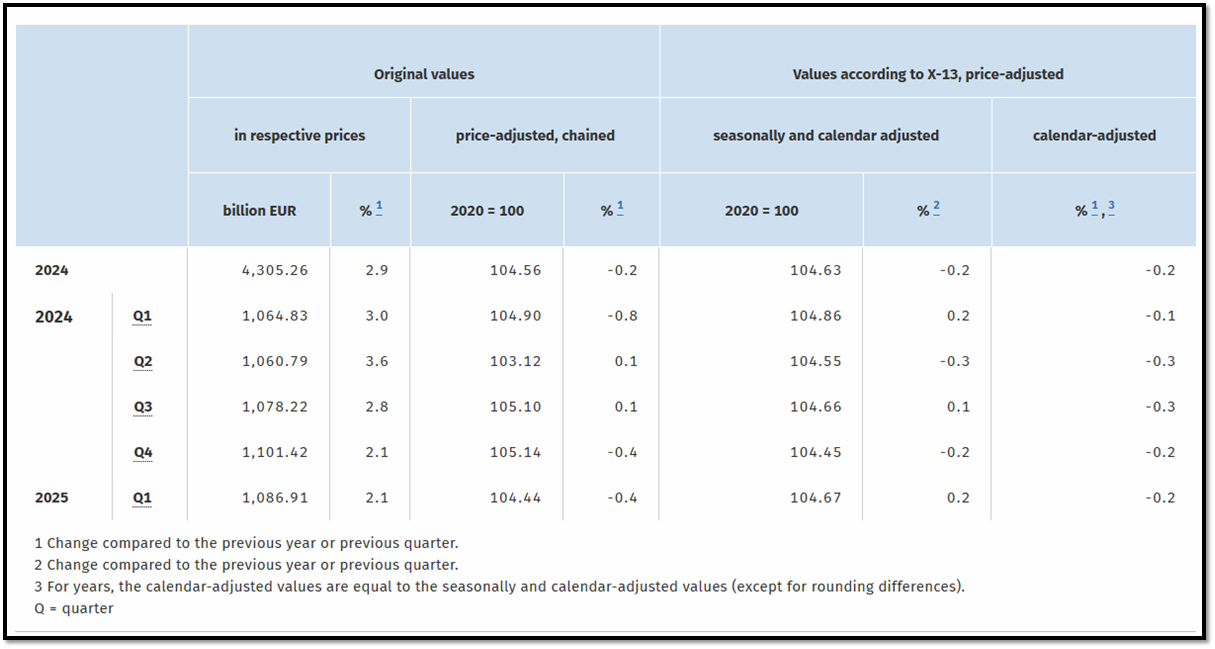
Germany’s economy grew by 0.2% in the first quarter of 2025, according to preliminary figures released Friday, matching market forecasts. This modest rebound follows a 0.2% contraction in the previous quarter and signals a fragile but welcome return to growth for Europe’s largest economy.
The upturn was supported by easing inflation and lower borrowing costs, which helped lift domestic demand and business investment. Consumer and business sentiment also improved, supported by the resolution of coalition talks and the formation of a stable federal government earlier in the year. The political clarity provided a tailwind, offering reassurance to markets amid broader uncertainty.
Still, underlying challenges persist. Compared to a year ago, Germany’s gross domestic product (GDP) declined by 0.2%. This marks the seventh consecutive quarter of year-on-year contraction, highlighting the enduring impact of structural weaknesses and global economic pressures. Trade tensions, particularly stemming from shifting U.S. tariff policy, continue to weigh on sentiment and export performance.
Economists caution that while the quarterly growth is a step forward, it does not yet signal a strong or sustained recovery. Germany will need continued policy support and a more stable global backdrop to build on this early momentum.
Global markets ended the week with broad U.S. dollar weakness after the Treasury announced plans to expand long-term debt buybacks, adding liquidity and pressuring yields.
Detail Dollar Weakens as Falling Yields Lift Markets (08.20.2026)Global markets responded to falling U.S. Treasury yields after expanded government bond buybacks eased long-term borrowing costs and pressured the dollar.
Detail Euro Hits Two-Month High as Metals Fall (08.19.2026)Global markets remained focused on diverging central bank expectations, rising bond yields, and renewed Middle East tensions.
DetailThen Join Our Telegram Channel and Subscribe Our Trading Signals Newsletter for Free!
Join Us On Telegram!


