


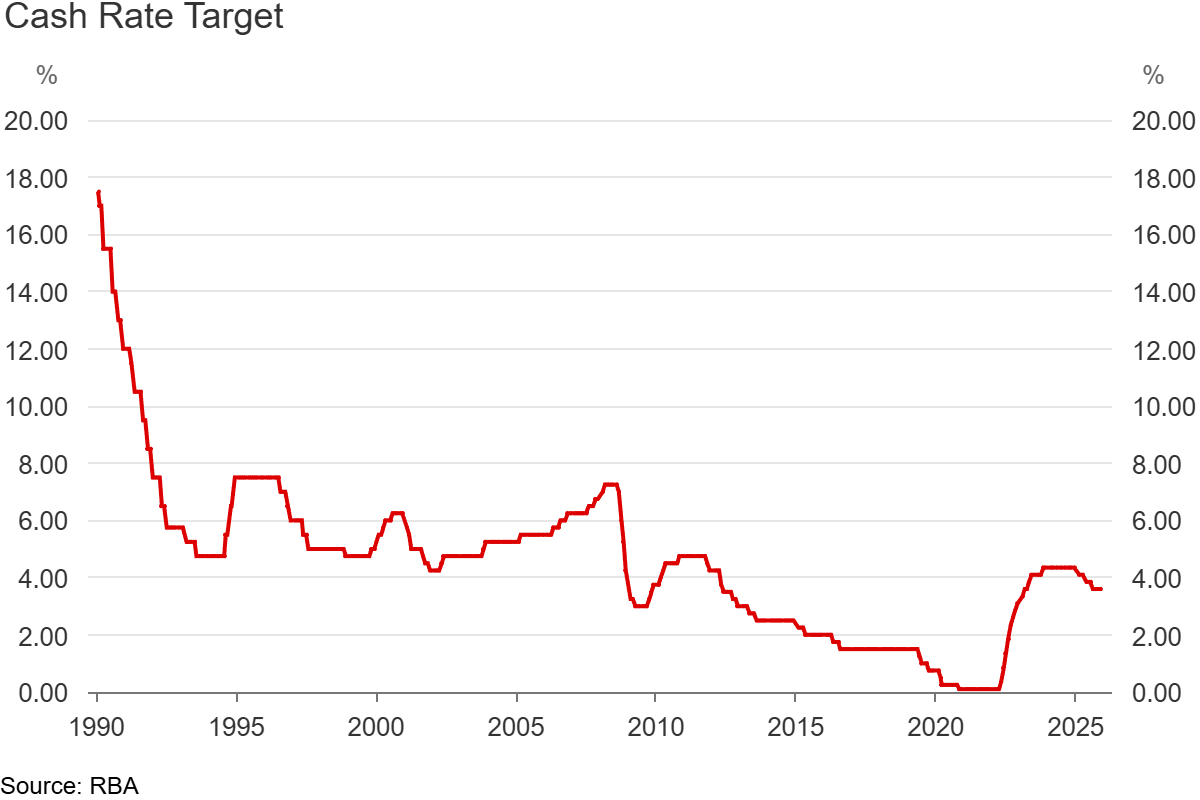
The Reserve Bank of Australia kept the cash rate unchanged at 3.6% in its final policy meeting of 2025, delivering a third consecutive hold and matching market expectations.
Borrowing costs remain at their lowest level since April 2023, reflecting a central bank that sees progress on inflation but is not yet convinced the threat has fully subsided.
The RBA noted that inflation has fallen sharply from its 2022 peak, yet recent data show a mild upturn that requires close attention. Officials cautioned that although part of this rise may prove temporary, early signs point to broader and potentially more persistent price pressures. This shift in tone underscores growing concern that inflation could become more difficult to contain if underlying demand stays firm.
Australia’s labour market was described as “a little tight.” Unemployment has edged higher, and job creation has slowed, but overall labour underutilization remains low. Many firms continue to struggle to secure skilled workers, an imbalance that could keep wage and price pressures elevated unless demand tapers further.
The RBA emphasized several uncertainties shaping the months ahead. Domestically, policymakers are still assessing how restrictive current rate settings actually are. Globally, shifting trade conditions and geopolitical tensions continue to influence Australia’s inflation and growth dynamics. The central bank also warned that strong private sector activity could strain capacity if it carries into 2026.
With signals pointing in different directions, the board opted for caution. Leaving rates unchanged gives the RBA room to evaluate incoming data early in 2026 before altering its stance. Policymakers reiterated that they remain ready to adjust settings if inflation moves away from target, aiming to preserve stability as the economy transitions into the new year.
 BOJ Takes Rates to a 31-Year High
The Bank of Japan raised its key short-term interest rate by 25 basis points to 1.25% in September, pushing borrowing costs to their highest level since April 1995 and taking another step away from decades of ultra-loose monetary policy.
Detail Fed Hike Sets the Tone for Markets (09.18.2026)Monetary policy remained a key driver at the end of the week following the Federal Reserve’s first rate hike since July 2023.
 Fed Hikes to 4%, and It May Not Be Done
The Federal Reserve raised interest rates for the first time since 2023, delivering a unanimous 25 basis point increase to 3.75%–4.00% in September.
DetailThen Join Our Telegram Channel and Subscribe Our Trading Signals Newsletter for Free!
Join Us On Telegram!


