


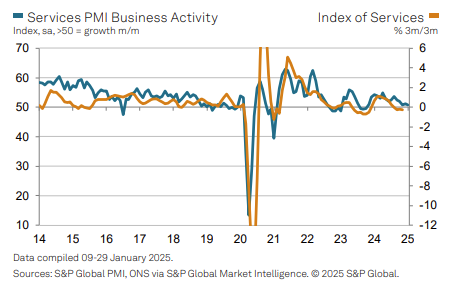
The S&P Global UK Services PMI® data for January signaled continued expansion in business activity, though at a marginal pace.
The seasonally adjusted Business Activity Index fell to 50.8, down from 51.1 in December, marking the joint-lowest level in 15 months. The latest reading remains well below pre-pandemic levels, highlighting sluggish growth in the services sector.
Service providers cited several factors weighing on business activity, including:
Total new work orders declined in January, ending a 14-month streak of continuous growth. Some businesses attributed the drop to higher interest rates and global economic uncertainty, while others pointed to reduced confidence following the Autumn Budget. However, technology services remained a bright spot, with strong demand supporting limited pockets of business expansion.
Staffing levels declined for the fourth straight month, with the pace of job losses accelerating to its highest level since January 2021. Rising payroll costs and shrinking margins led to hiring freezes and restructuring efforts.
Input price pressures surged, with cost inflation reaching a nine-month high due to increased salary payments and supplier price hikes.
Prices charged by service sector firms rose at the fastest rate in 13 months, although some businesses opted for price discounting to stimulate demand.
Export sales fell for the second consecutive month, though the decline was less severe than in December. While demand from the U.S. remained stable, spending in Europe weakened.
Backlogs of work declined significantly, reflecting excess capacity after months of subdued demand. The reduction in unfinished work was the steepest since August 2023.
Business confidence fell to its lowest level since December 2022, as firms expressed concerns over squeezed margins, weak demand, and disappointing UK economic growth prospects.
The January data paints a mixed picture for the UK services sector, with marginal growth overshadowed by mounting cost pressures and rising job losses. With inflationary pressures intensifying and business confidence weakening, the sector faces a challenging start to 2025.
Source: S&P Global
A deepening sell-off in technology and artificial intelligence stocks pressured financial markets, forcing investors to liquidate precious metals holdings to cover losses elsewhere.
Escalating Middle East tensions pushed oil prices higher following a deadly drone strike on Saudi Aramco's Shaybah facility, renewing inflation concerns and expectations for further Federal Reserve tightening.
Rising oil prices renewed inflation concerns as uncertainty surrounding the US-Iran conflict and continued disruptions in the Strait of Hormuz reinforced expectations for further monetary tightening.
Then Join Our Telegram Channel and Subscribe Our Trading Signals Newsletter for Free!
Join Us On Telegram!


