


Recent figures from the Office for National Statistics show that the UK labor market entered 2026 on a softer footing.
The number of employees on payrolls stood at approximately 30.3 million in January, marking a decline compared with the same month a year earlier. The annual drop pointed to a more cautious hiring environment, as businesses respond to slower economic momentum and rising uncertainty across key industries.
Month-to-month changes were limited, pointing to moderation rather than disruption. The labor market appears to be settling into a steadier but slower phase following the strong rebound that followed the pandemic period. Companies are adjusting to higher operating costs, softer growth expectations and tighter financial conditions, prompting a more selective approach to recruitment.
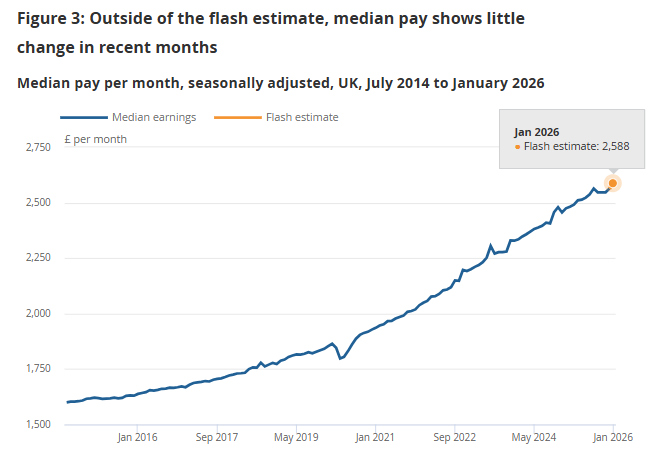
Despite cooling employment growth, pay continues to move higher. Median monthly earnings rose to £2,588, reflecting a solid annual increase. This resilience in wages suggests that labor supply remains constrained enough to preserve worker bargaining power, even as hiring activity eases. That said, pay dynamics differ across sectors, underlining uneven performance within the broader economy.
Industry data highlights diverging trends. Health and social care employment continued to expand, supported by structural demographic demand. By contrast, retail and wholesale sectors recorded notable job losses, reflecting weaker consumer spending patterns and longer-term shifts in shopping behaviour. The divergence illustrates how different parts of the economy are adjusting at varying speeds.
Taken together, the data points to a labor market that is becoming more balanced yet remains delicate. Rising wages offer support to household incomes, while declining payroll growth reflects softer business confidence. For the Bank of England, these signals carry weight. Labor market conditions remain central to future interest rate decisions and the broader economic trajectory in 2026.
A deepening sell-off in technology and artificial intelligence stocks pressured financial markets, forcing investors to liquidate precious metals holdings to cover losses elsewhere.
Escalating Middle East tensions pushed oil prices higher following a deadly drone strike on Saudi Aramco's Shaybah facility, renewing inflation concerns and expectations for further Federal Reserve tightening.
Rising oil prices renewed inflation concerns as uncertainty surrounding the US-Iran conflict and continued disruptions in the Strait of Hormuz reinforced expectations for further monetary tightening.
Then Join Our Telegram Channel and Subscribe Our Trading Signals Newsletter for Free!
Join Us On Telegram!


