


The U.S. economy expanded at an annualized rate of 3.1% in the third quarter of 2024, according to the "third" estimate released by the U.S. Bureau of Economic Analysis (BEA).
The U.S. economy expanded at an annualized rate of 3.1% in the third quarter of 2024, according to the "third" estimate released by the U.S. Bureau of Economic Analysis (BEA). This marks a slight improvement from the previously reported 2.8% in the "second" estimate and follows a 3.0% growth rate in the second quarter. The upward revision reflects stronger consumer spending and exports, offset slightly by downward adjustments to private inventory investment.
The increase in real GDP was primarily fueled by:
While these components boosted GDP, the rise in imports, which are subtracted from GDP calculations, and declines in private inventory and residential fixed investment partially offset the gains.
The acceleration in GDP growth from Q2 to Q3 was driven by:
These factors outweighed the larger declines in private inventory and residential fixed investment during the quarter.
In current dollar terms, GDP rose by 5.0%, or $358.2 billion, to reach $29.37 trillion, representing a $20.6 billion upward revision from the prior estimate.
The price index for gross domestic purchases increased by 1.9%, unchanged from the previous estimate. The personal consumption expenditures (PCE) price index rose by 1.5%, while the core PCE index, excluding food and energy, was revised upward by 0.1 percentage points to 2.2%.
The updated data highlights a strong U.S. economy in the third quarter, supported by solid domestic and international demand.
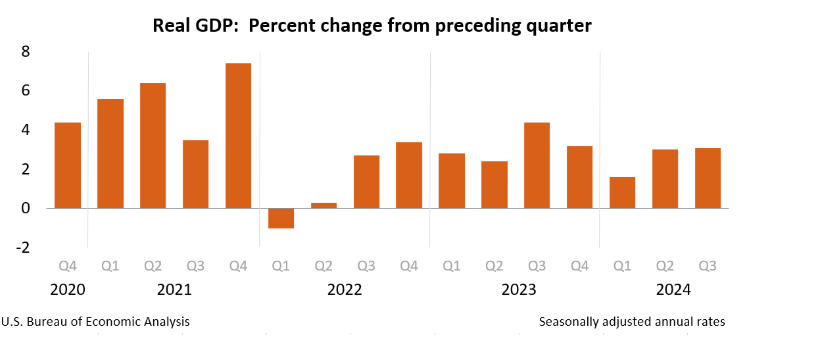
Source: Bureau of Economic Analysis
Escalating Middle East tensions pushed oil prices higher following a deadly drone strike on Saudi Aramco's Shaybah facility, renewing inflation concerns and expectations for further Federal Reserve tightening.
Rising oil prices renewed inflation concerns as uncertainty surrounding the US-Iran conflict and continued disruptions in the Strait of Hormuz reinforced expectations for further monetary tightening.
Elevated oil prices and rising Treasury yields weighed on precious metals as persistent geopolitical tensions reinforced inflation concerns and expectations for further Federal Reserve tightening.
Then Join Our Telegram Channel and Subscribe Our Trading Signals Newsletter for Free!
Join Us On Telegram!


