


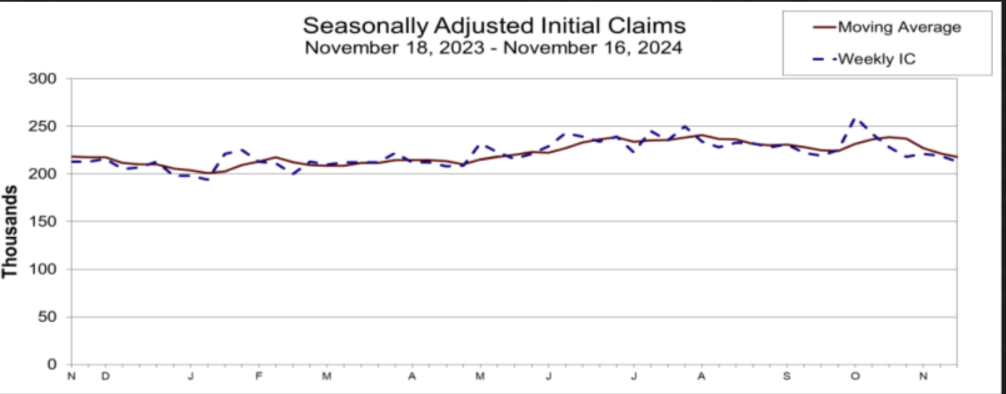
For the week ending November 16, initial claims for U.S. unemployment benefits, seasonally adjusted, dropped to 213,000, a decrease of 6,000 from the previous week’s revised figure of 219,000. The prior week's claims were revised upward by 2,000, from 217,000 to 219,000.
For the week ending November 16, initial claims for U.S. unemployment benefits, seasonally adjusted, dropped to 213,000, a decrease of 6,000 from the previous week’s revised figure of 219,000. The prior week's claims were revised upward by 2,000, from 217,000 to 219,000. The 4-week moving average of initial claims fell to 217,750, a decrease of 3,750 from the revised average of 221,500 from the previous week, which had been adjusted upward by 500.
As of the week ending November 9, the seasonally adjusted insured unemployment rate rose to 1.3%, up by 0.1 percentage points from the prior week. The total number of people receiving unemployment benefits increased by 36,000, reaching 1,908,000—the highest level since November 2021, when it stood at 1,974,000. The previous week’s insured unemployment figure was revised down slightly by 1,000, from 1,873,000 to 1,872,000.
The 4-week moving average for insured unemployment claims rose to 1,879,250, an increase of 5,000 from the revised average of 1,874,250. This marks the highest 4-week moving average since November 2021, when it reached 1,928,000. The previous week’s moving average was revised down by 250, from 1,874,500 to 1,874,250.
Source: U.S. Department of Labor
 Fed Inflation Concerns Remain
The latest Federal Reserve minutes show that inflation remains a central concern for policymakers, even as recent economic data has reduced the urgency for another rate increase. Some officials believe price pressures are becoming more widespread, while a smaller group directly supported further tightening.
Detail Dollar Falls on Debt Concerns as Yields Rise (24 – 28 August)
Global markets entered the week with the US dollar under continued pressure as concerns over federal debt and Treasury market management moved to the center of investor attention. The Dollar Index hovered near 98.8 following sharp losses in the previous week, while the US Treasury’s expanded bond buyback programme pushed longer-term yields and the dollar lower. The move supported gold, silver, and major currencies, while investors assessed its longer-term implications for US borrowing costs and the yield curve.
Detail Persistent USD Weakness Lifts Yields (08.24.2026)Global markets remained shaped by persistent U.S. dollar weakness, shifting central bank expectations, and renewed Middle East risks.
Then Join Our Telegram Channel and Subscribe Our Trading Signals Newsletter for Free!
Join Us On Telegram!


