


US manufacturing contracted further in September as output and new orders dropped amid weak demand and political uncertainty.
The US manufacturing sector continued to slide deeper into contraction at the end of Q3, with sharper declines in output and new orders in September, driven by weak demand and political uncertainty. Employment experienced its steepest drop since early 2010, excluding the pandemic period. However, business confidence increased slightly, driven by optimism for post-presidential election improvements.
While input cost inflation eased somewhat, it remained notable, and firms increased their selling prices at the fastest pace since April. The seasonally adjusted S&P Global US Manufacturing PMI dropped to 47.3 in September from 47.9 in August, marking the third straight month of deteriorating conditions and the worst since June 2023.
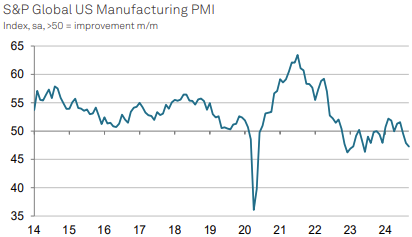
Source: S&P Global PMI. ©2024 S&P Global.
Escalating Middle East tensions pushed oil prices higher following a deadly drone strike on Saudi Aramco's Shaybah facility, renewing inflation concerns and expectations for further Federal Reserve tightening.
Rising oil prices renewed inflation concerns as uncertainty surrounding the US-Iran conflict and continued disruptions in the Strait of Hormuz reinforced expectations for further monetary tightening.
Elevated oil prices and rising Treasury yields weighed on precious metals as persistent geopolitical tensions reinforced inflation concerns and expectations for further Federal Reserve tightening.
Then Join Our Telegram Channel and Subscribe Our Trading Signals Newsletter for Free!
Join Us On Telegram!


