


U.S. inflation showed little change in November, reinforcing expectations that the Federal Reserve can maintain a cautious policy stance into 2026.
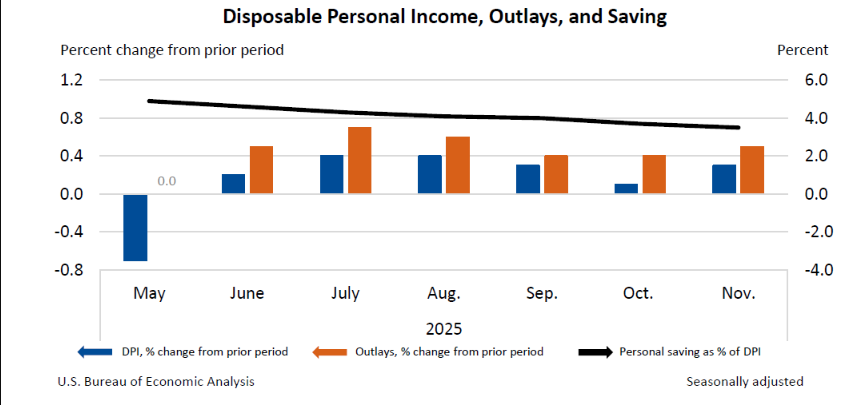
The Personal Consumption Expenditures (PCE) Price Index rose 0.2% month over month, matching October’s pace and market forecasts. The data point to a gradual cooling in price pressures rather than any renewed acceleration.
Underlying inflation trends stayed stable, with the core PCE index, which excludes food and energy, also rising 0.2% on the month. Movements within major categories were mixed:
The increase in energy costs reflected volatility in global energy markets, though it did not alter the broader inflation trend.
On a year-over-year basis, headline PCE inflation edged up to 2.8% from 2.7%, while core PCE also ticked higher to 2.8%, in line with expectations. Although inflation remains above the Fed’s 2% target, the steady pace suggests it is moving in an orderly and predictable range.
With wages, consumer demand, and supply chains showing signs of stabilization, the November report offers reassurance that inflation is neither reaccelerating nor cooling abruptly. Markets are now looking ahead to upcoming Federal Reserve communications for clearer guidance on the timing and direction of future policy decisions.
A deepening sell-off in technology and artificial intelligence stocks pressured financial markets, forcing investors to liquidate precious metals holdings to cover losses elsewhere.
Escalating Middle East tensions pushed oil prices higher following a deadly drone strike on Saudi Aramco's Shaybah facility, renewing inflation concerns and expectations for further Federal Reserve tightening.
Rising oil prices renewed inflation concerns as uncertainty surrounding the US-Iran conflict and continued disruptions in the Strait of Hormuz reinforced expectations for further monetary tightening.
Then Join Our Telegram Channel and Subscribe Our Trading Signals Newsletter for Free!
Join Us On Telegram!


