


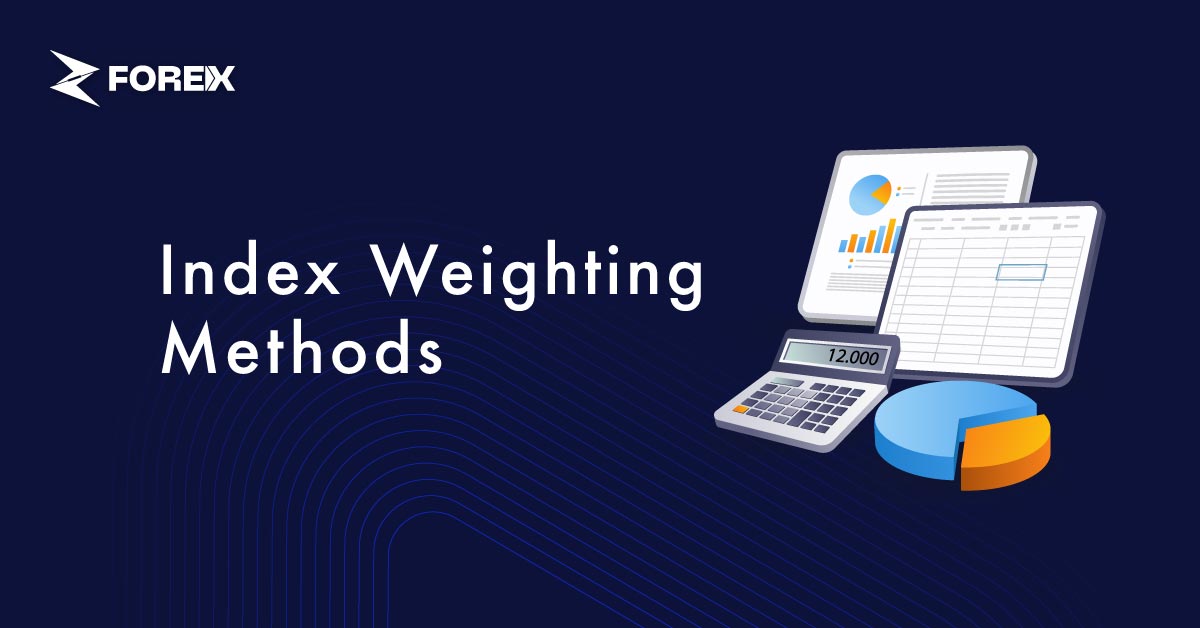
Two indices can track the same stock market and still tell slightly different stories. The reason comes down to how much influence each company has inside the index. Some indices give more weight to stocks with higher prices, while others favor companies with larger market values.
An index may contain dozens or even hundreds of stocks, but they do not always have the same influence. Weight simply shows how much each company contributes to the movement of the index. A stock with a 10% weight will normally have a much bigger impact than one with a 1% weight.
For example, imagine an index where Company A has a 20% weight and Company B has a 5% weight. If both stocks rise by 5%, Company A will have roughly four times more influence on the index.
Now, let’s look at how the weighting methods work in more detail.
A price-weighted index gives more influence on stocks with higher prices. The company with the highest stock price has the largest impact on the index, regardless of whether it is the biggest company by market value.
For example, suppose an index contains three stocks priced at $300, $100, and $20. The $300 stock will carry much more weight than the $20 stock. If the $300 stock rises or falls sharply, it can move the whole index more noticeably.
This is the key idea behind price weighting:
Higher share price = greater influence on the index.
The Dow Jones Industrial Average is the best-known example of a price-weighted index. The Nikkei 225 also uses a price-based weighting approach.
A price-weighted index is calculated by adding the share prices of all companies and dividing the total by an index divisor.
Price-Weighted Index = Sum of Stock Prices ÷ Divisor
If three stocks trade at $300, $100, and $20, their combined price is $420. If we use a simple divisor of 3, the index value would be 140. Real indices such as the Dow use a specially adjusted divisor instead of simply dividing by the number of stocks.
The divisor keeps the index consistent when events such as stock splits, reverse splits, or constituent changes occur. These events can change a stock's quoted price without creating an equivalent change in the company's actual value.
For example, after a 2-for-1 stock split, a $200 share may trade near $100 even though the company's market value has not suddenly fallen by half. The index divisor is adjusted so this mechanical price change does not create an artificial drop in the index.
Price-weighted indices are less common today, but a few major benchmarks still use this approach.
A market-cap-weighted index gives more influence to companies with a larger total market value. Instead of focusing only on the share price, it considers both the stock price and the number of shares outstanding.
Market Capitalization = Share Price × Shares Outstanding
For example, a company with a $100 share price and 100 million shares has a market value of $10 billion. Another company may trade at $500 per share but have only 10 million shares, giving it a market value of $5 billion. In a market-cap-weighted index, the first company would have the larger weight.
A company's weight is calculated by comparing its market capitalization with the combined market capitalization of all companies in the index.
Company Weight = Company Market Cap ÷ Total Index Market Cap
For example:
|
Company |
Share Price |
Shares |
Market Cap |
Index Weight |
|---|---|---|---|---|
| Company A | $300 | 10 million | $3 billion | 13.0% |
| Company B | $100 | 100 million | $10 billion | 43.5% |
| Company C | $20 | 500 million | $10 billion | 43.5% |
Even though Company A has the highest share price, Companies B and C have much larger market values. As a result, they have greater influence on the index.
In practice, many major indices do not use a company’s full market capitalization. Instead, they use free-float market capitalization, which counts only the shares that are readily available for public trading.
Some shares may be held by governments, founders, controlling shareholders, or strategic investors and are not normally traded in the open market. These shares are excluded or reduced when calculating the company’s index weight.
Free-Float Market Cap = Share Price × Publicly Available Shares
If a company has 100 million shares but only 70 million are available to public investors, the index may calculate its weight using those 70 million shares rather than the full amount. This approach helps the index better reflect the portion of the company that investors can trade.
The main difference is simple: price-weighted indices focus on share prices, while market-cap-weighted indices focus on company size.
|
Feature |
Price-Weighted Index |
Market-Cap-Weighted Index |
|---|---|---|
| Weight is based on | Share price | Company market value |
| Higher-priced stocks have more influence | Yes | Not necessarily |
| Larger companies have more influence | Not necessarily | Yes |
| Shares outstanding matter | No | Yes |
| Stock splits can change weighting | Yes | Usually no |
| Common today | Less common | Very common |
| Major example | Dow Jones Industrial Average | S&P 500 |
| Other examples | Nikkei 225, DJTA, DJUA | FTSE 100, DAX, Russell 2000 |
Both weighting methods can work well, but they influence index behavior in different ways.
Price-Weighted Indices
Advantages
Limitations
Market-Cap-Weighted Indices
Advantages
Limitations
Market-cap weighting is much more common and is used by many of the world’s major stock indices.
One stock can move an index more than you might expect if it carries a large weight. In the Dow, higher-priced stocks usually have more influence, while in the S&P 500, the largest companies by market value tend to matter most.
Index breadth can also be misleading. An index may rise even when many of its constituents are falling, simply because a few heavily weighted companies are performing strongly. This is why traders should look beyond the headline index move.
Earnings matter differently for the same reason. A sharp move in a major constituent can pull the whole index higher or lower, while a similar move in a small-weight stock may barely affect it. So, knowing the biggest index weights can be useful before major earnings are released.
Does a higher stock price mean a company has a higher market value?
No. Market value also depends on the number of shares outstanding. A lower-priced stock can represent a much larger company.
Can a stock split change a company’s index weight?
Yes, especially in a price-weighted index. In a market-cap-weighted index, a normal stock split does not change the company’s overall market value.
Why can the Dow rise while the S&P 500 falls?
They use different weighting methods and have different constituents. The stocks driving the Dow may not be the same ones driving the S&P 500.
Can one company have too much influence on an index?
Yes. In market-cap-weighted indices, very large companies can account for a significant share of total index performance.
Is the Nasdaq-100 a standard market-cap-weighted index?
Not exactly. The Nasdaq-100 uses a modified market-cap weighting method, which limits how much influence the largest companies can have.
Sign up in seconds for free, access your platform, and start trading with ease.

 PAMM vs MAM vs Copy Trading: Key Differences
With PAMM, money participates in a managed pool. MAM keeps client accounts separate but gives the manager a central way to trade them. Copy Trading leaves the follower with an independent account and reproduces another trader’s positions there.
Detail What Happens When a Company Joins or Leaves the S&P 500?
How companies join or leave the S&P 500, what happens before and after the change, and the key announcement and effective dates that matter.
Detail What Is PAMM and How Does It Work?
Learn how PAMM accounts work, how profits, losses and manager fees are calculated, and what to check before allocating funds to a trading strategy.
DetailThen Join Our Telegram Channel and Subscribe Our Trading Signals Newsletter for Free!
Join Us On Telegram!


