


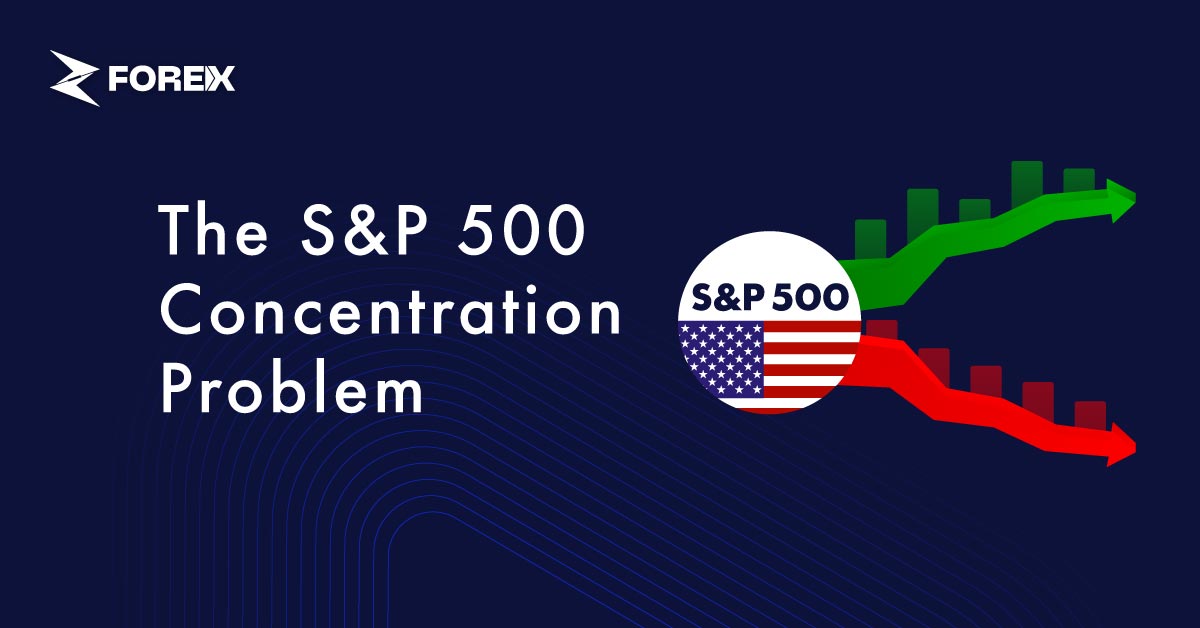
For decades, buying an S&P 500 index fund has been known as the set-it-and-forget-it investment around traders. Ask around, and most people will tell you it is a snapshot of the entire US economy, a massive bucket holding hundreds of companies across every major industry.
On the surface, that sounds exactly right.
The index does technically hold 500 massive corporations, ranging from tech giants and Wall Street banks to healthcare networks, retail chains, and energy suppliers. Because of this massive list, a lot of everyday investors assume their money is spread safely across the board.
But if you peel back the layers, you will find a reality that has become impossible to ignore lately.
The S&P 500 might have 500 names on the roster, but a tiny group of players is pulling almost all the weight. This means the index is not nearly as diversified as advertising makes it seem. Wall Street calls this the concentration problem, and understanding how it works is essential now that a handful of mega-cap companies are completely dominating market returns.
Put simply, the concentration problem is what happens when a few massive companies end up with a disproportionate amount of power over the index.
The S&P 500 uses a market-cap weighting system, meaning a company's size dictates its share of the pie. The bigger a business gets, the more influence it wields over how the index moves.
Most of the time, this setup is brilliant. It naturally lets thriving companies take the driver's seat while struggling businesses quietly shrink into the background. The trouble starts when the top handful of companies grow so large that they dictate the direction of the entire market.
Over the past few years, the biggest technology and communication firms have reached valuations that would have looked like typos a decade ago. Because of this, whether the S&P 500 has a good or bad day often comes down to what just five or ten stocks did, leaving the other 490-plus companies behind.
To see how this plays out, think about two hypothetical companies in the index.
Company A is a tech behemoth worth 3 trillion dollars. Company B is a regional player worth 30 billion dollars. Even if both stocks jump by 10 percent in a single afternoon, their impact on the S&P 500 will not be anywhere close to equal.
The tech giant moves the needle in a massive way because it takes up a huge percentage of the total index. This is not a calculation error or a bug in the system. It is exactly how market-cap weighting was built to behave. The real challenge comes when those massive companies keep outpacing everyone else year after year. Eventually, the index stops reflecting the broader economy and starts reflecting just those few winners.
This conversation has taken off lately because the growth of big tech has been nothing short of historic.
Booming industries like artificial intelligence, cloud computing, chips, and enterprise software have minted a few clear winners. Investors have piled into these names, bidding up their stock prices and inflating their market caps to historic highs.
As a result, a tiny club of stocks now commands a massive chunk of the entire index. We have seen periods where the top ten companies alone made up well over a third of the S&P 500's total value. That kind of top-heavy structure fundamentally changes how the index behaves. When these giants are doing great, the index can hit record highs even if the average business on Main Street is struggling. Flip that script, and a bad week for tech can drag the whole index down, regardless of how healthy the other sectors are.
It is easy for regular investors to overlook this risk because the big 500 number gives a false sense of security. It feels diversified.
But look at it this way. Imagine a college classroom with 500 students, but only ten of them actually determine the final grade for the entire group. On paper, everyone is participating. In reality, a tiny clique decides the outcome. The same thing happens in stock indices. A long list of names does not mean everyone is actually contributing to the gains.
A major point of confusion for a lot of folks is assuming that a rising S&P 500 means the average American business is thriving. That is a dangerous assumption.
There have been plenty of stretches where the S&P 500 notched brand-new records while a huge chunk of its underlying companies were quietly stuck in a slump. Because the mega-cap stocks carry so much weight, a big rally from them can easily mask widespread weakness elsewhere. From a bird's-eye view, everything looks fantastic. However, that’s not always the case. This is why pros look at market breadth to see what is really happening.
Market breadth tells you exactly how many stocks are actually contributing to a market move.
A healthy, sustainable bull market usually looks like a team effort. You want to see big corporations, mid-sized companies, and smaller players all moving up together across various sectors.
When only a few tech giants are charging ahead while the rest of the market lags behind, it raises some red flags. It does not mean a market crash is guaranteed, but it does mean the rally is standing on fewer and fewer pillars. The narrower the support system gets, the more vulnerable the entire market becomes if one of the bigger companies perform a bit worse than usual.
You cannot talk about market concentration without bringing up the Magnificent Seven. This group of tech powerhouses became the dominant story on Wall Street because they single-handedly drove the lion's share of index returns for a while.
This created quite a debate. Bullish investors argued that these companies earned their top spots by generating mind-boggling profits, hoarding cash, and leading the charge on innovation. Skeptics warned that putting too much capital into just a few baskets was a recipe for trouble.
Both sides have a point. These companies grew because they were wildly successful, but their sheer size means the entire stock market is now heavily dependent on their next earnings reports.
While concentration gets a bad rap as a risk factor, it is not all bad news.
One major perk is that the market-cap system automatically funnels your money into the most successful businesses. If you own an S&P 500 fund, you have to ride the massive wave of tech growth without having to manually pick the winners yourself years ago. The index essentially rebalances itself, letting winners run and cutting losers loose, which is exactly why passive investing has worked so incredibly well for decades.
The flip side of that coin is that expectations for these giants are now sky-high.
Wall Street expects perfect earnings, endless expansion, and flawless execution from these market leaders quarter after quarter. If one of them misses a target or gives a weak forecast, the damage does not stay contained to that one stock. Because they are so heavy, a sharp drop in a couple of key names can trigger a rough day for the entire index, making your supposedly diversified portfolio a lot more volatile than you expected.
To get an accurate read on how concentrated the market really is, investors often look at the equal-weight version of the S&P 500.
In an equal-weight index, every single company gets the exact same slice of the pie, whether it is a multi-trillion-dollar tech giant or a smaller utility provider. This view gives you a totally different perspective on performance. When mega-caps are running the show, the equal-weight index usually underperforms. When the broader market finally catches up and leadership spreads out, the equal-weight version takes the lead. Tracking both is a great way to see if a rally is genuine or just a tech-driven illusion.
If you are a long-term investor, this concentration issue is not a reason to panic and dump your S&P 500 funds. The index is still a phenomenal, low-cost wealth builder.
However, you do need to know what you actually own. You are not just buying a balanced slice of corporate America. You are also making a massive, concentrated bet on the continued dominance of a handful of tech executives.
Once you realize that, you can make smarter decisions about your asset allocation. Some investors are perfectly fine with that tech-heavy exposure. Others choose to balance things out by adding specific funds for smaller companies, international markets, or equal-weighted alternatives. There is no single right answer, but flying blind is never a good strategy.
If you look back through financial history, this actually is not a new phenomenon. The market has always had its darlings.
Go back far enough, and railroads controlled the entire market. Later on, energy companies and oil barons held massive sway. Before the 2008 financial crisis, banks were the heavyweights. Today, it just happens to be technology and communication platforms. The names change, but the script stays the same. The market naturally rewards whichever industry is driving the current era of economic growth.
The S&P 500 concentration problem is a great reminder that modern investing requires looking past the headlines. The index is a great tool, and market-cap weighting has made a lot of people rich over the long haul, but a rising index does not automatically mean every sector is doing great.
The goal here isn't to run away from concentration. It is simple to understand. Markets are always evolving, leaders rotate, and new giants will eventually replace the old ones. The S&P 500 has adapted to these shifts for nearly a century. But as long as a few massive companies dominate the landscape, remember that the index headline number is telling a very different story than what the average stock is experiencing underneath. Knowing that difference is what helps you invest with open eyes.
Sign up in seconds for free, access your platform, and start trading with ease.

 PAMM vs MAM vs Copy Trading: Key Differences
With PAMM, money participates in a managed pool. MAM keeps client accounts separate but gives the manager a central way to trade them. Copy Trading leaves the follower with an independent account and reproduces another trader’s positions there.
Detail What Happens When a Company Joins or Leaves the S&P 500?
How companies join or leave the S&P 500, what happens before and after the change, and the key announcement and effective dates that matter.
Detail What Is PAMM and How Does It Work?
Learn how PAMM accounts work, how profits, losses and manager fees are calculated, and what to check before allocating funds to a trading strategy.
DetailThen Join Our Telegram Channel and Subscribe Our Trading Signals Newsletter for Free!
Join Us On Telegram!


