


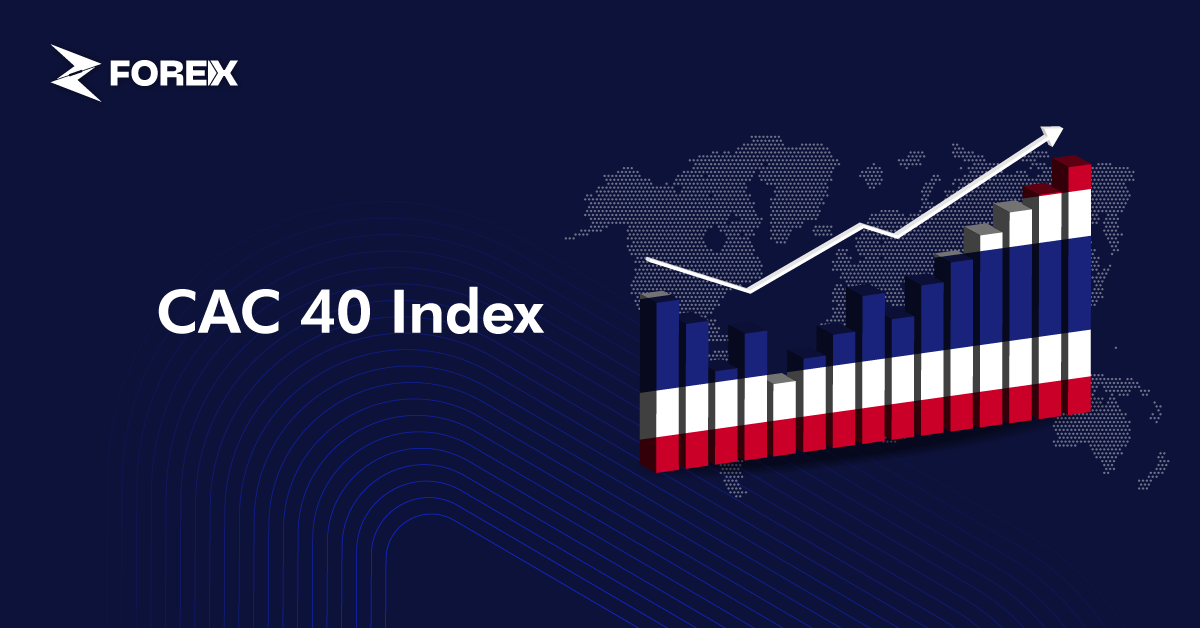
The CAC 40 brings together 40 of the largest companies traded in Paris, spanning luxury, aerospace, banking, energy and healthcare. As France’s main stock index, it includes globally recognized names such as LVMH, Airbus, TotalEnergies and Sanofi.
The companies come from different industries, but many share one important characteristic: their businesses extend far beyond France. Sales in the U.S., Asia and other parts of Europe can have a major influence on their earnings.
This gives the CAC 40 a wider reach than its French label might suggest. On trading platforms, products linked to the index may also appear under names such as France 40 or FRA40.
A company does not get more influence simply because its share price is higher. The CAC 40 uses free-float-adjusted market capitalization, which considers both company size and the proportion of shares available for public trading.
As a result, larger companies with more freely traded shares generally have a greater effect on the index. Individual weights are also capped to prevent one company from becoming too dominant.
The composition is reviewed regularly rather than staying fixed. Companies can enter or leave as their size, trading activity and eligibility change, allowing the CAC 40 to adjust as France’s largest listed businesses develop.
The CAC 40 may contain only 40 stocks, but they represent industries with very different economic drivers. LVMH and Hermès connect the index to global luxury spending, while Airbus and Safran bring exposure to aviation and industrial demand. TotalEnergies adds energy, while financial groups such as BNP Paribas and AXA respond more closely to interest rates and credit conditions.
That mix means the same development can produce very different reactions across the index:
So a strong or weak day for the CAC 40 does not necessarily say much about every company inside it. The sectors carrying the move matter.
The CAC 40 is often mentioned alongside the EURO STOXX 50, but they answer different questions. The CAC 40 focuses on French-listed large companies, while the EURO STOXX 50 combines major companies from across the eurozone.
|
CAC 40 |
EURO STOXX 50 |
|
|---|---|---|
| Companies | 40 | 50 |
| Focus | France | Eurozone |
| Countries represented | Primarily France | Multiple eurozone countries |
| Weighting | Free-float market cap | Free-float market cap |
There is some overlap because major French companies can appear in both. That can cause the two indices to move in similar directions, particularly when large shared constituents or major European sectors are driving trading.
The distinction is still useful: the CAC 40 gives a more concentrated view of France’s largest listed companies, while the EURO STOXX 50 spreads its exposure across the eurozone.
The CAC 40 is associated with France, but the businesses inside it are often far more international than the name suggests. Many of its largest companies sell to customers across North America, Asia and the rest of Europe, making overseas demand a major part of their earnings.
An aircraft manufacturer can depend on orders from airlines around the world, an energy company on global commodity prices, and a luxury group on consumers thousands of kilometres from Paris. This creates an important distinction between where a company is listed and where it actually makes its money.
The result is that the CAC 40 can sometimes move in a very different direction from French economic data. A slowdown at home may have limited impact on a company whose sales are spread across dozens of countries.
Few major indices have the same connection to luxury as the CAC 40. France is home to groups such as LVMH, Hermès and L’Oréal, giving high-end consumer spending a noticeable role in the index.
Their fortunes are tied to a different set of signals from those affecting a typical domestic French business:
This is also why economic developments in Asia can reach the CAC 40 surprisingly quickly. A change in Chinese consumer demand can move some of France’s largest listed companies even when conditions inside France have barely changed.
For companies selling around the world, the euro is more than the currency in which their shares trade. Revenue earned in dollars, yuan or other currencies eventually has to be reported in euros, creating a direct link between exchange rates and company results.
A weaker euro can increase the reported value of foreign earnings and may help some European exporters compete abroad. A stronger euro can work in the opposite direction. But the effect is rarely uniform: companies have different production locations, costs and currency hedges.
ECB policy enters through another route. Changes in interest rates can affect financing costs and valuations, while banks respond to changes in lending conditions and interest margins. The same ECB decision can therefore have very different consequences for a bank, a luxury group and an industrial exporter.
Global exposure does not make domestic developments irrelevant. There are periods when attention shifts firmly back to France, particularly during elections, budget disputes or changes in fiscal policy.
One place this can become visible is the bond market. If concerns about French government finances push sovereign borrowing costs higher, financial conditions can tighten and bank stocks may come under pressure. Political uncertainty can also affect business confidence and expectations for taxes, spending or regulation.
Domestic consumer activity matters as well, although its importance varies considerably across the 40 companies. The CAC 40 therefore sits between two worlds: global businesses can pull it away from the French economy, while politics, fiscal conditions and local financing can bring France sharply back into focus.
Political developments do not affect every CAC 40 company equally, but they can become important when they change expectations for taxes, government spending, regulation or public finances.
French government bonds can be particularly useful in these periods. If political or fiscal concerns push French yields higher relative to other major eurozone bonds, the effects can spread to borrowing costs and financial stocks. Banks may receive more attention because of their exposure to sovereign debt and the domestic economy.
For globally focused companies, the direct impact may be smaller. This is why a political shock can produce a very uneven response across the CAC 40 rather than moving all 40 stocks in the same way.
A rise or fall in the CAC 40 becomes more informative once you know which companies are responsible for it. A rally led by luxury stocks can point to a very different environment from one driven by banks, energy or industrials.
A few comparisons can help when needed. If the CAC 40 moves sharply while the EURO STOXX 50 changes little, the cause may be more specific to France or to sectors with a larger presence in the French index. If both move together, the driver may be broader across eurozone equities.
It can also help to check the euro, French bond yields and major company results rather than reading the index level in isolation. Together, they can provide a clearer explanation for the move.
Because the index combines French conditions with global businesses, there is no single indicator that explains its direction. What deserves attention depends partly on which sectors are carrying the most weight.
Useful areas to follow include:
Exposure is available through products such as ETFs, futures and options. Trading platforms may also use names such as France 40 or FRA40 for instruments linked to CAC 40 movements.
The CAC 40 is highly visible, but 40 companies cannot capture everything happening across French businesses. Smaller listed companies have different financing needs, customer bases and exposure to the domestic economy, none of which may be fully reflected in the headline index.
The same applies to economic performance. A strong CAC 40 does not automatically mean French consumers or businesses are doing well. Global sales from luxury, aerospace, energy or healthcare companies can support the index even when conditions at home are weaker.
That distinction is particularly important with the CAC 40 because some of its most influential companies are also among France’s most international.
The CAC 40 may be France’s headline stock index, but its reach extends well beyond the country. A handbag sold in Shanghai, an aircraft order from the Middle East or a move in the euro can matter alongside French growth and politics.
Following the CAC 40 therefore means looking at both sides of its identity: the French environment in which its companies are listed and the global economy in which many of them actually do business.
Sign up in seconds for free, access your platform, and start trading with ease.

 PAMM vs MAM vs Copy Trading: Key Differences
With PAMM, money participates in a managed pool. MAM keeps client accounts separate but gives the manager a central way to trade them. Copy Trading leaves the follower with an independent account and reproduces another trader’s positions there.
Detail What Happens When a Company Joins or Leaves the S&P 500?
How companies join or leave the S&P 500, what happens before and after the change, and the key announcement and effective dates that matter.
Detail What Is PAMM and How Does It Work?
Learn how PAMM accounts work, how profits, losses and manager fees are calculated, and what to check before allocating funds to a trading strategy.
DetailThen Join Our Telegram Channel and Subscribe Our Trading Signals Newsletter for Free!
Join Us On Telegram!


