


Prices do not always move higher at a steady pace. Sometimes buying accelerates, momentum builds, and an asset climbs quickly. This type of upward move is known as a rally and can occur across almost any financial market. While some rallies mark the beginning of a longer uptrend, others prove short-lived.
A rally is a strong upward move in the price of an asset. It happens when buying pressure becomes stronger than selling pressure. As more buyers enter the market, the price starts moving higher.
A rally can happen in stocks, forex, commodities, indices, or crypto. It can last for a few minutes, several days, or even weeks. The timeframe depends on the market and the trader looking at the chart.
There is no fixed percentage that defines a rally. A 2% rise may be a major move for one asset but normal for another.
It is also important to know that a rally does not always mean a new uptrend has started. Prices can rally for a short period even when the larger market trend is still falling.
Not every price increase is a rally. A single bullish candle or a small rebound is not enough. A rally needs clear buying strength and continued upward movement.
Traders look for several signs:
Not every rally will show all of these signs at once. The key is that buyers have taken control and pushed prices higher with enough strength to stand out from normal day-to-day movements.
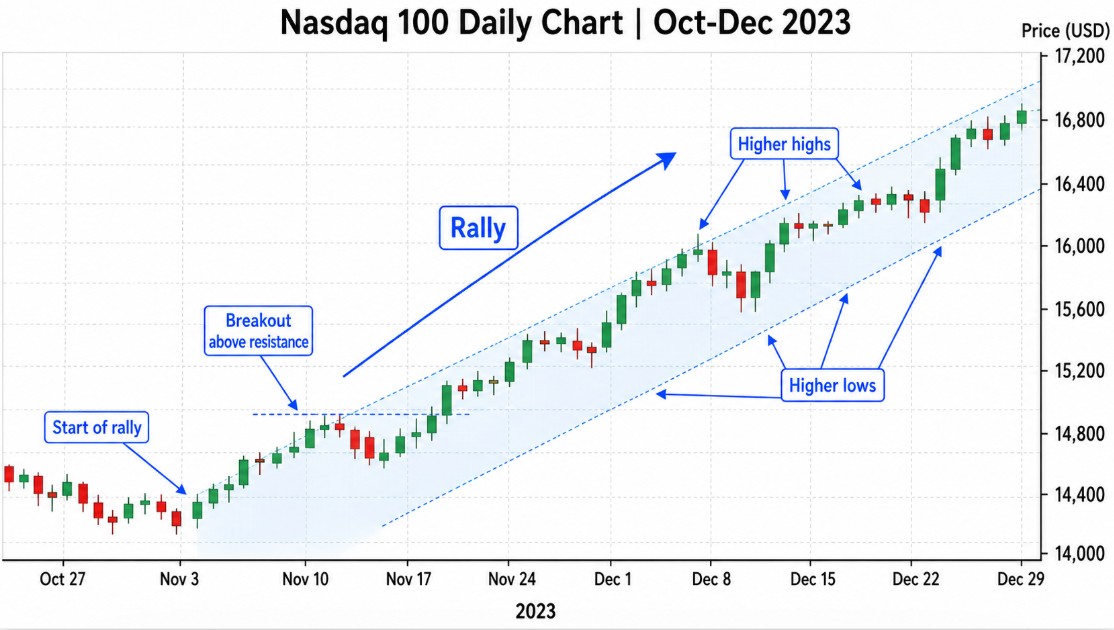
The easiest way to spot a rally is to watch how price behavior changes. The market may move sideways or fall before buyers step in. Then upward momentum starts to build.
A rally becomes clearer when price begins making higher highs. Pullbacks also start forming at higher levels. Bullish candles may become larger and important resistance levels can break.
One strong candle does not make a rally. The real signal comes from the broader price structure, where sustained buying pressure keeps prices moving higher across multiple candles or trading sessions.
A rally starts when buying demand becomes stronger than selling pressure. This can happen for many reasons. Sometimes the trigger is clear news. In other cases, expectations change before the actual event happens.
As a rally gains momentum, buying pressure keeps prices moving higher. Several common signals can help traders recognize when that momentum is holding:
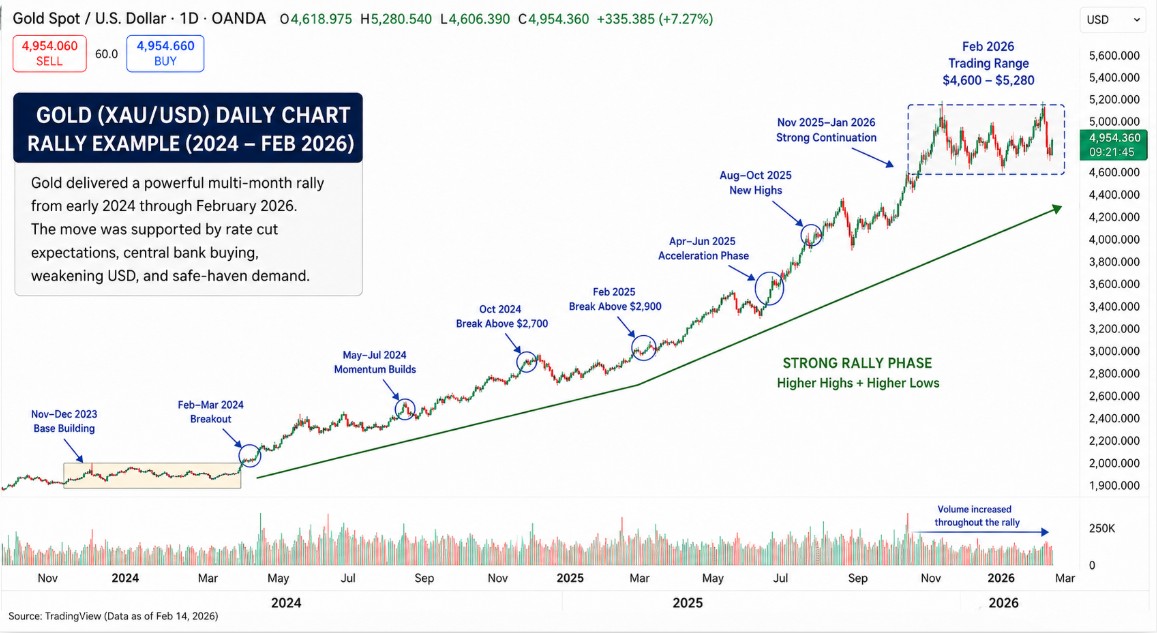
Even the strongest rallies eventually lose some momentum. As the pace slows, the next move comes down to one key question: do buyers still have enough strength to push prices higher?
Step-1: Pullback and Continuation
Price may fall back for a short period before buyers return. If support holds, the rally can continue higher.
Step-2: Consolidation
Price may start moving sideways after a strong rise. This gives the market time to pause before the next larger move.
Step-3: Reversal
If buying pressure fades, sellers may take control. Price can break recent support and begin moving lower.
Step-4: New Uptrend
A rally can also develop into a wider uptrend. This becomes clearer when price keeps forming higher highs and higher lows over time.
No. A rally is a strong upward movement in price. An uptrend is a wider market structure that keeps moving higher over time.
|
Rally |
Uptrend |
|
|---|---|---|
| Basic idea | A strong upward price move | A series of higher highs and higher lows |
| Duration | Can be short or long | Usually lasts longer |
| Structure | May be one strong upward leg | Needs a clear rising structure |
| Can happen in a downtrend? | Yes | Not on the same timeframe |
| What it shows | Buyers are strong for a period | Buyers remain in control over time |
Some rallies develop into lasting uptrends, while others are only temporary bursts of strength. Even a sharp rise can lose momentum and eventually reverse.
A simple way to remember the difference is this: a rally is a move, while an uptrend is a structure.
A rally can create good opportunities, but it can also tempt traders to act too late. The best approach depends on whether you are already in the move or watching from the side.
Imagine EUR/USD has been moving sideways between 1.0800 and 1.0850. Buyers then push price above 1.0850 and the rally begins.
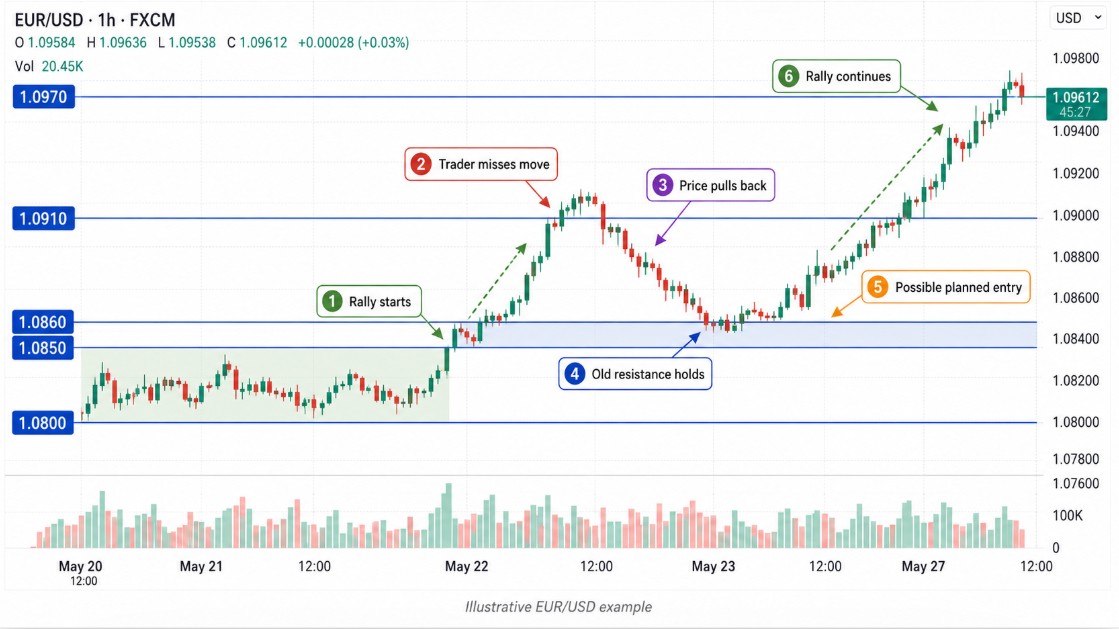
The key lesson is simple. Missing the first move does not mean you need to chase it. A pullback can offer a better place to reassess the rally and plan the trade.
How much does a price need to rise to be called a rally?
There is no fixed percentage. The size of the move depends on the asset, timeframe, and normal volatility.
Can a rally happen without breaking resistance?
Yes. Price can rally toward resistance and still fail there. A breakout simply gives the move stronger confirmation.
Can a rally happen in a downtrend?
Yes. A market can move sharply higher for a short period while the larger trend is still bearish.
Does an overbought RSI mean the rally is finished?
No. RSI can stay overbought during a strong rally. Traders should also watch price structure and support levels.
Can forex traders use volume to confirm a rally?
Yes, but spot forex volume is not centralized. Traders combine tick volume with price action and momentum.
Why can markets rally after bad economic news?
Because traders react to expectations. Weak data may increase hopes for lower interest rates, which can support some markets.
Sign up in seconds for free, access your platform, and start trading with ease.

 PAMM vs MAM vs Copy Trading: Key Differences
With PAMM, money participates in a managed pool. MAM keeps client accounts separate but gives the manager a central way to trade them. Copy Trading leaves the follower with an independent account and reproduces another trader’s positions there.
Detail What Happens When a Company Joins or Leaves the S&P 500?
How companies join or leave the S&P 500, what happens before and after the change, and the key announcement and effective dates that matter.
Detail What Is PAMM and How Does It Work?
Learn how PAMM accounts work, how profits, losses and manager fees are calculated, and what to check before allocating funds to a trading strategy.
DetailThen Join Our Telegram Channel and Subscribe Our Trading Signals Newsletter for Free!
Join Us On Telegram!


