


Some prices simply get more attention than others. EUR/USD at 1.1000, gold at $4,000, or a stock reaching $100 can suddenly become a focal point for traders. These numbers may look arbitrary, but the reactions around them are not always random.
Psychology, order placement, and technical structure can all come together near these levels, turning a simple round number into an area the market starts to respect.
A psychological price level is a price that attracts more attention than the numbers around it. These are usually clean, easy-to-remember values such as 1.1000 in EUR/USD, $100 for a stock, or $4,000 for gold.
There is nothing special built into the number itself. Its importance comes from how traders react to it. Many traders may place entries, profit targets, stop-loss orders, or pending orders around the same area. When enough market participants focus on one price, it can start behaving like support or resistance.
For example, EUR/USD at 1.1000 may receive far more attention than 1.0987. A stock approaching $100 can have the same effect. The level becomes a reference point for traders deciding whether to enter, exit, hold, or wait.
Not every price level has the same weight. Traders usually pay the most attention to major round numbers, while smaller divisions can act as secondary reference points.
In EUR/USD, for example:
The spacing changes from one market to another. Gold traders may focus on prices such as $4,000 or $4,100, while stock traders may watch $50, $100, or $500. What matters is whether the number stands out naturally within that instrument's normal price range.
Round numbers are easy to notice and remember, so traders often use levels like 1.1000, $100, or 5,000 as reference points for entries, exits, and targets.
They can also become psychological anchors. A stock crossing $100, EUR/USD reaching parity at 1.0000, or Bitcoin hitting a major milestone can change how traders view the price.
The number itself is not stronger technically. Its importance comes from the attention and orders it attracts.
Psychological levels can become important when many traders place orders around the same price. Take-profit, stop-loss, limit, and breakout orders can all gather near round numbers and affect price movement.
Imagine EUR/USD is rising toward 1.1000.
Traders who are already long may decide to take profits near this level. Some may place their orders slightly below it, such as 1.0995, expecting others to sell around the same area.
If enough sell orders gather there, the rise may slow before EUR/USD even reaches 1.1000.
Now imagine traders expect 1.1000 to act as resistance and open short positions.
They may place their stop-loss orders just above 1.1000. If the price breaks through the level, those stops are triggered and turn into buy orders.
Breakout traders may also start buying, adding even more demand. This can push the price higher more quickly.
So, a psychological level can slow price before a breakout and strengthen the move after it breaks.
The round number itself is not what moves the price. The orders placed around it are what matter.
A round number can attract attention immediately, but that does not mean every round number will matter to the market. A level becomes more useful when traders have several reasons to watch the same area.
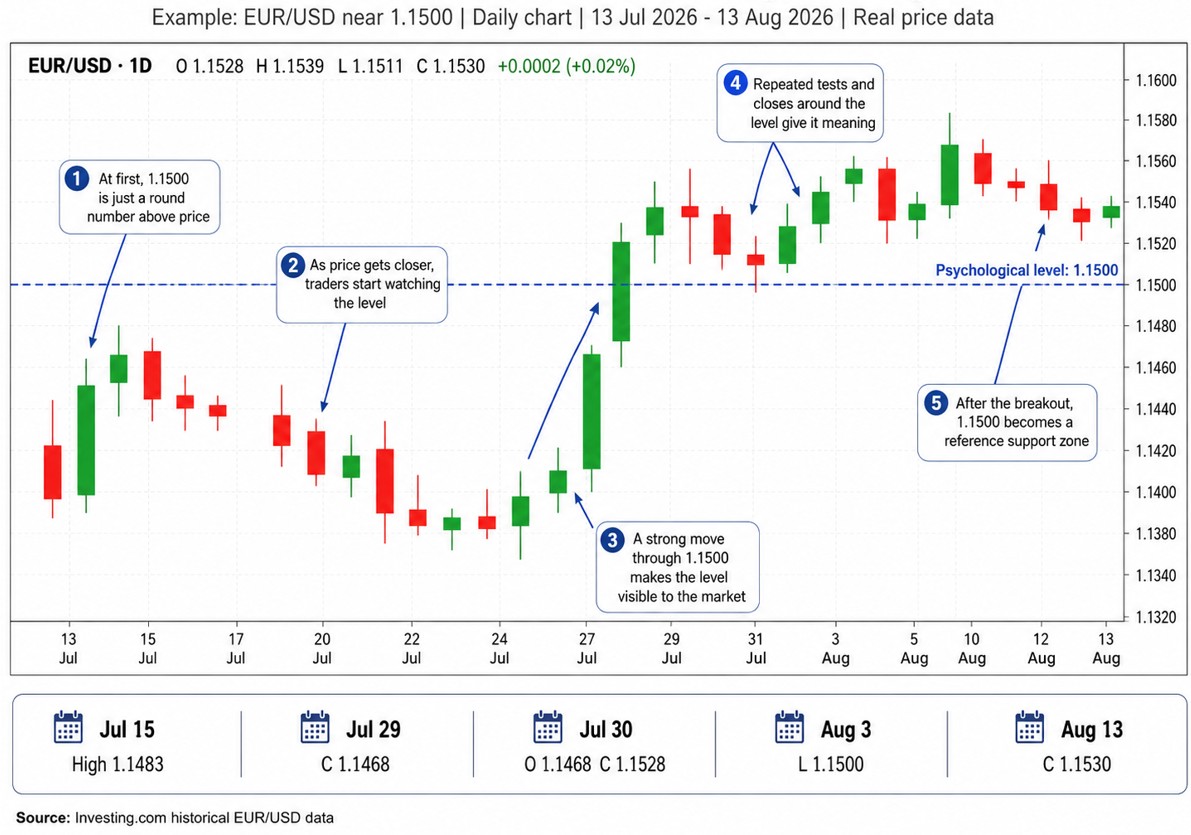
Clean prices naturally stand out on a chart. Levels such as 1.1000 in EUR/USD or $100 in a stock are easier to remember than prices like 1.0973 or $98.46.
This gives the level an initial psychological advantage.
A round number becomes more relevant when price has reacted around it before.
For example, if EUR/USD repeatedly struggles near 1.1000, traders may start treating that area as resistance. Each visible reaction can attract more attention the next time price returns.
Psychological levels become more interesting when they overlap with normal market structure.
Suppose a previous swing high sits near 1.0995 and the major round number is 1.1000. Instead of seeing two separate levels, traders may treat the whole area as a resistance zone.
The round number alone may not be enough. The previous price reaction gives it more technical meaning.
Some prices attract attention simply because they represent an important milestone.
An index reaching 10,000, Bitcoin approaching $100,000, or a currency pair reaching parity can become widely discussed levels. News coverage, analyst commentary, and trader expectations can bring even more attention to the same price.
A psychological level may carry more weight when another technical signal appears in the same area.
This can include:
This overlap is known as confluence. The idea is simple. The more reasons traders have to watch the same area, the greater the chance that meaningful order flow will develop around it.
Still, confluence does not guarantee a reaction. It only gives traders more reason to pay attention when price reaches the level.
Price does not always react exactly when it touches a psychological level. The important part is what happens as the market gets closer to it. Traders begin adjusting positions, placing orders, and deciding whether the level is likely to hold or break.
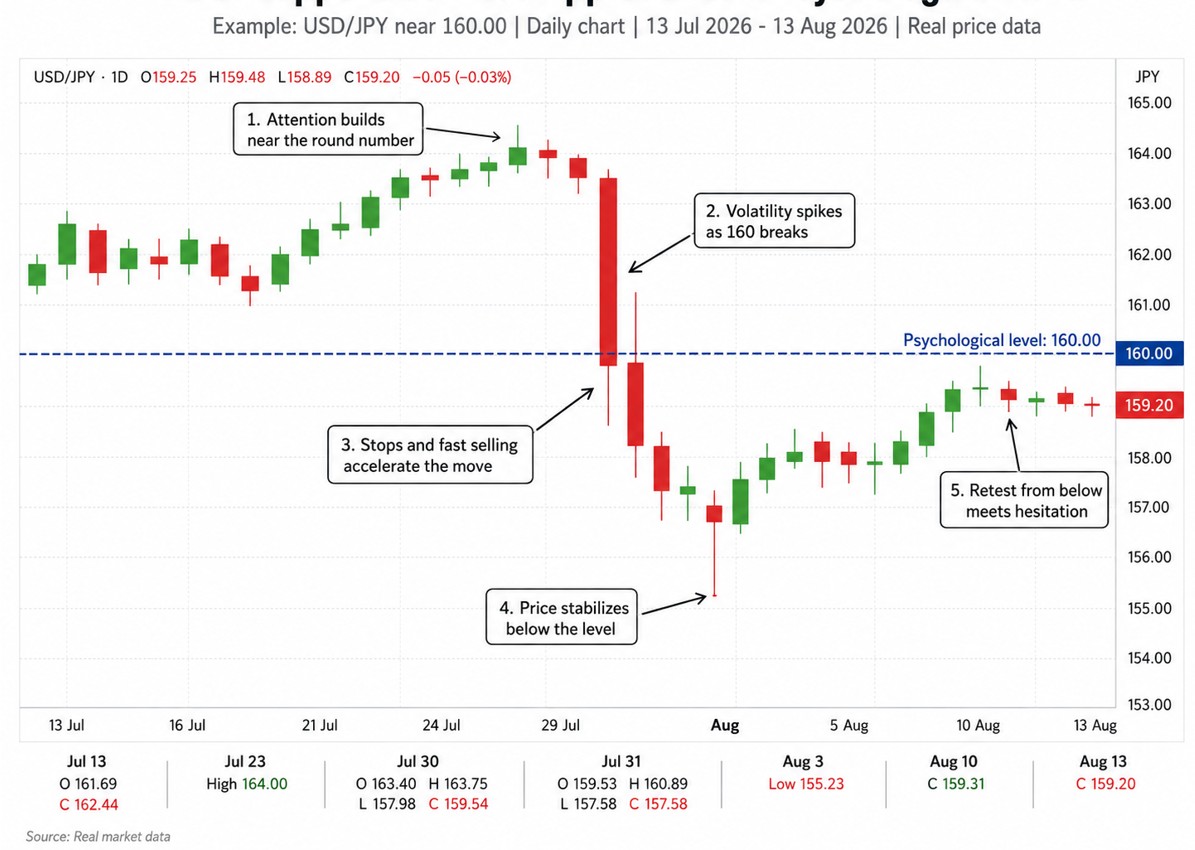
The process can be viewed in four simple stages.
As price moves toward the level, attention starts to build.
Some traders may take profits before reaching it. Others may enter against the move, expecting support or resistance. Breakout traders may wait for price to cross the level before acting.
This can cause momentum to slow even before the exact number is reached.
Once price reaches the area, the market may react in several ways:
This first reaction gives traders more information than the level itself. Simply reaching a psychological price is not a buy or sell signal.
The next question is whether the market can stay beyond the level.
If buyers cannot hold price above resistance, the move may turn into a rejection. If sellers cannot keep price below support, the same can happen in the opposite direction.
A strong move through the area, followed by continued trading beyond it, suggests the level may have failed.
After a breakout, price may return to the psychological level.
For example, resistance at 1.1000 may become support after EUR/USD breaks above it. Traders then watch whether buyers defend the area on the retest.
A successful retest can support the breakout idea. If price quickly moves back through the level, the original break may have been weak or false.
The key is not to predict what the psychological level should do. Watch how price behaves when it gets there.
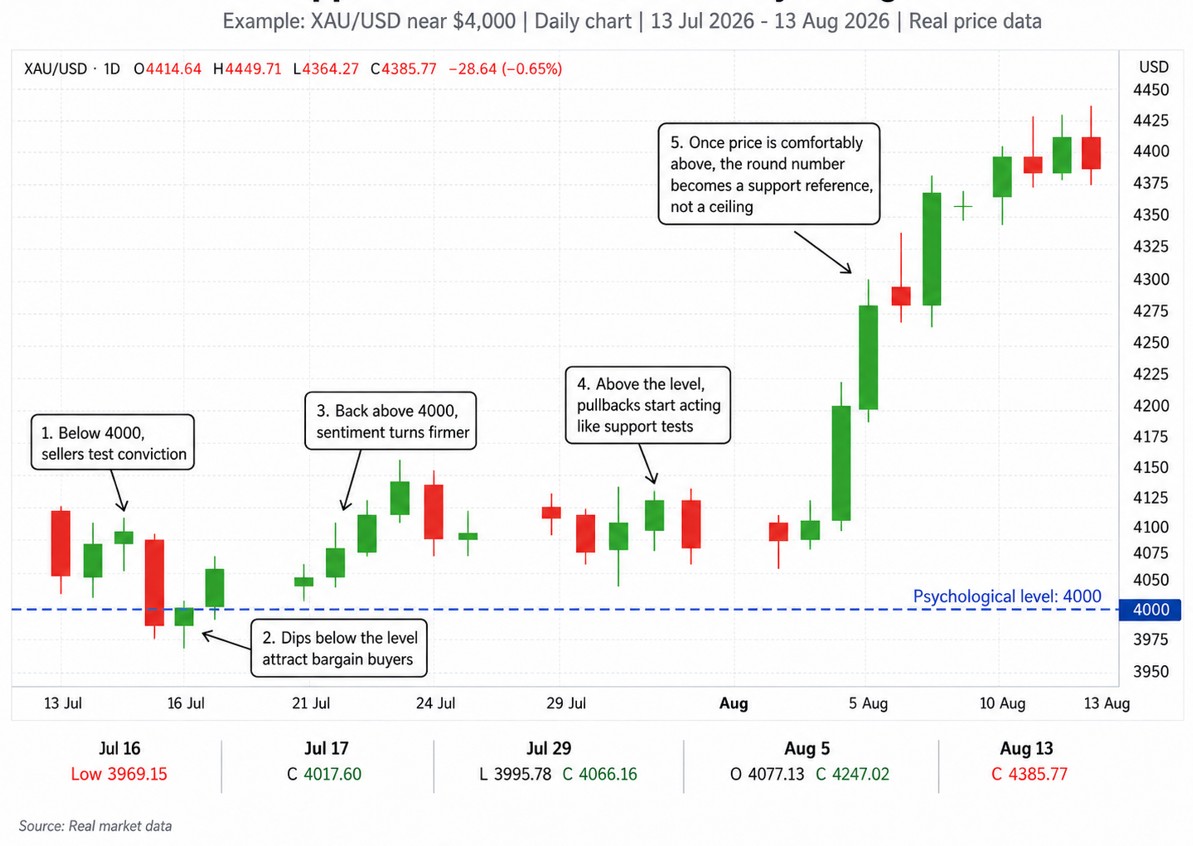
The area around a psychological level can behave differently depending on which side price is coming from. Traders may take profits, place new entries, or trigger stop-loss and breakout orders around the same zone.
|
Price Position |
Common Trader Behavior |
Possible Market Reaction |
|---|---|---|
| Price rises toward a major level from below | Long traders take profit and some sellers enter | Price may slow, stall, or reverse |
| Price breaks above the level | Short stops are triggered and breakout traders may buy | The move can accelerate higher |
| Price falls toward a major level from above | Short traders take profit and some buyers step in | Price may stabilize or bounce |
| Price breaks below the level | Long stops are triggered and breakout traders may sell | The decline can accelerate |
For example, if EUR/USD approaches 1.1000 from below, some traders may see it as resistance and sell near the area. If price breaks above 1.1000 and holds there, those sellers may close their positions while new buyers enter.
The same logic works in reverse when price approaches a psychological level from above.
This is why the level itself is only part of the picture. Traders should also consider which direction price is approaching from and what happens after it crosses the zone.
Psychological levels become more useful when they overlap with other reasons for traders to watch the same area. A round number by itself may cause a reaction, but confluence can make that area more meaningful.
Examples include:
For example, a stock approaching $100 may attract attention simply because it is a clean number. If $100 also lines up with a previous high, traders now have two reasons to watch the same area.
Timeframe also matters. A psychological level that is visible on a daily or four-hour chart will usually attract more attention than a minor round number that only appears relevant on a one-minute chart.
The main idea is simple: the level becomes more interesting when psychology and market structure point to the same area. It still does not guarantee a reversal or breakout, but it gives traders a stronger reason to watch the price reaction closely.
Are psychological levels the same as support and resistance?
Not exactly. A psychological level is based on attention around certain prices. It can become support or resistance if price repeatedly reacts there.
Why does price sometimes reverse before reaching a round number?
Some traders place take-profit or limit orders slightly before the obvious level. This can create buying or selling pressure before price reaches the exact number.
Should I place my stop-loss just beyond a psychological level?
Not automatically. Stops should be based on where your trade idea becomes invalid, not simply a fixed distance beyond a round number.
Do psychological levels work in forex, stocks, gold, and crypto?
Yes. Round-number clustering can appear across different markets, but the important price increments vary by instrument.
Are psychological levels reliable enough to trade on their own?
Usually not. They work better as areas to watch alongside market structure, price action, trend direction, and other forms of confirmation.
Sign up in seconds for free, access your platform, and start trading with ease.

 PAMM vs MAM vs Copy Trading: Key Differences
With PAMM, money participates in a managed pool. MAM keeps client accounts separate but gives the manager a central way to trade them. Copy Trading leaves the follower with an independent account and reproduces another trader’s positions there.
Detail What Happens When a Company Joins or Leaves the S&P 500?
How companies join or leave the S&P 500, what happens before and after the change, and the key announcement and effective dates that matter.
Detail What Is PAMM and How Does It Work?
Learn how PAMM accounts work, how profits, losses and manager fees are calculated, and what to check before allocating funds to a trading strategy.
DetailThen Join Our Telegram Channel and Subscribe Our Trading Signals Newsletter for Free!
Join Us On Telegram!


