


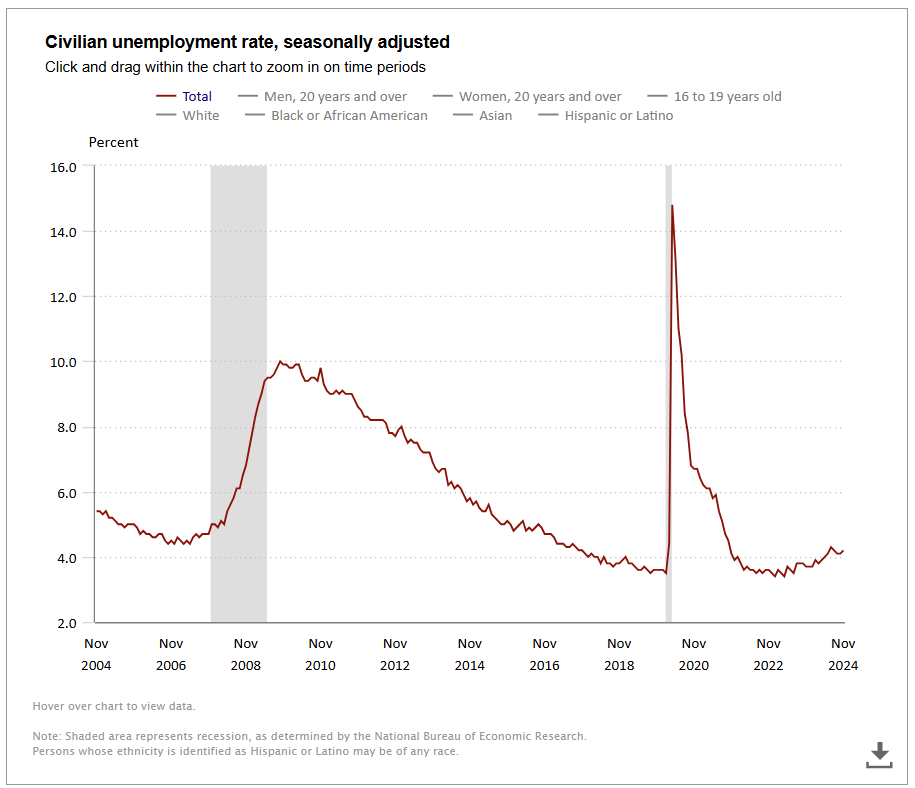
In November 2024, the U.S. economy added 227,000 jobs, while the unemployment rate remained largely unchanged at 4.2%, according to the U.S. Bureau of Labor Statistics.
In November 2024, the U.S. economy added 227,000 jobs, while the unemployment rate remained largely unchanged at 4.2%, according to the U.S. Bureau of Labor Statistics. Job growth was concentrated in healthcare, leisure and hospitality, government, and social assistance, offset by losses in retail trade.
The unemployment rate held steady at 4.2%, with 7.1 million unemployed individuals. These figures reflect little change from October but are higher than a year ago when the unemployment rate stood at 3.7% with 6.3 million unemployed.
The labor force participation rate remained stable at 62.5%, and the employment-population ratio dipped slightly to 59.8%. Among major demographic groups, unemployment rates showed minimal movement, with the rate for Black workers rising slightly to 6.4%, while rates for Whites, Asians, Hispanics, and others remained steady.
Long-term unemployment remained unchanged at 1.7 million, accounting for 23.2% of total unemployment. The number of part-time workers seeking full-time jobs was also stable at 4.5 million, an increase from 4.0 million a year earlier.
The establishment survey revealed notable sectoral job changes in November:
Other industries, including mining, construction, wholesale trade, and financial services, showed little or no employment change.
Average hourly earnings for private nonfarm payroll employees rose by 13 cents, or 0.4%, to $35.61, representing a 4.0% yearly increase. Wages for production and nonsupervisory employees increased by 9 cents, or 0.3%, to $30.57.
The average workweek for private nonfarm employees rose by 0.1 hours to 34.3 hours. Manufacturing employees worked an unchanged average of 40.0 hours, while overtime edged up to 2.9 hours.
Revised data showed employment increases for September and October, with 32,000 more jobs in September (from 223,000 to 255,000) and 24,000 additional jobs in October (from 12,000 to 36,000). These adjustments resulted in a combined upward revision of 56,000 jobs for the two months.
The November report indicates continued resilience in the U.S. labor market, with steady job creation across key sectors despite pockets of weakness in retail trade.
Source: U.S. Bureau of Labor Statistics
Kenaikan harga minyak memicu kembali kekhawatiran akan inflasi, sementara ketidakpastian seputar konflik AS-Iran serta gangguan yang terus berlanjut di Selat Hormuz memperkuat ekspektasi akan pengetatan kebijakan moneter lebih lanjut.
Detail Harga Minyak dan Ekspektasi Kenaikan Suku Bunga The Fed Berikan Tekanan pada Logam (20/10/2026)Harga minyak yang tinggi serta imbal hasil obligasi pemerintah (Treasury) yang meningkat memberikan tekanan pada logam mulia, di tengah ketegangan geopolitik yang terus berlanjut yang memperkuat kekhawatiran akan inflasi dan ekspektasi pengetatan kebijakan lebih lanjut oleh Federal Reserve.
Detail Waktu Musim Panas Eropa (25 Oktober 2026)
Kami ingin menginformasikan mengenai penyesuaian jadwal perdagangan untuk instrumen-instrumen tertentu sehubungan dengan berakhirnya masa *Daylight Saving Time* (DST) di Eropa pada tanggal 25 Oktober 2026.
DetailBergabunglah dengan Channel Telegram Kami dan Berlangganan Sinyal Trading Kami secara Gratis!
Bergabunglah dengan Telegram!


