


The euro advanced near $1.12 as the dollar softened, even as ECB rate cut bets remained firmly priced in. The yen strengthened for a fourth straight day despite a contraction in Japan’s Q1 GDP.
Gold hovered around $3,220, pressured by improved risk appetite. The pound climbed past $1.33 after strong UK GDP figures, while silver dipped to $32.50 amid reports of new U.S. sanctions on Chinese semiconductor firms, weakening its industrial demand outlook.
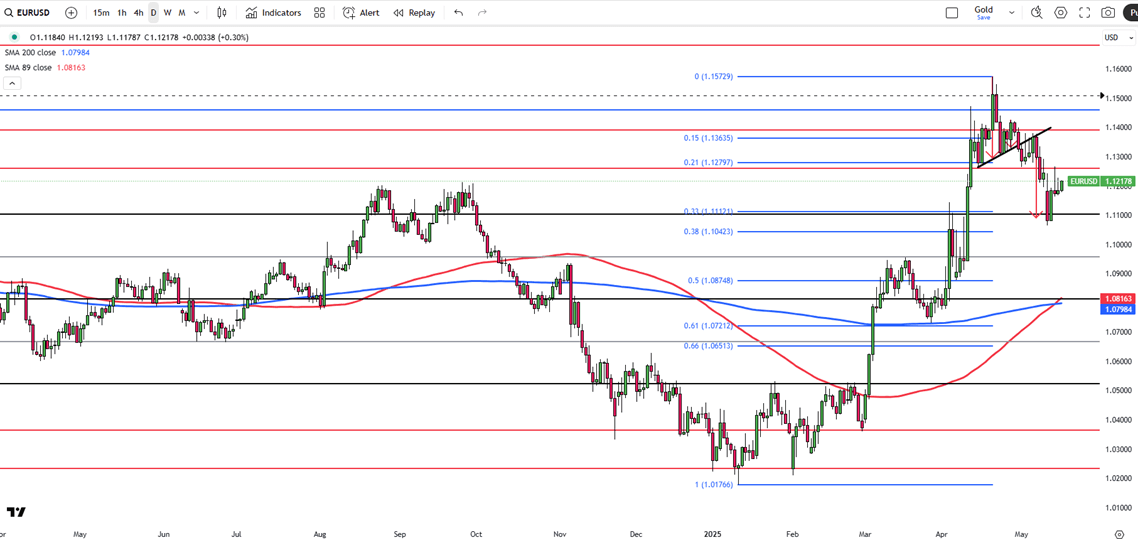
The euro rose to $1.12 on Friday, supported by a softer U.S. dollar following weaker inflation data and lingering caution around U.S.-China trade developments. Although a 90-day tariff truce was reached, U.S. tariffs on Chinese goods remain elevated at around 40%, maintaining trade friction. Meanwhile, the market is nearly fully pricing in a European Central Bank rate cut in June, with expectations of the deposit rate falling to 1.79% by year-end. ECB policymakers have signaled further easing may be needed as inflation trends toward the 2% target.
EUR/USD now faces resistance at 1.1260, with additional levels at 1.1460 and 1.1580. On the downside, initial support is seen at 1.1040, followed by 1.1000 and 1.0960.
| R1: 1.1260 | S1: 1.1040 |
| R2: 1.1460 | S2: 1.1000 |
| R3: 1.1580 | S3: 1.0960 |
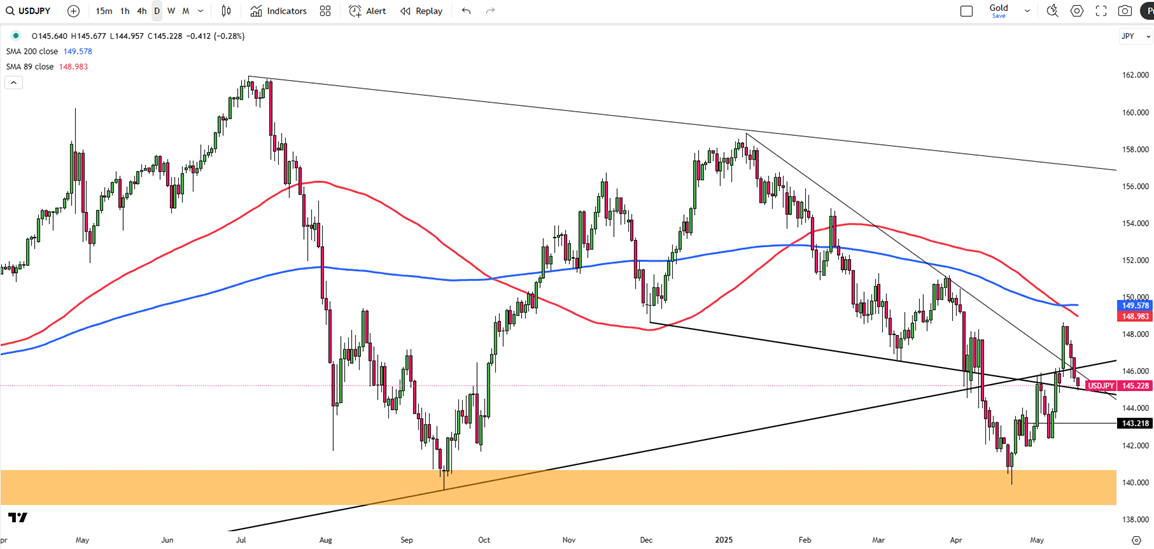
The Japanese yen strengthened toward 145 per dollar, extending its rally for a fourth straight day, despite Japan’s economy shrinking by 0.2% in the first quarter, worse than forecasts. While the Bank of Japan acknowledged the risks posed by U.S. trade policies, it remains confident that rising wages and prices will support eventual policy normalization. Investors are closely watching U.S.-Japan trade negotiations, with Japan insisting that any deal must include the auto sector and that the 25% U.S. tariff on Japanese cars be removed.
Resistance is noted at 148.60, with further barriers at 149.80 and 151.20. Major support levels lie at 139.70, 137.00, and 135.00.
| R1: 148.60 | S1: 139.70 |
| R2: 149.80 | S2: 137.00 |
| R3: 151.20 | S3: 135.00 |
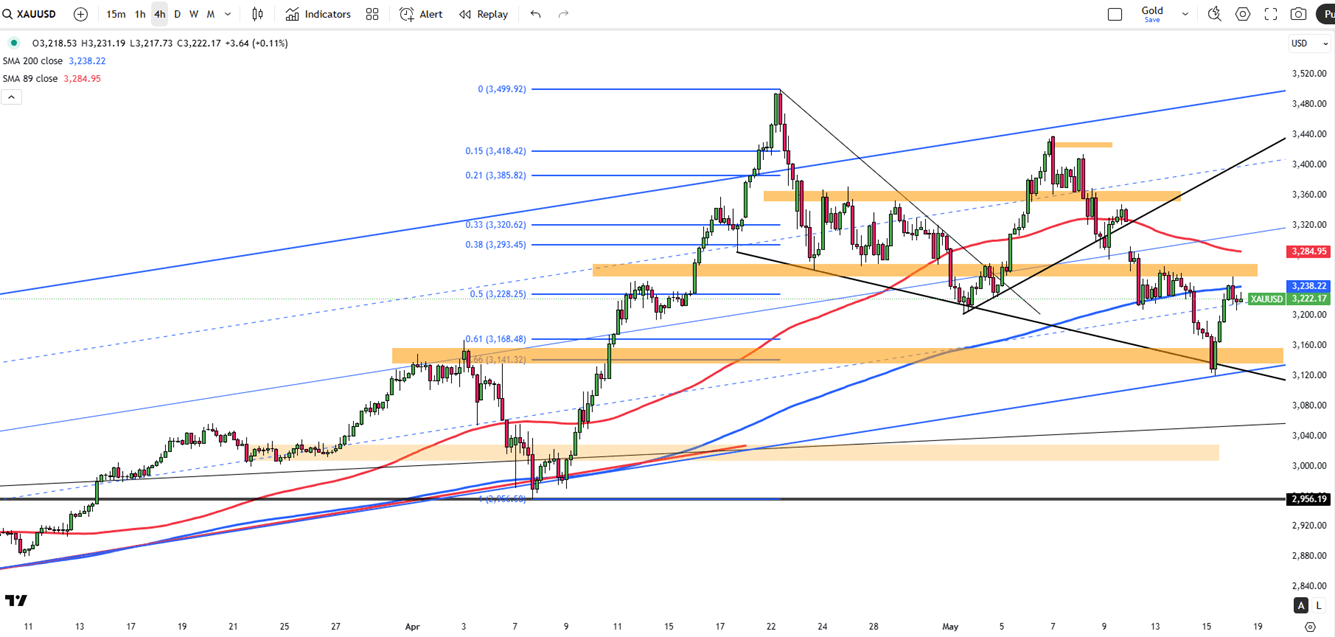
Gold fell to approximately $3,220 per ounce, on track for a weekly loss of more than 3% as appetite for the precious metal diminished with easing global trade tensions. The 90-day tariff truce between the U.S. and China reduced fears of a drawn-out trade war, while geopolitical concerns also eased with a stable India-Pakistan ceasefire.
Talks between Russia and Ukraine are losing momentum. Although soft U.S. inflation data has reinforced expectations for at least two Federal Reserve rate cuts this year, Fed Chair Powell cautioned that future inflation may be volatile due to persistent supply shocks.
Key support is located at $3,120, followed by $3,030 and $2,956. Resistance levels are seen at $3,250, then $3,300 and $3,350.
| R1: 3250 | S1: 3120 |
| R2: 3300 | S2: 3030 |
| R3: 3350 | S3: 2956 |
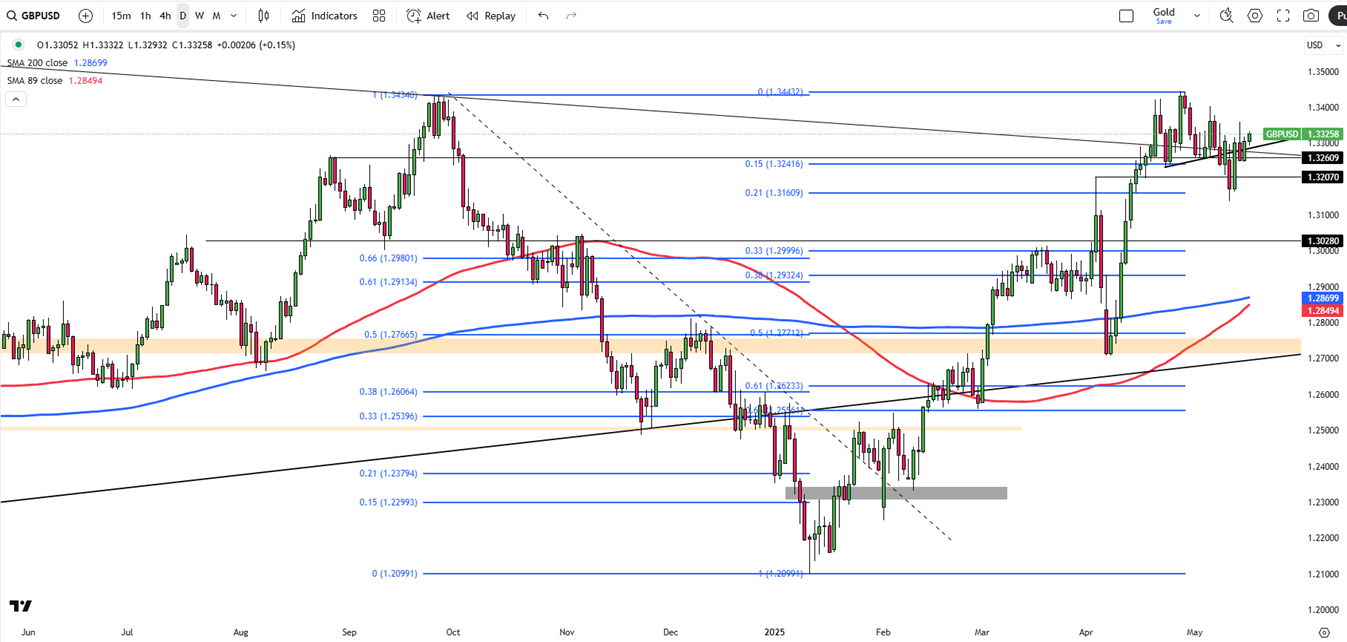
The British pound climbed to $1.3320 on Friday after strong UK GDP data showed the economy grew 0.7% in Q1 and 1.3% year-over-year, easing pressure on the Bank of England to cut rates aggressively. While a cut is still likely, the solid growth figures suggest urgency has diminished. At the same time, a softer U.S. dollar, driven by speculation that the U.S. may be allowing depreciation to support exports, has supported sterling. However, the UK’s broader outlook remains mixed, with rising unemployment and slowing wage growth signaling uneven momentum.
GBP/USD faces resistance at 1.3350, with additional levels at 1.3450 and 1.3550. Support levels are at 1.3160, 1.3000, and 1.2960.
| R1: 1.3350 | S1: 1.3160 |
| R2: 1.3450 | S2: 1.3000 |
| R3: 1.3550 | S3: 1.2960 |
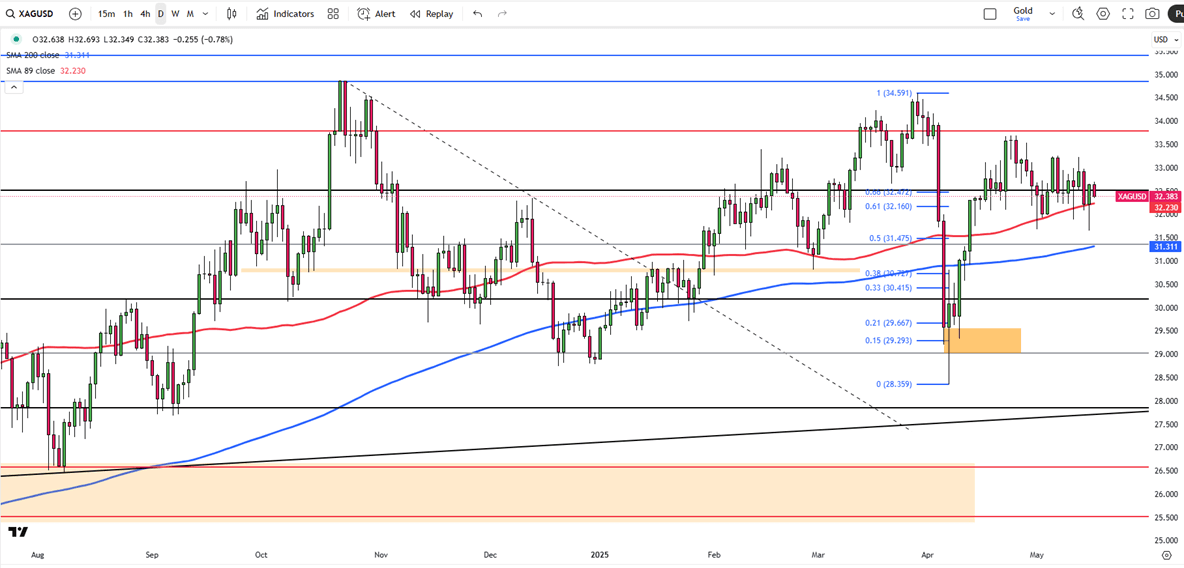
Silver pulled back to around $32.50 in Friday’s Asian session, giving up part of its recent gains following reports that the U.S. plans to blacklist several Chinese semiconductor firms. Given silver’s integral role in electronics and chip manufacturing, the news weighed on sentiment.
Demand for precious metals has also weakened with easing trade tensions, as the U.S. and China agreed to reduce tariffs, cutting U.S. duties from 145% to 30% and China’s from 125% to 10%. Despite this, silver found support from a weakening U.S. dollar, which followed soft economic data reinforcing expectations for Federal Reserve rate cuts. Powell, however, warned that persistent supply shocks could complicate inflation control moving forward.
Resistance begins at $32.50, with further levels at $33.80 and $34.20. Support is seen at $31.40, followed by $30.20 and $29.80.
| R1: 32.50 | S1: 31.40 |
| R2: 33.80 | S2: 30.20 |
| R3: 34.20 | S3: 29.80 |
Meningkatnya ketegangan di Timur Tengah mendorong kenaikan harga minyak menyusul serangan pesawat nirawak yang mematikan terhadap fasilitas Shaybah milik Saudi Aramco, sehingga memicu kembali kekhawatiran akan inflasi serta ekspektasi terhadap pengetatan kebijakan lebih lanjut oleh Federal Reserve.
Detail Risiko Inflasi Kembali Muncul Seiring Naiknya Harga Minyak (21/10/2026)Kenaikan harga minyak memicu kembali kekhawatiran akan inflasi, sementara ketidakpastian seputar konflik AS-Iran serta gangguan yang terus berlanjut di Selat Hormuz memperkuat ekspektasi akan pengetatan kebijakan moneter lebih lanjut.
Detail Harga Minyak dan Ekspektasi Kenaikan Suku Bunga The Fed Berikan Tekanan pada Logam (20/10/2026)Harga minyak yang tinggi serta imbal hasil obligasi pemerintah (Treasury) yang meningkat memberikan tekanan pada logam mulia, di tengah ketegangan geopolitik yang terus berlanjut yang memperkuat kekhawatiran akan inflasi dan ekspektasi pengetatan kebijakan lebih lanjut oleh Federal Reserve.
DetailBergabunglah dengan Channel Telegram Kami dan Berlangganan Sinyal Trading Kami secara Gratis!
Bergabunglah dengan Telegram!


