


The European Central Bank kept its policy settings unchanged in March, but the message carried more weight than the decision itself.
The European Central Bank kept its policy settings unchanged in March, but the message carried more weight than the decision itself. The main rate stands at 2.15%, the deposit rate at 2.00%, and the marginal lending facility at 2.40%. Stability in rates, however, contrasts with a shifting economic backdrop.
The conflict in the Middle East is now feeding directly into the ECB’s outlook. Rising energy costs are adding upward pressure on prices, while at the same time weakening growth dynamics across the region. This combination is challenging to manage, as inflation risks and growth concerns influence each other in opposing ways.
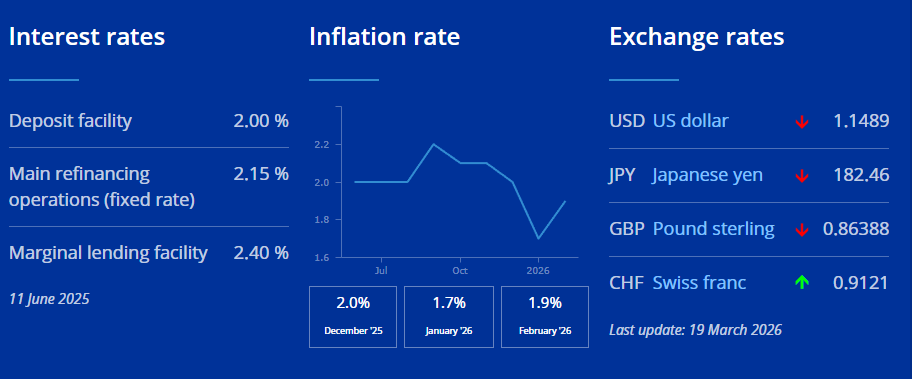
The ECB now sees inflation reaching 2.6% in 2026, before easing toward 2.0% in 2027 and stabilizing near 2.1% in 2028. Core inflation was also revised higher, reinforcing the idea that price pressures are proving more persistent than previously expected. Economic expansion is predicted to remain modest. The Eurozone is projected to grow by 0.9% in 2026, followed by 1.3% in 2027 and 1.4% in 2028. Higher commodity costs, reduced purchasing power, and weaker confidence are all contributing to a slower trajectory.
The ECB now finds itself walking a narrow path. Energy-driven inflation keeps price risks alive, while the same forces weigh on economic activity. With no clear resolution in sight, decisions are likely to remain data-driven and assessed meeting by meeting, leaving the policy path open and the outlook uncertain.
A deepening sell-off in technology and artificial intelligence stocks pressured financial markets, forcing investors to liquidate precious metals holdings to cover losses elsewhere.
Escalating Middle East tensions pushed oil prices higher following a deadly drone strike on Saudi Aramco's Shaybah facility, renewing inflation concerns and expectations for further Federal Reserve tightening.
Rising oil prices renewed inflation concerns as uncertainty surrounding the US-Iran conflict and continued disruptions in the Strait of Hormuz reinforced expectations for further monetary tightening.
Then Join Our Telegram Channel and Subscribe Our Trading Signals Newsletter for Free!
Join Us On Telegram!


