


The Institute for Supply Management® (ISM®) reported that the Manufacturing PMI® for May 2025 declined slightly to 48.5%, compared to 48.7% in April.
This marks another month of contraction in U.S. manufacturing, although the broader economy continued to expand for the 61st consecutive month. A reading above 42.3% typically signals overall economic growth, suggesting that the current decline remains confined largely to the manufacturing sector.
Susan Spence noted that while demand remains weak, there are early signs of stabilization, especially in new orders and backlogs. However, export demand declined further, and customer inventories are still too low, which could encourage higher production in the near term.
Production continues to contract, but the decline has moderated compared to April. Employment remains soft, with layoffs persisting as companies avoid natural attrition. Inputs including inventories and imports softened further amid trade disruptions and post-tariff adjustments. Prices remain elevated, although the pace of increases has moderated.
Industries Reporting Expansion (7 total):
Industries Reporting Contraction (7 total):
The May 2025 ISM report reflects a broad but mixed picture for the U.S. manufacturing sector. While contraction persists, the pace has moderated in some areas, hinting that the worst of the downturn may be easing. Persistent challenges remain, particularly on the input side and in global trade, but modest improvements in orders and sector breadth offer some cautious optimism.
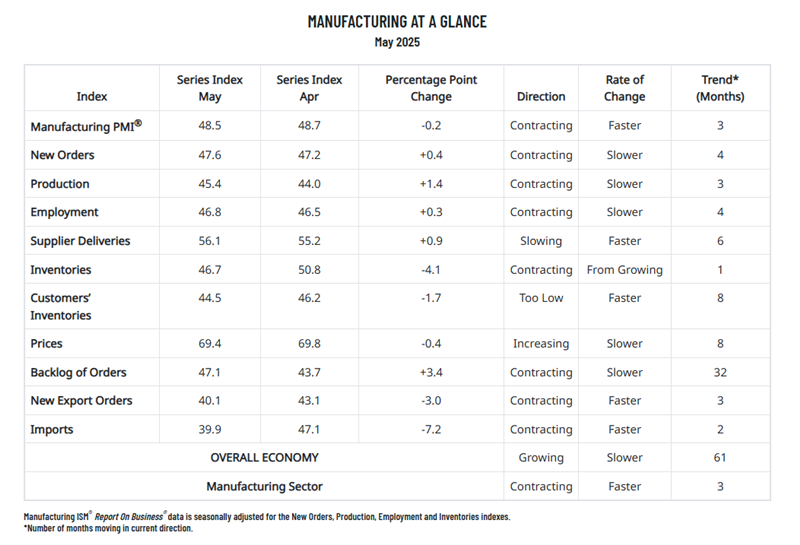
Source: ISM
Escalating Middle East tensions pushed oil prices higher following a deadly drone strike on Saudi Aramco's Shaybah facility, renewing inflation concerns and expectations for further Federal Reserve tightening.
Rising oil prices renewed inflation concerns as uncertainty surrounding the US-Iran conflict and continued disruptions in the Strait of Hormuz reinforced expectations for further monetary tightening.
Elevated oil prices and rising Treasury yields weighed on precious metals as persistent geopolitical tensions reinforced inflation concerns and expectations for further Federal Reserve tightening.
Then Join Our Telegram Channel and Subscribe Our Trading Signals Newsletter for Free!
Join Us On Telegram!


