


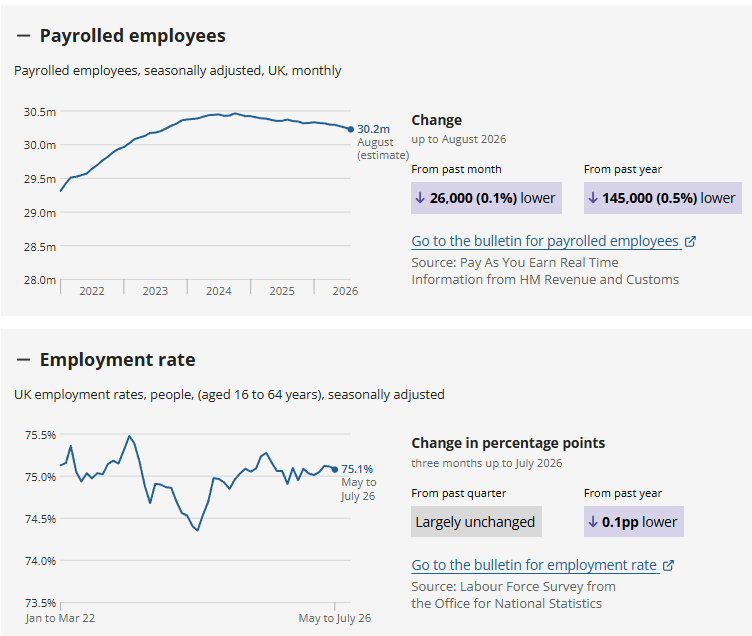
The UK labor market continued to weaken in August 2026, with payroll employment declining for a seventh consecutive month. The number of payrolled employees fell by 26,000 from July to 30.2 million, marking the largest monthly decline since November 2025.
Compared with August last year, payroll employment decreased by 145,000, or around 0.5%. However, employment trends varied considerably across sectors.
Wholesale and retail trade recorded the largest annual decline, losing 76,000 jobs, while administrative and support services added 72,000 employees.
Regional differences were also significant. Payroll employment fell by around 2% in Camden and the City of London, while the Causeway Coast and Glens region recorded growth of 1.1%.
Despite weaker employment, wages continued to rise. Median monthly pay increased 3.5% year-on-year to £2,657. Construction recorded the strongest wage growth at 5.5%, while median earnings in education declined by 0.4%.
Seven consecutive months of falling payroll employment could raise concerns about the outlook for UK economic growth and household spending.
At the same time, continued wage increases remain relevant for inflation. This leaves the Bank of England facing competing signals, with persistent wage pressures supporting caution on inflation while weakening employment could limit the case for further monetary tightening. Labor market developments will therefore remain an important factor in upcoming BoE interest rate decisions.
Energy markets cooled on Monday as Brent crude slipped toward $103 a barrel, ending a two-session rally. Declining oil prices and easing Treasury yields provided support to major currencies and precious metals as investors awaited upcoming US inflation data.
 Dollar Keeps Firm Ahead of US Inflation (12 – 16 October)
The dollar held firm heading into the new week as investors awaited key US inflation figures to guide Federal Reserve policy. The Dollar Index held above 102 after four consecutive weekly gains, while the euro and yen remained under pressure from wide interest rate differentials and persistent fiscal concerns. September’s consumer and producer inflation reports will be closely watched as markets assess whether the Fed has room to pause its tightening cycle.
Detail Falling Yields Lift Metals as Currencies Stabilize (10.09.2026)Easing oil prices and retreating Treasury yields (around 5.23% ) provided some relief to financial markets as improving US-Iran diplomatic prospects reduced immediate inflation concerns.
Then Join Our Telegram Channel and Subscribe Our Trading Signals Newsletter for Free!
Join Us On Telegram!


