


The latest US economic figures show stronger growth alongside sticky inflation, presenting a difficult policy environment for the Federal Reserve. While economic activity remains resilient, underlying price pressures continue to exceed the central bank’s 2% target.
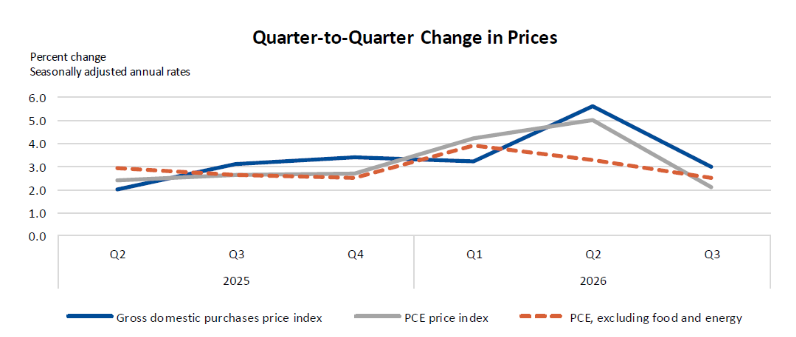
The Fed’s preferred inflation measure, the core Personal Consumption Expenditures (PCE) price index, increased 0.3% in September, matching expectations. On an annual basis, core inflation accelerated to 3.1% from 3.0%, exceeding forecasts.
Headline PCE inflation rose 0.5% monthly and 3.6% annually, reflecting continued price pressures across the economy.
Personal income increased 0.2%, while nominal consumer spending advanced 0.5%. However, inflation-adjusted consumption remained nearly unchanged, suggesting that higher prices accounted for much of the increase in household expenditure.
US real GDP expanded at an annualized 3.4% in the third quarter, surpassing the 3.2% market forecast and accelerating from 2.2% in the previous quarter.
Consumer spending, investment and government expenditure supported growth, although weaker exports partially offset these gains.
Meanwhile, real final sales to private domestic purchasers increased 4.9%, indicating that underlying demand from households and businesses remained strong.
The combination of strong economic growth and persistent inflation complicates the Fed’s next steps.
Although the quarterly GDP report indicated some moderation in the annualized PCE price index, September’s monthly figures suggest that underlying inflation has not eased sufficiently.
With economic activity exceeding expectations and core inflation remaining above target, policymakers have less reason to pursue immediate monetary easing.
The latest figures could therefore reinforce the Fed’s cautious, data-dependent approach, keeping expectations for near-term interest rate cuts limited.
Precious metals faced heavy selling pressure as a stronger US dollar, hawkish Federal Reserve expectations, and an AI-driven equity market sell-off triggered widespread liquidation.
The US dollar extended its strength as the October FOMC minutes reinforced expectations for further Federal Reserve rate hikes, putting additional pressure on major currencies and precious metals.
The US dollar remained firm as hawkish Federal Reserve commentary pushed expectations for a December rate hike higher, with markets pricing a 96% probability of a quarter-point increase.
DetailThen Join Our Telegram Channel and Subscribe Our Trading Signals Newsletter for Free!
Join Us On Telegram!


