


Markets are almost fully pricing in another Federal Reserve rate cut this week, yet the US bond market continues to move in the opposite direction.
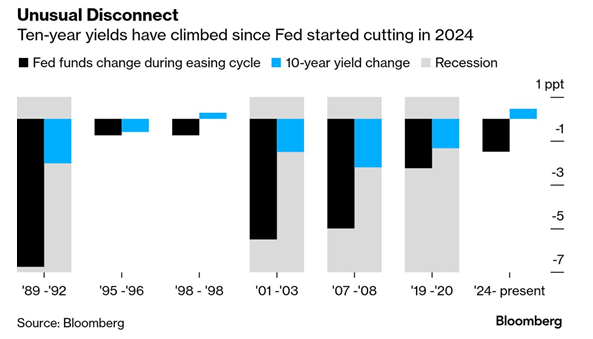
Instead of falling alongside policy easing, Treasury yields have been climbing since September 2024. Bloomberg notes that a divergence of this magnitude hasn’t appeared since the 1990s, raising questions about what today’s yield curve is really signaling.
Analysts are split on what the rising yields mean. The main interpretations include:
The bond market’s behavior also contradicts former President Donald Trump’s repeated claim that faster and deeper rate cuts would quickly pull down long-term borrowing costs. Instead, the 10-year Treasury yield has risen nearly 50 bps to around 4.1% since the Fed began cutting, and the 30-year has climbed more than 80 bps. Rather than easing financial conditions, the rate-cut cycle has coincided with tighter long-term financing.
Attention is increasingly turning to the Fed’s long-run credibility as Trump prepares to nominate a successor to Jerome Powell once the chair’s term ends. Analysts warn that appointing a politically driven chair, or pressuring the current Committee into sharper easing, could lift inflation expectations. Instead of pulling yields down, such a shift might push them even higher and disturb broader financial stability.
Markets expect a quarter-point reduction this week and two more cuts in 2026, bringing the policy rate toward 3%. Yet the bond market’s refusal to follow the Fed’s easing path suggests that short-term policy is no longer the dominant force at play. Rising fiscal deficits, expanding Treasury issuance, and questions about long-term inflation control now appear to be shaping yield behavior more powerfully than the Fed’s actions.
Renewed expectations for further Federal Reserve tightening kept the dollar supported as policymakers continued to warn about persistent inflation risks.
 Fed, BOJ Hikes Lift Dollar as Oil Falls (21 – 25 September)
Global markets entered the week balancing tighter monetary policy against signs of easing Middle East energy risks. The Federal Reserve remains the main macro driver after raising rates to 3.75%–4.00%, its first hike since 2023, and signaling that another increase remains possible this year. The Dollar Index advanced to 100.4, while Treasury yields remained elevated. The Bank of Japan also tightened policy, raising rates to 1.25%, although dissent within the board suggested that future increases could come at a slower pace.
Detail Falling Oil Prices Support Metals (09.21.2026)Easing oil prices offered some relief to financial markets as renewed diplomatic efforts in the Middle East reduced immediate inflation concerns.
Then Join Our Telegram Channel and Subscribe Our Trading Signals Newsletter for Free!
Join Us On Telegram!


